Back

Ziegler-Natta Polymerization quiz

Control buttons has been changed to "navigation" mode.
1/15
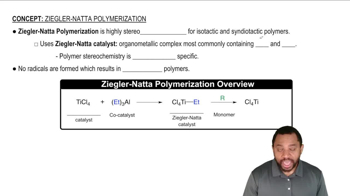
  • What type of catalyst is used in Ziegler-Natta polymerization?

    An organometallic catalyst, typically containing titanium and aluminum compounds, is used.
  • What is the main advantage of Ziegler-Natta polymerization regarding polymer structure?

    It produces highly stereoselective polymers, such as isotactic or syndiotactic polymers, with linear structures.
  • Which two elements are most commonly found in Ziegler-Natta catalysts?

    Titanium and aluminum are most commonly found in these catalysts.
  • What is the role of titanium tetrachloride in the Ziegler-Natta mechanism?

    Titanium tetrachloride acts as the inactive catalyst that is activated by triethylaluminum.
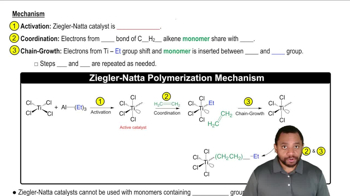
  • How is the Ziegler-Natta catalyst activated?

    It is activated when one ethyl group from triethylaluminum attaches to titanium tetrachloride.
  • What is the first step in the Ziegler-Natta polymerization mechanism?

    The first step is the activation of the catalyst.
  • What happens during the coordination step of the Ziegler-Natta mechanism?

    The π bond electrons of the alkene monomer coordinate with the titanium center.
  • How does chain growth occur in Ziegler-Natta polymerization?

    The monomer inserts between the titanium and ethyl group, and this process repeats to grow the polymer chain.
  • Why are no free radicals formed in Ziegler-Natta polymerization?

    The mechanism involves coordination and insertion steps, not radical intermediates.
  • What type of polymers does Ziegler-Natta polymerization typically produce?

    It typically produces linear polymers with defined stereochemistry.
  • Why can't monomers with polar groups be used in Ziegler-Natta polymerization?

    Polar groups deactivate the catalyst, preventing polymerization.
  • What determines the stereochemistry of the polymer in Ziegler-Natta polymerization?

    The specific catalyst used determines the polymer's stereochemistry.
  • What is the role of triethylaluminum in the Ziegler-Natta catalyst system?

    Triethylaluminum acts as a cocatalyst, donating an ethyl group to activate titanium.
  • What is the repeating process in Ziegler-Natta polymerization that leads to polymer growth?

    The coordination and insertion steps are repeated to add more monomer units.
  • What is the significance of catalyst specificity in Ziegler-Natta polymerization?

    Catalyst specificity allows for control over the polymer's stereoregularity and properties.