 Back
BackAlkynes: Structure, Properties, Reactions, and Synthesis
Study Guide - Smart Notes
 Tailored notes based on your materials, expanded with key definitions, examples, and context.
Alkynes and Synthesis
Introduction to Alkynes
Alkynes are organic compounds characterized by the presence of a carbon–carbon triple bond. This functional group imparts unique chemical properties, including increased acidity and reactivity compared to alkenes and alkanes. Alkynes are important in both biological and industrial contexts, such as in pharmaceuticals and organic synthesis.
Terminal alkyne: The triple bond is at the end of the carbon chain, with a hydrogen atom directly attached to one of the triple-bonded carbons.
Internal alkyne: Both triple-bonded carbons are attached to other carbon atoms.
General formula:
Degrees of unsaturation: Each triple bond introduces two degrees of unsaturation.
Hybridization: Each carbon in the triple bond is sp hybridized, resulting in linear geometry (180° bond angles).
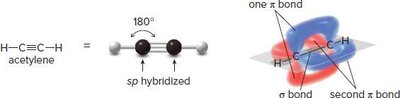
Example: Acetylene (ethyne), HC≡CH, is the simplest alkyne.
Nomenclature of Alkynes
Alkynes are named similarly to alkenes, with the suffix -yne replacing -ane in the parent alkane name. The longest chain containing the triple bond is chosen, and the chain is numbered to give the triple bond the lowest possible number.
Compounds with two or more triple bonds are named as diynes, triynes, etc.
Compounds with both double and triple bonds are named as enynes.
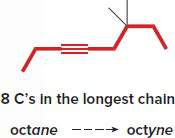
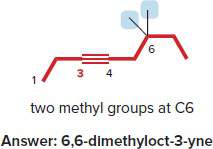
Example: 6,6-dimethyloct-3-yne
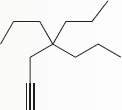
Additional info: The ethynyl group (HC≡C–) is a common substituent derived from acetylene.

Properties of Alkynes
The physical properties of alkynes are similar to those of other hydrocarbons with comparable molecular weights and shapes.
Low melting and boiling points, which increase with molecular weight.
Soluble in organic solvents, insoluble in water.
Alkynes are more polarizable than alkenes due to loosely held π electrons.
Biologically and Industrially Interesting Alkynes
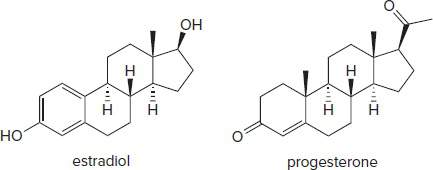
Alkynes are found in several biologically active molecules, including synthetic hormones used in oral contraceptives and natural toxins.
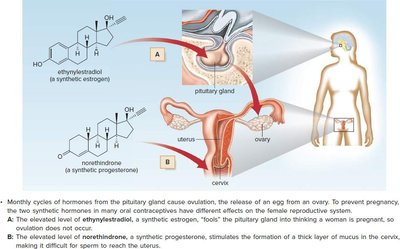
Ethynylestradiol and norethindrone are synthetic hormones used in oral contraceptives.
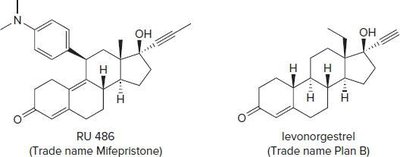
RU 486 and levonorgestrel are synthetic hormones with alkynyl groups, used for pregnancy prevention and emergency contraception.
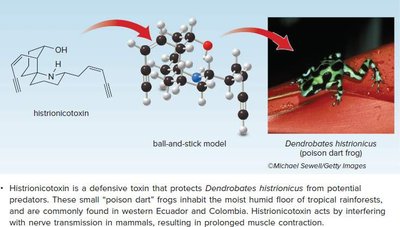
Histrionicotoxin is a natural diyne toxin from the skin of the poison dart frog, Dendrobates histrionicus.
Preparation of Alkynes
Elimination Reactions
Alkynes are commonly synthesized by elimination reactions, where a strong base removes two equivalents of HX from a vicinal or geminal dihalide, resulting in an alkyne via two successive E2 eliminations.
Vicinal dihalide: Halogens on adjacent carbons.
Geminal dihalide: Halogens on the same carbon.
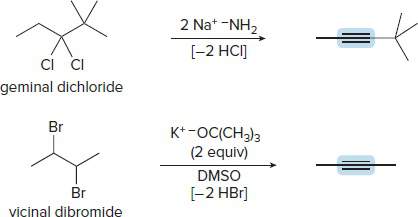
Example: Conversion of an alkene to an alkyne by halogenation followed by elimination.

Reactions of Alkynes
Addition Reactions
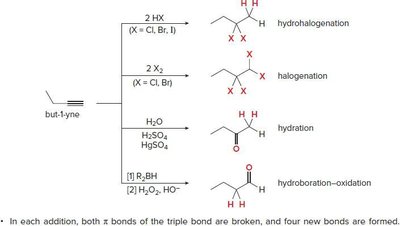
Alkynes undergo addition reactions due to their weak π bonds. Two sequential additions occur: the first equivalent of reagent forms an alkene, which then reacts with a second equivalent to yield a product with four new bonds.

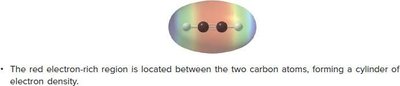
Electrostatic potential map: Alkynes are electron-rich and nucleophilic.
Four key addition reactions: Hydrohalogenation, halogenation, hydration, and hydroboration–oxidation.
Terminal Alkynes: Acidity and Acetylide Anions
Terminal alkynes have acidic C–H bonds due to high s-character (sp hybridization). They can be deprotonated by strong bases to form acetylide anions, which are strong nucleophiles used in carbon–carbon bond formation.
Base | pKa of Conjugate Acid | Ability to Deprotonate Alkyne |
|---|---|---|
−NH2 | 38 | Yes |
H− | 35 | Yes |
−OH | 15.7 | No |
−OR | 15.5–18 | No |
Additional info: Only bases with conjugate acids pKa > 25 can deprotonate terminal alkynes.
Addition of Hydrogen Halides (Hydrohalogenation)
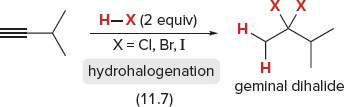
Alkynes react with hydrogen halides (HX) in two steps:
Addition of one equivalent forms a vinyl halide.
Addition of a second equivalent forms a geminal dihalide.
Markovnikov's rule applies: both H atoms bond to the less substituted carbon in terminal alkynes.
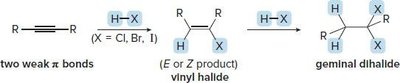

Mechanism: Electrophilic addition proceeds via carbocation intermediates, stabilized by resonance when halogens are present.

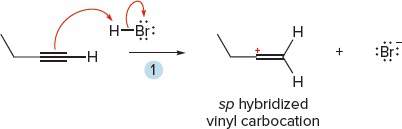
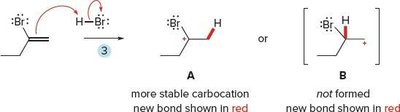
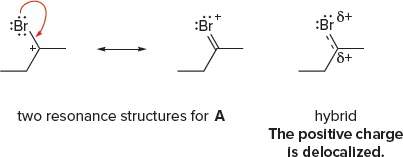
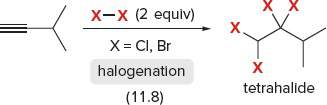
Addition of Halogen (Halogenation)
Halogens (Cl2 or Br2) add to alkynes:
One equivalent forms a trans dihalide.
Second equivalent forms a tetrahalide.
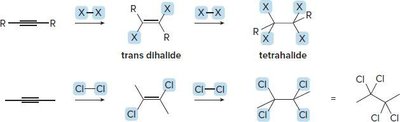
Addition of Water (Hydration)
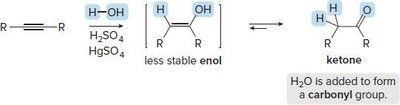
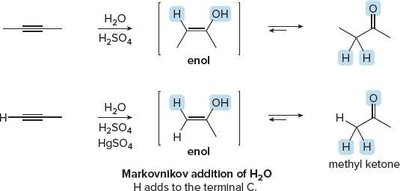
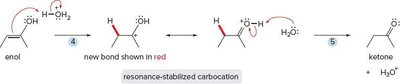
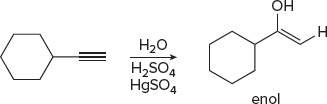
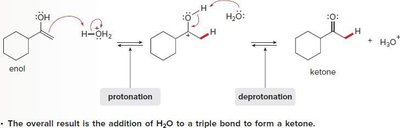
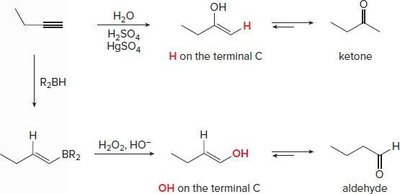
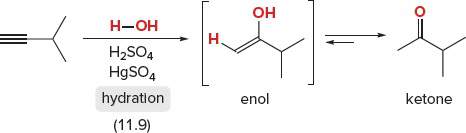
Acid-catalyzed hydration of alkynes forms enols, which rapidly tautomerize to ketones (or aldehydes for terminal alkynes). Markovnikov addition places the H on the less substituted carbon.


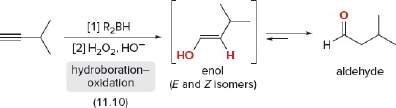
Hydroboration–Oxidation
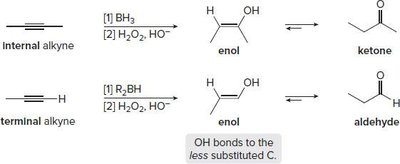
Hydroboration–oxidation is a two-step process that adds water across the triple bond:
Internal alkynes yield ketones.
Terminal alkynes yield aldehydes (anti-Markovnikov addition).

Reactions of Acetylide Anions
Acetylide Anions with Alkyl Halides
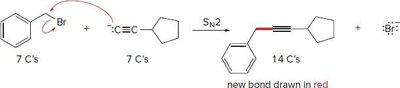
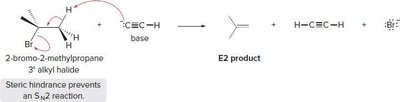
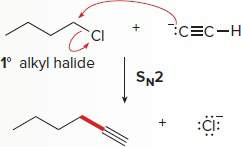
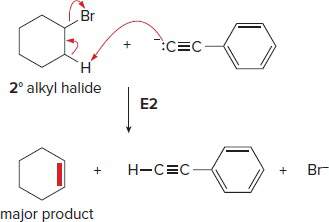
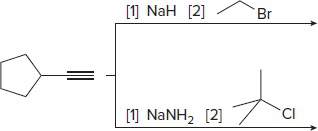
Acetylide anions, formed from terminal alkynes, are strong nucleophiles that react with alkyl halides via SN2 mechanism to form new carbon–carbon bonds. The reaction is most efficient with methyl and primary alkyl halides; secondary and tertiary halides undergo elimination (E2).
Sequential SN2 Reactions: Synthesis of Internal Alkynes
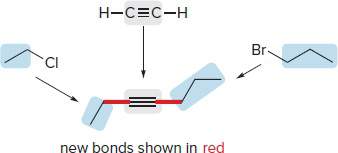
Acetylene can undergo two sequential deprotonations and SN2 reactions to form internal alkynes with two new carbon–carbon bonds.


Acetylide Anions with Epoxides
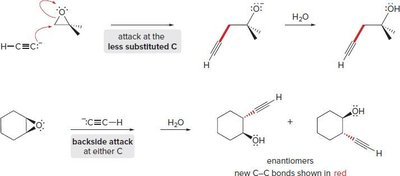
Acetylide anions open epoxide rings via SN2 mechanism, forming alcohols with new carbon–carbon bonds. Backside attack occurs at the less substituted carbon of the epoxide.

Organic Synthesis Using Alkynes
Retrosynthetic Analysis
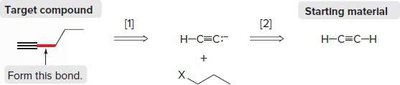
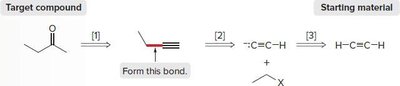
Retrosynthetic analysis is a systematic approach to planning multistep organic syntheses, working backward from the target compound to simpler precursors. Key steps include identifying carbon–carbon bond-forming reactions and functional group interconversions.
Compare carbon skeletons and functional groups of starting material and product.
Identify methods to introduce functional groups in the product.
Work backward from product and forward from starting material.
Check synthesis by writing steps in the synthetic direction.
Summary Table: Key Reactions of Alkynes
Reaction | Reagents | Product |
|---|---|---|
Hydrohalogenation | 2 HX (X = Cl, Br, I) | Geminal dihalide |
Halogenation | 2 X2 (X = Cl, Br) | Tetrahalide |
Hydration | H2O, H2SO4, HgSO4 | Ketone (or methyl ketone for terminal alkynes) |
Hydroboration–oxidation | R2BH, H2O2, HO− | Aldehyde (for terminal alkynes), ketone (for internal alkynes) |
Conclusion
Alkynes are versatile organic compounds with unique structural, physical, and chemical properties. Their reactivity, especially in addition and nucleophilic substitution reactions, makes them valuable in organic synthesis, including the construction of complex molecules and pharmaceuticals. Understanding their nomenclature, properties, and reactions is essential for mastering organic chemistry at the college level.
