 Back
BackIsomerism and Stereochemistry in Organic Chemistry
Study Guide - Smart Notes
 Tailored notes based on your materials, expanded with key definitions, examples, and context.
Isomerism in Organic Compounds
Definition and Classification of Isomers
Isomers are compounds that have the same molecular formula but differ in the arrangement of atoms or the spatial orientation of their atoms. Isomerism is a fundamental concept in organic chemistry, as it explains the diversity of organic compounds with identical formulas but different properties.
Structural (Constitutional) Isomers: Compounds with the same molecular formula but different connectivity of atoms.
Stereoisomers: Compounds with the same molecular formula and connectivity but different spatial arrangements of atoms.
Example: Butane (C4H10) and isobutane are structural isomers.
Physical and Chemical Properties of Isomers
The physical and chemical properties of isomers can vary significantly due to differences in structure or spatial arrangement. These differences are used to distinguish between isomers in laboratory and industrial settings.
Physical Properties: Melting point, boiling point, solubility, and density.
Chemical Properties: Reactivity, types of reactions, and mechanisms.
Example: Ethanol and dimethyl ether (C2H6O) are functional group isomers with different boiling points and reactivity.
Types of Isomerism
Structural (Constitutional) Isomerism
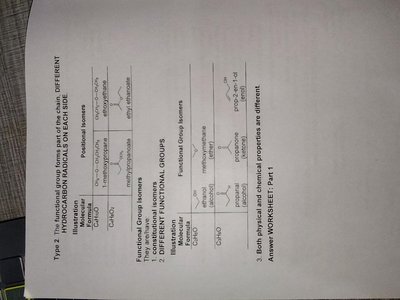
Structural isomerism arises when compounds have the same molecular formula but different connectivity of atoms. The main types include:
Chain Isomerism: Different carbon chain arrangements.
Position Isomerism: Different positions of functional groups or substituents.
Functional Group Isomerism: Different functional groups.
Type | Example 1 | Example 2 |
|---|---|---|
Chain Isomerism | n-butane | isobutane |
Position Isomerism | 1-butanol | 2-butanol |
Functional Group Isomerism | ethanol | dimethyl ether |
Stereoisomerism
Stereoisomers have the same molecular formula and connectivity but differ in the spatial arrangement of atoms. The two main types are:
Geometric (cis-trans) Isomerism: Occurs in compounds with restricted rotation, such as alkenes or cyclic compounds.
Optical Isomerism (Enantiomerism): Occurs in chiral molecules that are non-superimposable mirror images of each other.
Example: 2-butene exists as cis-2-butene and trans-2-butene (geometric isomers).
Chirality and Optical Activity
Chirality and Chiral Centers
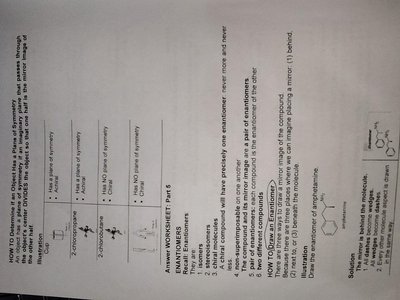
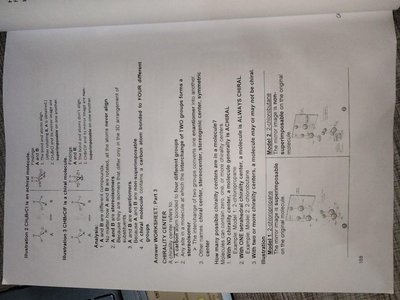
A molecule is chiral if it is not superimposable on its mirror image. The presence of a chiral center (usually a carbon atom bonded to four different groups) leads to optical isomerism.
Enantiomers: Non-superimposable mirror images.
Optical Activity: Enantiomers rotate plane-polarized light in opposite directions.
Example: Lactic acid has a chiral center and exists as two enantiomers.
Identifying Chiral Centers
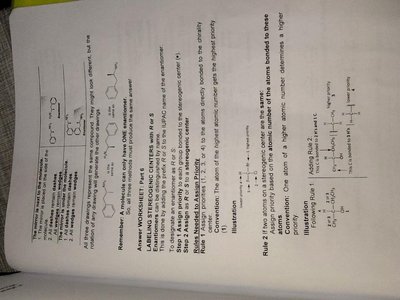
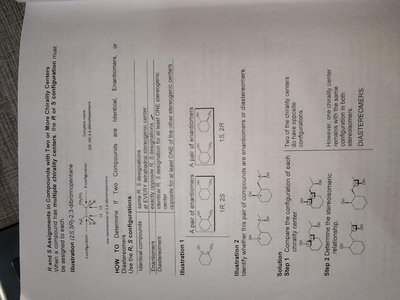
To identify chiral centers, look for carbon atoms bonded to four different groups. Use the Cahn-Ingold-Prelog priority rules to assign configurations (R/S).
Assign priorities based on atomic number.
Orient the molecule so the lowest priority group is away from you.
Determine the order of the remaining groups (clockwise = R, counterclockwise = S).
Geometric (cis-trans) Isomerism
Definition and Examples
Geometric isomerism occurs in compounds with restricted rotation, such as alkenes or cyclic compounds. The two main forms are cis (same side) and trans (opposite side).
Cis Isomer: Similar groups on the same side of the double bond or ring.
Trans Isomer: Similar groups on opposite sides.
Example: 1,2-dichloroethene exists as cis- and trans-isomers.
Physical and Chemical Properties of Isomers
Comparison of Properties
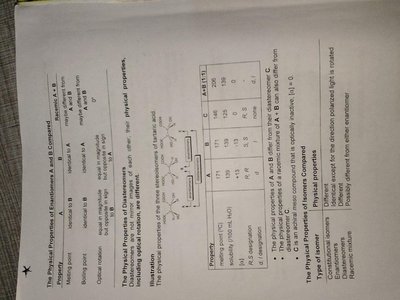
Isomers often have different physical and chemical properties due to their structural or spatial differences. These differences are summarized in the table below:
Property | Isomer 1 | Isomer 2 |
|---|---|---|
Boiling Point | Higher | Lower |
Melting Point | Varies | Varies |
Solubility | Varies | Varies |
Chemical Reactivity | Different | Different |
How to Distinguish Between Isomers
Stepwise Approach
To distinguish between isomers, follow these steps:
Compare molecular formulas to confirm isomerism.
Analyze connectivity for structural isomerism.
Check for chiral centers and spatial arrangement for stereoisomerism.
Use physical and chemical properties for further differentiation.
Summary Table: Types of Isomerism
Type | Definition | Example |
|---|---|---|
Chain Isomerism | Different carbon chain arrangements | n-pentane vs. isopentane |
Position Isomerism | Different positions of functional groups | 1-propanol vs. 2-propanol |
Functional Group Isomerism | Different functional groups | ethanol vs. dimethyl ether |
Geometric Isomerism | Different spatial arrangement around double bonds | cis-2-butene vs. trans-2-butene |
Optical Isomerism | Non-superimposable mirror images | Lactic acid enantiomers |
Additional info: The notes also include worked examples and illustrations for identifying isomers, assigning R/S configurations, and distinguishing between enantiomers and diastereomers. These are essential skills for organic chemistry students and are frequently tested in exams.
