Back
BackOrganic Chemistry Multiple Choice and Conceptual Guidance
Study Guide - Smart Notes
 Tailored notes based on your materials, expanded with key definitions, examples, and context.
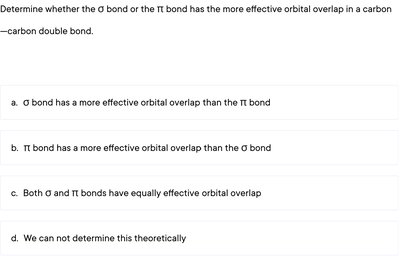
Q1. Determine whether the σ bond or the π bond has the more effective orbital overlap in a carbon–carbon double bond.
Background
Topic: Bonding in Alkenes
This question tests your understanding of the nature of sigma (σ) and pi (π) bonds, specifically their orbital overlap and effectiveness in a double bond (such as in alkenes).
Key Terms and Concepts:
σ (Sigma) bond: Formed by head-on (axial) overlap of orbitals, usually between two sp2 hybridized carbons in a double bond.
π (Pi) bond: Formed by side-to-side overlap of unhybridized p orbitals above and below the plane of the atoms.
Orbital overlap: The extent to which atomic orbitals on adjacent atoms share space, influencing bond strength and effectiveness.
Step-by-Step Guidance
Recall that a carbon–carbon double bond consists of one σ bond and one π bond.
Consider the geometry of orbital overlap: σ bonds result from direct, end-to-end overlap, while π bonds result from parallel, side-to-side overlap.
Think about which type of overlap (end-to-end vs. side-to-side) allows for greater electron density between the nuclei, leading to a stronger bond.
Try solving on your own before revealing the answer!
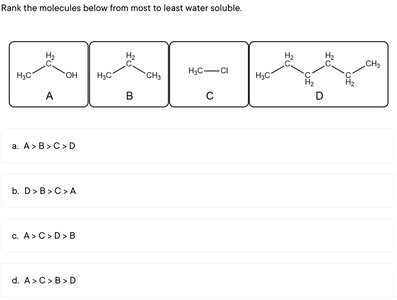
Q2. Rank the molecules below from most to least water soluble.
Background
Topic: Solubility and Functional Groups
This question tests your ability to compare the water solubility of organic molecules based on their functional groups and molecular structure.
Key Terms and Concepts:
Water solubility: The ability of a compound to dissolve in water, often increased by the presence of polar groups (e.g., –OH, –Cl).
Hydrogen bonding: Molecules with –OH groups can form hydrogen bonds with water, increasing solubility.
Hydrophobic effect: Larger nonpolar hydrocarbon chains decrease solubility in water.
Step-by-Step Guidance
Identify the functional groups present in each molecule (e.g., alcohol, alkyl halide).
Recall that alcohols (–OH) are generally more water-soluble than alkyl halides (–Cl) due to hydrogen bonding.
Compare the size of the hydrocarbon chain in each molecule; larger chains decrease solubility.
Rank the molecules by considering both the presence of polar groups and the size of the nonpolar portion.
Try solving on your own before revealing the answer!
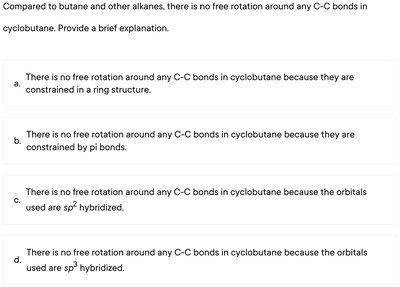
Q3. Compared to butane and other alkanes, there is no free rotation around any C–C bonds in cyclobutane. Provide a brief explanation.
Background
Topic: Conformational Analysis and Ring Strain
This question tests your understanding of molecular rotation, especially in cyclic versus acyclic alkanes.
Key Terms and Concepts:
Free rotation: The ability of single bonds (σ bonds) to rotate freely in open-chain alkanes.
Ring strain: In cyclic compounds, the ring structure restricts rotation around C–C bonds.
Step-by-Step Guidance
Recall that in open-chain alkanes, C–C single bonds can rotate freely due to the nature of σ bonds.
Consider the effect of forming a ring (like cyclobutane) on the ability of the bonds to rotate.
Think about why the ring structure prevents free rotation, even though the bonds are still σ bonds.
Try solving on your own before revealing the answer!
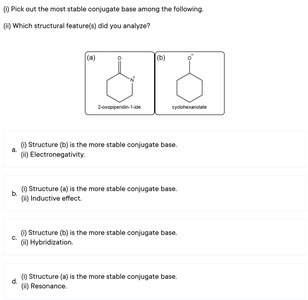
Q4. (i) Pick out the most stable conjugate base among the following. (ii) Which structural feature(s) did you analyze?
Background
Topic: Acidity and Conjugate Base Stability
This question tests your ability to compare the stability of conjugate bases and identify the structural features that influence this stability.
Key Terms and Concepts:
Conjugate base: The species formed when an acid loses a proton (H+).
Stability factors: Electronegativity, resonance, inductive effect, and hybridization can all affect conjugate base stability.
Step-by-Step Guidance
Examine the structures provided and identify the atom bearing the negative charge in each conjugate base.
Consider the electronegativity of the atom holding the charge and whether resonance stabilization is possible.
Analyze if any inductive effects or hybridization differences are present that could stabilize the negative charge.
Try solving on your own before revealing the answer!
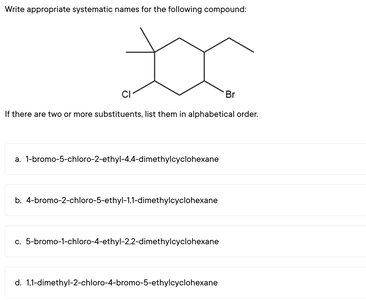
Q5. Write appropriate systematic names for the following compound. If there are two or more substituents, list them in alphabetical order.
Background
Topic: IUPAC Nomenclature of Cycloalkanes
This question tests your ability to apply IUPAC rules to name substituted cyclohexane derivatives, including correct numbering and alphabetical order of substituents.
Key Terms and Concepts:
IUPAC nomenclature: Systematic method for naming organic compounds.
Substituent priority: Number the ring to give the lowest possible numbers to substituents, and list them alphabetically in the name.
Step-by-Step Guidance
Identify all substituents on the cyclohexane ring (e.g., bromo, chloro, ethyl, dimethyl).
Number the ring to give the substituents the lowest possible set of numbers, starting with the substituent that comes first alphabetically.
List the substituents in alphabetical order in the compound's name, regardless of their position numbers.
Try solving on your own before revealing the answer!
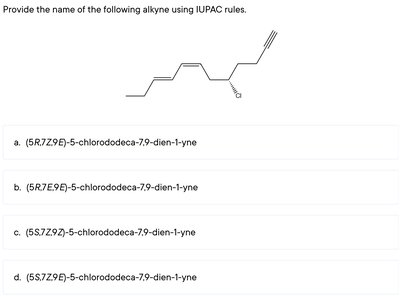
Q6. Provide the name of the following alkyne using IUPAC rules.
Background
Topic: IUPAC Nomenclature of Alkynes
This question tests your ability to name alkynes with multiple substituents and double bonds, including the use of E/Z (cis/trans) notation for alkenes.
Key Terms and Concepts:
Alkyne: Hydrocarbon with a carbon–carbon triple bond.
E/Z notation: Used to specify the geometry of double bonds when there are different substituents on each carbon of the double bond.
Numbering: Number the chain to give the triple bond the lowest possible number, and assign locants to substituents and double bonds accordingly.
Step-by-Step Guidance
Identify the longest carbon chain containing the triple bond and number it to give the triple bond the lowest possible number.
Assign E/Z configuration to each double bond as needed, based on the priority of substituents.
List the substituents and their positions, and assemble the name according to IUPAC rules.
Try solving on your own before revealing the answer!