 Back
BackStudy Guide: Reactions of Aldehydes and Ketones
Study Guide - Smart Notes
 Tailored notes based on your materials, expanded with key definitions, examples, and context.
Chapter 12: Reactions of Aldehydes and Ketones
Overview of Aldehydes and Ketones
Aldehydes and ketones are important classes of organic compounds characterized by the presence of a carbonyl group (C=O). Their reactivity is central to many synthetic transformations in organic chemistry, particularly nucleophilic addition reactions.
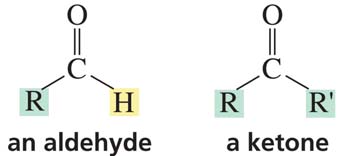
Aldehydes have the general structure R-CHO, where the carbonyl carbon is bonded to at least one hydrogen atom.
Ketones have the general structure R-CO-R', where the carbonyl carbon is bonded to two alkyl or aryl groups.
Reactivity of Aldehydes and Ketones
The carbonyl group is highly polarized, making the carbon atom electrophilic and susceptible to attack by nucleophiles. Aldehydes are generally more reactive than ketones due to less steric hindrance and fewer electron-donating groups.
Regioselectivity: Nucleophiles add to the carbonyl carbon, while electrophiles add to the oxygen.
Reactivity order: Formaldehyde > Aldehyde > Ketone


Nucleophilic Addition Reactions
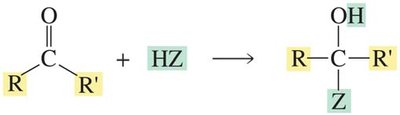
Nucleophilic addition is the primary reaction type for aldehydes and ketones. The π bond of the carbonyl is broken, and new bonds are formed.
General reaction:
Reactions with Carbon Nucleophiles (Grignard Reagents)
Grignard Reagents
Grignard reagents (RMgX) are organomagnesium compounds that act as strong nucleophiles, enabling the formation of new carbon-carbon bonds. They are prepared by reacting alkyl or aryl halides with magnesium metal in ether.
Reaction with aldehydes and ketones: Grignard reagents add to the carbonyl carbon, followed by acid workup, to yield alcohols.
Versatility: Multiple combinations of starting materials can produce the same alcohol product.

Example: Synthesis of Tertiary Alcohol
2-pentanone reacts with ethylmagnesium bromide to form 3-methyl-3-hexanol.
Grignard Reactions with Esters and Acyl Chlorides
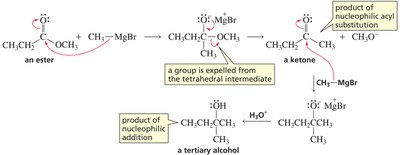
Grignard reagents can also react with esters and acyl chlorides, typically requiring two equivalents to yield alcohols.
Reduction Reactions: Hydride Addition
Hydride Donors
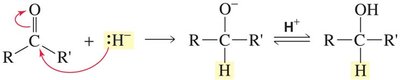
Hydride ions (H-) are strong nucleophiles used to reduce carbonyl compounds to alcohols. Common hydride donors include sodium borohydride (NaBH4) and lithium aluminum hydride (LiAlH4).
Reduction of aldehydes and ketones:
Reduction Examples
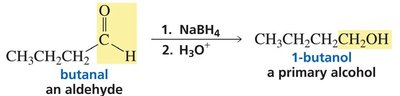
NaBH4 reduces butanal to 1-butanol.
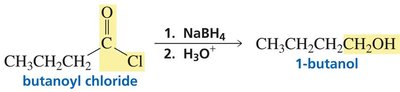
NaBH4 reduces butanoyl chloride to 1-butanol.
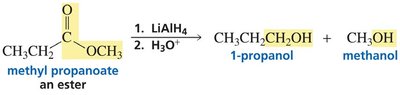
LiAlH4 reduces methyl propanoate to 1-propanol and methanol.
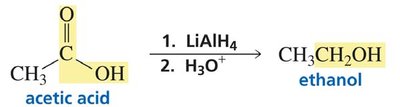
LiAlH4 reduces acetic acid to ethanol.
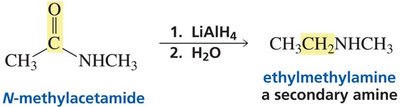
LiAlH4 reduces N-methylacetamide to ethylmethylamine.
Reactions with Amines
Imine Formation
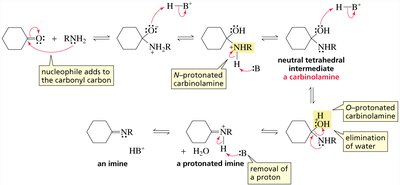
Primary amines react with aldehydes and ketones to form imines via nucleophilic addition followed by dehydration. The reaction is reversible and catalyzed by acid.
Mechanism: Nucleophile adds to carbonyl, forming a carbinolamine intermediate, which loses water to yield an imine.
Biological importance: Imines are involved in amino group transfer reactions, such as those catalyzed by aminotransferase enzymes.
Example: Reductive Amination
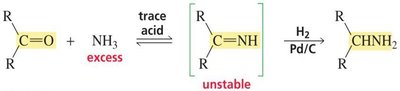
Imines can be hydrogenated to form amines, a process known as reductive amination.
Reactions with Alcohols
Acetal and Hemiacetal Formation
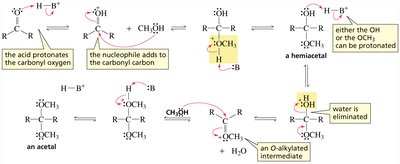
Aldehydes and ketones react with alcohols to form hemiacetals and acetals. This process is important in carbohydrate chemistry and requires acid catalysis due to the poor nucleophilicity of alcohols.
Mechanism: Protonation of the carbonyl oxygen, nucleophilic attack by alcohol, formation of hemiacetal, further reaction to acetal.
Application: Acetal formation is a key step in the structure of sugars such as D-glucose.
Summary Table: Reactivity and Reduction of Carbonyl Compounds
Compound | Reactivity to Nucleophiles | Reduction Agent | Product |
|---|---|---|---|
Formaldehyde | Most reactive | NaBH4, LiAlH4 | Primary alcohol |
Aldehyde | High | NaBH4, LiAlH4 | Primary alcohol |
Ketone | Moderate | NaBH4, LiAlH4 | Secondary alcohol |
Ester | Low | LiAlH4 | Alcohols |
Acyl chloride | Low | NaBH4, LiAlH4 | Alcohol |
Carboxylic acid | Lowest | LiAlH4 | Alcohol |
Amide | Lowest | LiAlH4 | Amine |
Additional info: This summary table is inferred from the reduction reactions and reactivity trends discussed in the notes.
