Combining Resistors in Series & Parallel definitions Flashcards

Combining Resistors in Series & Parallel definitions
Control buttons has been changed to "navigation" mode.
1/15
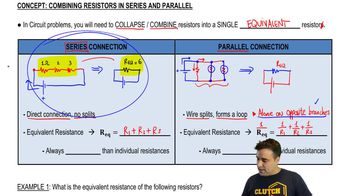
  • Equivalent Resistance
    A single resistor that represents the total resistance of a group of resistors in a circuit.
  • Series Connection
    Resistors connected end-to-end, increasing total resistance by summing individual resistances.
  • Parallel Connection
    Resistors connected across the same two points, decreasing total resistance by providing multiple paths for current.
  • Direct Connection
    A connection between resistors without any splits in the wire, characteristic of series circuits.
  • Loop
    A closed path in a circuit where current can flow, often used to identify parallel connections.
  • Voltage Source
    A component, like a battery, that provides electrical energy to a circuit.
  • Current
    The flow of electric charge through a conductor, influenced by the circuit's resistance.
  • Ohm
    The unit of electrical resistance, symbolized by Ω, representing the resistance between two points.
  • Common Denominator
    A shared multiple of the denominators of two or more fractions, used to simplify parallel resistance calculations.
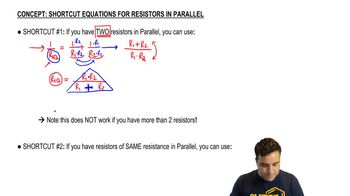
  • Shortcut Equation
    A simplified formula for calculating equivalent resistance in specific resistor configurations.
  • Branch
    A part of a circuit where the current can split into different paths, relevant in parallel circuits.
  • Charge
    An electrical property of particles that causes them to experience a force in an electric field.
  • Resistor Network
    A combination of multiple resistors in a circuit, which can be simplified to a single equivalent resistor.
  • Fraction
    A mathematical expression representing the division of one quantity by another, used in parallel resistance calculations.
  • Simplification
    The process of reducing a complex resistor network to a simpler form with fewer components.