Skip to main content
Physics with Calculus
My Course
Learn
Exam Prep
AI Tutor
Study Guides
Textbook Solutions
Flashcards
Explore
Try the app
My Course
Learn
Exam Prep
AI Tutor
Study Guides
Textbook Solutions
Flashcards
Explore
Try the app
Back
Kinematics in 2D quiz
You can tap to flip the card.
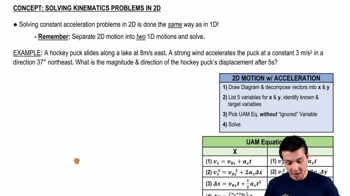
What is the main strategy for solving kinematics problems in two dimensions?
You can tap to flip the card.
👆
What is the main strategy for solving kinematics problems in two dimensions?
Break the problem into two one-dimensional motions (x and y directions) and solve them separately using the same equations as in 1D motion.
Track progress
Control buttons has been changed to "navigation" mode.
1/15
Related flashcards
Related practice
Recommended videos
Kinematics in 2D definitions
Kinematics in 2D
15 Terms
Kinematics in 2D
4. 2D Kinematics
5 problems
Topic
Patrick
Intro to Relative Velocity
4. 2D Kinematics
7 problems
Topic
Patrick
4. 2D Kinematics - Part 1 of 2
5 topics
12 problems
Chapter
Patrick
4. 2D Kinematics - Part 2 of 2
2 topics
6 problems
Chapter
Guided course
08:29
Kinematics in 2D
11153
views
136
rank
7
comments
Terms in this set (15)
Hide definitions
What is the main strategy for solving kinematics problems in two dimensions?
Break the problem into two one-dimensional motions (x and y directions) and solve them separately using the same equations as in 1D motion.
How do you decompose a two-dimensional vector into its components?
Use trigonometric functions: the x-component is the magnitude times cos(theta), and the y-component is the magnitude times sin(theta).
What are the five key variables you list for each direction in a 2D kinematics problem?
The five variables are displacement (Δx or Δy), initial velocity (v₀x or v₀y), final velocity (vfx or vfy), acceleration (ax or ay), and time (t).
If a hockey puck’s initial velocity is 8 m/s east, what are its initial velocity components?
The x-component (east) is 8 m/s, and the y-component (north) is 0 m/s.
How do you calculate the x and y components of an acceleration vector at 3 m/s², 37° northeast?
Ax = 3 × cos(37°) = 2.4 m/s², Ay = 3 × sin(37°) = 1.8 m/s².
Which kinematic equation is used to find displacement when final velocity is unknown?
Use Δx = v₀x·t + 0.5·ax·t² (and similarly for Δy).
What is the formula for the magnitude of total displacement in two dimensions?
The magnitude is √(Δx² + Δy²), using the Pythagorean theorem.
How do you find the direction (angle) of the displacement vector?
Use θ = tan⁻¹(Δy/Δx).
What is the displacement in the x direction after 5 seconds for the hockey puck problem?
Δx = 70 meters.
What is the displacement in the y direction after 5 seconds for the hockey puck problem?
Δy = 22.5 meters.
What is the magnitude of the hockey puck’s displacement after 5 seconds?
The magnitude is 73.5 meters.
At what angle (relative to east) does the hockey puck move after 5 seconds?
The angle is 17.8 degrees north of east.
Why is the magnitude of the total displacement greater than either component?
Because it is the hypotenuse of the right triangle formed by the x and y displacements.
Why can you use the same kinematic equations in 2D as in 1D?
Because each direction (x and y) is treated independently, as separate one-dimensional motions.
What is the first step when solving a 2D kinematics problem?
Draw a diagram and decompose all vectors into their x and y components.
 BackBack
 08:29
08:29