How can you identify a graph that shows position (x) versus time for an object?
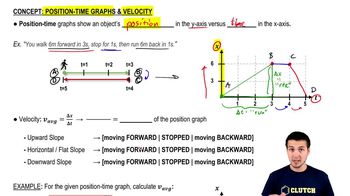
A position-time graph has position (x) on the vertical (y) axis and time on the horizontal (x) axis, showing how an object's position changes over time.
What does the slope of a position-time graph represent in physics?
The slope of a position-time graph represents the object's velocity.
How is the position of an object, such as a car, represented on a position-time graph?
The position of the car is shown by its value on the vertical axis (y-axis) at a given time on the horizontal axis (x-axis) of the position-time graph.
How is constant velocity depicted on a motion map?
Constant velocity on a motion map is indicated by evenly spaced position markers and arrows of equal length and direction.
What is the general shape of a position-time graph for an object, such as a toy car, that is accelerating?
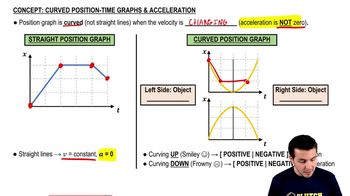
A position-time graph for an accelerating object is curved, indicating a changing slope and non-zero acceleration.
How does a position-time graph appear for a motorcycle that is accelerating?
The position-time graph for an accelerating motorcycle is curved, with the steepness of the curve increasing or decreasing depending on the direction of acceleration.
What is typically the independent variable on a motion graph?
Time is typically the independent variable on a motion graph and is plotted on the horizontal (x) axis.
What information does the slope of a position versus time graph provide?
The slope of a position versus time graph provides the velocity of the object.
What is most often assigned a value of zero when describing an object's position along a straight line?
The reference point is most often assigned a value of zero when describing an object's position.
How can you determine if an object is moving in the positive direction from a position-time graph?
An object is moving in the positive direction if the position-time graph has an upward slope (position increases as time increases).
How can you approximate the direction of acceleration at a specific position on a position-time graph?
The direction of acceleration can be approximated by the curvature of the position-time graph: upward curvature (smile) indicates positive acceleration, downward curvature (frown) indicates negative acceleration.
How can a motion diagram be used to represent the situation at a specific point on a position-time graph?
A motion diagram can represent the situation at a specific point by showing the object's position, direction, and velocity at that instant, corresponding to the slope and location on the position-time graph.
How would you describe the motion of an object between 1 and 4 seconds if its position-time graph is a horizontal line during that interval?
If the position-time graph is horizontal between 1 and 4 seconds, the object is stationary and its velocity is zero during that interval.
What type of statement about an object's motion can be supported by a position-time graph?
A position-time graph can support statements about the object's velocity, direction of motion, periods of rest, and changes in motion over time.
On a motion map, what does the symbol x typically represent?
On a motion map, x typically represents the object's position.
What is the term used to describe the overall change in an object's position?
The overall change in an object's position is called displacement.
The _____ of a position-time graph represents an object's velocity.
The slope of a position-time graph represents an object's velocity.
How do you describe where an object is located using a position-time graph?
An object's location is described by its position value on the vertical axis at a specific time on the horizontal axis of the position-time graph.
At what points on a position-time graph does an object momentarily stop?
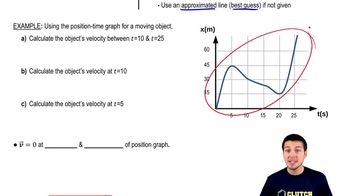
An object momentarily stops at the peaks (tops) and valleys (bottoms) of a position-time graph, where the slope is zero.
How can you identify when an object momentarily stops on a position-time graph?
An object momentarily stops when the position-time graph has a horizontal tangent (slope of zero), typically at the top or bottom of a curve.
How does a position-versus-time graph for a particle in simple harmonic motion (SHM) generally appear?
A position-versus-time graph for a particle in simple harmonic motion appears as a smooth, periodic curve (such as a sine or cosine wave), indicating oscillatory motion.
How would you construct a position-versus-time graph for a drag racer?
To construct a position-versus-time graph for a drag racer, plot the racer's position on the vertical axis and time on the horizontal axis; the graph will likely be a curve showing increasing position with time due to acceleration.