Refraction of Light & Snell's Law quiz #2 Flashcards

Refraction of Light & Snell's Law quiz #2
Control buttons has been changed to "navigation" mode.
1/23
  • What happens to light as it passes through a convex lens?
    Light refracts and converges towards the focal point as it passes through a convex lens.
  • How does refraction affect the apparent depth of a fish when viewed at normal incidence to the water?
    Refraction makes the fish appear closer to the surface than it actually is.
  • How does refraction affect the propagation of a wireless transmission?
    Refraction can change the direction of electromagnetic waves, affecting their propagation through different media.
  • Which object is best used to demonstrate the bending of light as it passes through a substance?
    A glass prism is best used to demonstrate the bending of light due to refraction.
  • In which case will refraction occur?
    Refraction occurs when light enters a new medium at an angle and changes speed.
  • What happens to a ray of green light as it enters a slab of ice?
    The green light slows down and bends towards the normal as it enters the ice.
  • What best describes what happens when light traveling through air enters water at an angle?
    Light slows down and bends towards the normal when entering water at an angle.
  • Why does a ray diagram show refraction but not reflection?
    A ray diagram shows refraction when the light changes direction due to entering a new medium, rather than bouncing off a surface.
  • Lenses such as those in microscopes and telescopes depend on which property of light?
    Lenses depend on the property of refraction of light.
  • What happens when light enters a region with a higher index of refraction?
    Light slows down and bends towards the normal when entering a region with a higher index of refraction.
  • When light enters a pair of glasses, what happens when it hits the glass?
    Light refracts, changing direction and speed as it enters the glass.
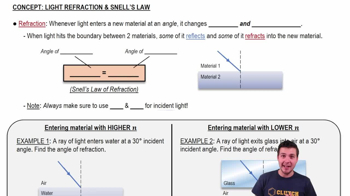
  • What is refraction?
    Refraction is the bending of light as it passes from one medium to another due to a change in speed.
  • How is Snell’s law used in designing lenses?
    Snell’s law is used to calculate how much light bends when passing through lens materials, allowing precise control of focusing.
  • The explanation for refraction must involve a change in which property?
    Refraction involves a change in the speed of light.
  • Refraction results from differences in which property of light?
    Refraction results from differences in the speed of light in different media.
  • What happens to a ray of light emitted beneath the surface of water?
    The ray refracts as it exits the water, bending away from the normal if entering a medium with a lower index of refraction.
  • When light goes from one material into another material having a higher index of refraction, what happens?
    Light slows down and bends towards the normal when entering a material with a higher index of refraction.
  • How do you calculate the critical angle for light traveling from crown glass?
    Use sin(theta_c) = n2/n1, where n1 is the index of crown glass and n2 is the index of the second medium.
  • What is the effect of refraction at a flat interface on a wavefront?
    Refraction causes the wavefront to change direction as it passes through the interface.
  • What happens when light travels from air into water?
    Light slows down and bends towards the normal when traveling from air into water.
  • What happens to a ray of light incident in air on a block of transparent solid with index of refraction n?
    The ray refracts, bending towards the normal if n > 1.
  • When light enters air from water, how does the angle of refraction compare to the angle of incidence?
    The angle of refraction is greater than the angle of incidence when light enters air from water.
  • What happens as light travels from air into water through an oil film?
    Light refracts at each interface, changing direction and speed according to the indices of refraction of air, oil, and water.