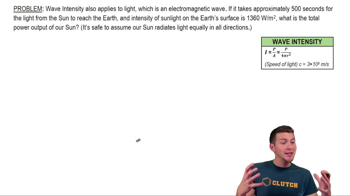
Which property of a light wave determines its brightness?
The intensity of a light wave determines its brightness. Higher intensity means greater brightness.
How does increasing the amplitude of a sound wave affect its volume (loudness)?
Increasing the amplitude of a sound wave increases its intensity, which results in a louder (higher volume) sound.
What is the term used to describe the height of a sound wave?
The height of a sound wave is called its amplitude.
How are wave intensity and loudness typically related?
Wave intensity and loudness are directly related; as the intensity of a sound wave increases, its loudness also increases.
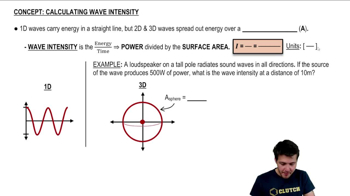
What is the formula for the intensity of a three-dimensional wave at a distance r from the source?
The formula is I = P / (4πr^2), where P is the power of the source and r is the distance from the source. The units are watts per meter squared.
How does the surface area over which a wave's energy is spread change as the distance from the source increases?
The surface area increases as the square of the distance from the source, following the formula A = 4πr^2. This means that as r increases, the area grows rapidly.
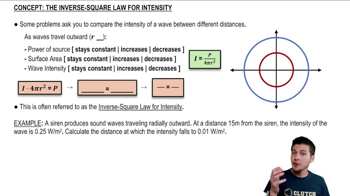
If the power of a wave source remains constant, what happens to the intensity as you move farther from the source?
The intensity decreases because the same amount of power is spread over a larger surface area. This is described by the inverse square law.
What does the inverse square law for intensity state about the relationship between intensity and distance?
It states that intensity is inversely proportional to the square of the distance from the source. Mathematically, I1/I2 = (R2/R1)^2.
In the example with a loudspeaker producing 500 watts of power, what is the intensity at 10 meters?
The intensity at 10 meters is 0.4 watts per meter squared. This is calculated using I = 500 / (4π × 10^2).
When comparing two distances from a wave source, which variable remains unchanged and why?
The power (P) of the source remains unchanged because the source emits the same amount of energy per unit time regardless of distance. Only the area over which the power is distributed changes.