
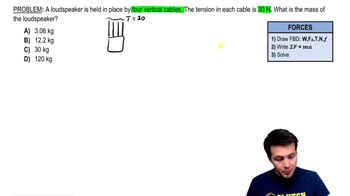
A 350-N, uniform, 1.50-m bar is suspended horizontally by two vertical cables at each end. Cable A can support a maximum tension of 500.0 N without breaking, and cable B can support up to 400.0 N. You want to place a small weight on this bar. (a) What is the heaviest weight you can put on without breaking either cable, and (b) where should you put this weight?
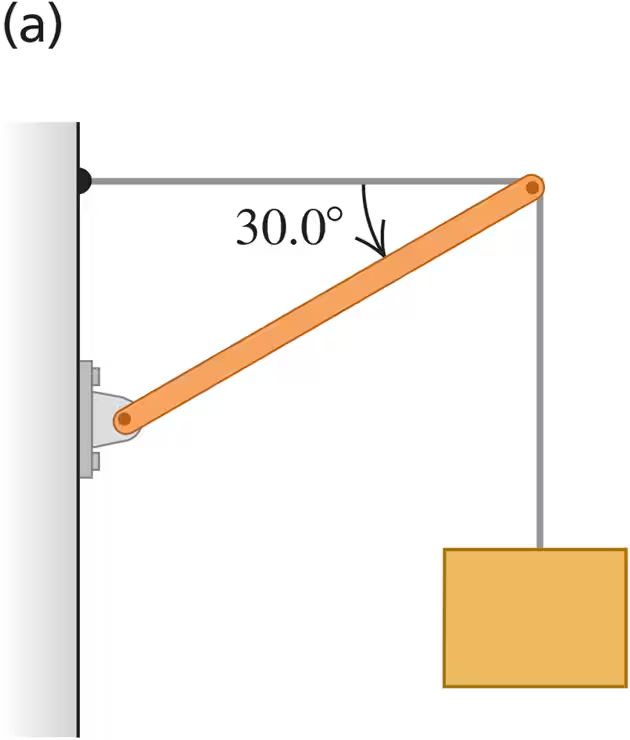
Find the tension T in each cable and the magnitude and direction of the force exerted on the strut by the pivot in each of the arrangements in Fig. E11.13. In each case let w be the weight of the suspended crate full of priceless art objects. The strut is uniform and also has weight w. Start each case with a free-body diagram of the strut.

Verified step by step guidance
Verified video answer for a similar problem:
Key Concepts
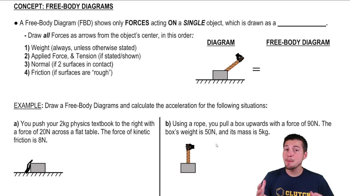
Free-Body Diagram
Tension in Cables
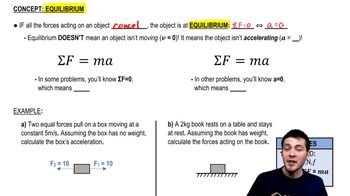
Equilibrium of Forces
A uniform ladder 5.0 m long rests against a frictionless, vertical wall with its lower end 3.0 m from the wall. The ladder weighs 160 N. The coefficient of static friction between the foot of the ladder and the ground is 0.40. A man weighing 740 N climbs slowly up the ladder. Start by drawing a free-body diagram of the ladder. What is the maximum friction force that the ground can exert on the ladder at its lower end?
A diving board 3.00 m long is supported at a point 1.00 m from the end, and a diver weighing 500 N stands at the free end (Fig. E11.11). The diving board is of uniform cross section and weighs 280 N. Find the force at the support point.
Find the tension T in each cable and the magnitude and direction of the force exerted on the strut by the pivot in each of the arrangements in Fig. E11.13. In each case let w be the weight of the suspended crate full of priceless art objects. The strut is uniform and also has weight w. Start each case with a free-body diagram of the strut.
The horizontal beam in Fig. E11.14 weighs 190 N, and its center of gravity is at its center. Find the tension in the cable.
The horizontal beam in Fig. E11.14 weighs 190 N, and its center of gravity is at its center. Find the horizontal and vertical components of the force exerted on the beam at the wall.
