Back

Introduction to Logarithms quiz

Control buttons has been changed to "navigation" mode.
1/15
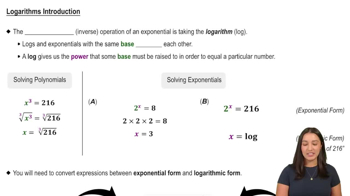
  • What is the inverse operation of an exponential function?

    The inverse operation of an exponential function is taking the logarithm (log).
  • How do you isolate x in the equation 2^x = 216 using logarithms?

    Take the log base 2 of both sides to get x = log base 2 of 216.
  • What must be true about the base of a logarithm when using it to cancel an exponential?

    The base of the logarithm must match the base of the exponential for cancellation to occur.
  • Rewrite 3^x = 81 in logarithmic form.

    It is log base 3 of 81 equals x, or log₃(81) = x.
  • Convert x = log base 4 of 64 to exponential form.

    It is 4 to the power of x equals 64, or 4^x = 64.
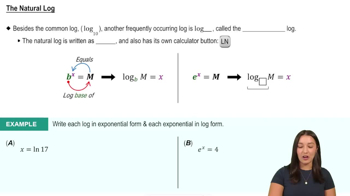
  • What is the common log and how is it written?

    The common log is log base 10 and is simply written as 'log'.
  • What is the natural log and how is it denoted?

    The natural log is log base e and is denoted as 'ln'.
  • Rewrite x = ln(17) in exponential form.

    It is e to the power of x equals 17, or e^x = 17.
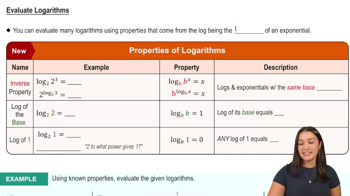
  • What does log base b of b^x equal?

    It equals x, because the log and exponent with the same base cancel each other.
  • What is the value of log base b of 1 for any base b?

    It is always 0, since any number to the power of 0 is 1.
  • Evaluate log base 2 of the cube root of 2 without a calculator.

    It is 1/3, because the cube root of 2 is 2^(1/3), and the log and exponent cancel.
  • What is the value of ln(1)?

    It is 0, since the natural log of 1 is always 0.
  • Evaluate log(10).

    It is 1, because log base 10 of 10 equals 1.
  • How can you rewrite log base 5 of 1/5 to evaluate it?

    Rewrite 1/5 as 5^(-1), so log base 5 of 5^(-1) equals -1.
  • What does a logarithm represent in terms of exponents?

    A logarithm gives the power that a base must be raised to in order to get a certain number.