
Ch. 10 - Chi-Square Tests and the F-Distribution
Larson - Elementary Statistics: Picturing the World 8th Edition
Larson8th EditionElementary Statistics: Picturing the WorldISBN: 9780137493470Not the one you use?Change textbook
Chapter 10, Problem 10.4.2

What conditions are necessary in order to use a one-way ANOVA test?

Verified step by step guidance
1
Ensure that the dependent variable is continuous (e.g., interval or ratio scale) and the independent variable is categorical with at least three groups or levels.
Verify that the observations within each group are independent of each other. This means that the data points in one group should not influence the data points in another group.
Check for normality: The dependent variable should be approximately normally distributed within each group. This can be assessed using visual methods like histograms or statistical tests like the Shapiro-Wilk test.
Assess homogeneity of variances: The variances of the dependent variable across the groups should be approximately equal. This can be tested using Levene's test or Bartlett's test.
Confirm that the sample sizes are not extremely small, as ANOVA is robust to minor violations of normality and homogeneity of variances when sample sizes are reasonably large and balanced across groups.

Verified video answer for a similar problem:

This video solution was recommended by our tutors as helpful for the problem above.
Video duration:
3m
Was this helpful?

Key Concepts

Here are the essential concepts you must grasp in order to answer the question correctly.

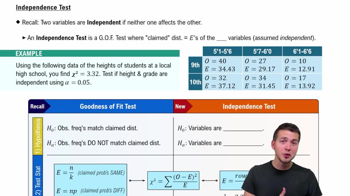
Independence of Observations

One-way ANOVA requires that the observations within each group are independent of one another. This means that the data collected from one group should not influence or be related to the data from another group. Independence is crucial to ensure that the results of the ANOVA test are valid and that any differences observed are due to the treatment rather than confounding factors.
Recommended video:
Guided course
06:28
Independence Test

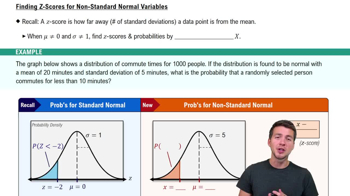
Normality

The assumption of normality states that the data in each group should be approximately normally distributed. This is important because ANOVA relies on the F-distribution, which assumes that the underlying populations are normally distributed. If the sample sizes are large enough, the Central Limit Theorem may mitigate this requirement, but for smaller samples, normality should be checked.
Recommended video:
Guided course
03:17
Finding Z-Scores for Non-Standard Normal Variables

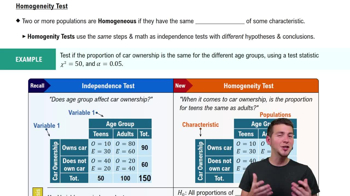
Homogeneity of Variances

Homogeneity of variances, or homoscedasticity, means that the variances among the different groups being compared should be roughly equal. This assumption is critical for the validity of the ANOVA results, as unequal variances can lead to inaccurate conclusions. Tests such as Levene's test can be used to assess this condition before performing a one-way ANOVA.
Recommended video:
Guided course
05:27
Homogeneity Test
Related Practice
Textbook Question

Performing a Chi-Square Independence Test In Exercises 13–28, perform the indicated chi-square independence test by performing the steps below.

a. Identify the claim and state H₀ and Hₐ


b. Determine the degrees of freedom, find the critical value, and identify the rejection region.


c. Find the chi-square test statistic.


d. Decide whether to reject or fail to reject the null hypothesis.


e. Interpret the decision in the context of the original claim.


Ages and Goals You are investigating the relationship between the ages of U.S. adults and what aspect of career development they consider to be the most important. You randomly collect the data shown in the contingency table. At α=0.10, is there enough evidence to conclude that age is related to which aspect of career development is considered to be most important? (Adapted from The Harris Poll)


75
views
Textbook Question

"Finding Left-Tailed Critical F-Values In this section, you only needed to calculate the right-tailed critical F-value for a two-tailed test. For other applications of the F-distribution, you will need to calculate the left-tailed critical F-value. To calculate the left-tailed critical F-value, perform the steps below.


1. Interchange the values for d.f.N and d.f.D.

2. Find the corresponding F-value in Table 7.

3. Calculate the reciprocal of the F-value to obtain the left-tailed critical F-value.


In Exercises 27 and 28, find the right- and left-tailed critical F-values for a two-tailed test using the level of significance α and degrees of freedom d.f.N and d.f.D.


α=0.10, d.f.N=20, d.f.D=15"

130
views
Textbook Question

Finding Expected Frequencies

In Exercises 3–6, find the expected frequency for the values of n and pᵢ.


n=500, pᵢ=0.9

146
views
Textbook Question

Performing a Chi-Square Goodness-of-Fit Test

In Exercises 7–16, (a) identify the claim and state H₀ and Hₐ, (b) find the critical value and identify the rejection region, (c) find the chi-square test statistic, (d) decide whether to reject or fail to reject the null hypothesis, and (e) interpret the decision in the context of the original claim.


Coffee A researcher claims that the numbers of cups of coffee U.S. adults drink per day are distributed as shown in the figure. You randomly select 1600 U.S. adults and ask them how many cups of coffee they drink per day. The table shows the results. At α=0.05, test the researcher’s claim. (Adapted from Gallup)


97
views
Textbook Question

"In Exercises 13–18, test the claim about the difference between two population variances σ₁² and σ₂² at the level of significance α. Assume the samples are random and independent, and the populations are normally distributed.


Claim: σ₁² > σ₂²; α = 0.10.

Sample statistics: s₁² = 773, n₁ = 5 and s₂² = 765, n₂ = 6"

49
views
Textbook Question

Describe the difference between the variance between samples MSB and the variance within samples MSW.

146
views