Ch. 6 - Confidence Intervals
Larson - Elementary Statistics: Picturing the World 8th Edition
Larson8th EditionElementary Statistics: Picturing the WorldISBN: 9780137493470Not the one you use?Change textbook
Chapter 6, Problem 6.4.11

In Exercises 9–12, construct the indicated confidence intervals for (a) the population variance and (b) the population standard deviation . Assume the sample is from a normally distributed population.
c = 0.90, s^2 = 35, n = 18

Verified step by step guidance
1
Step 1: Understand the problem. We are tasked with constructing confidence intervals for (a) the population variance (σ²) and (b) the population standard deviation (σ) using the given sample variance (s² = 35), sample size (n = 18), and confidence level (c = 0.90). The population is assumed to be normally distributed, which allows us to use the Chi-Square distribution.
Step 2: Identify the formula for the confidence interval of the population variance. The confidence interval for the population variance is given by: \( \frac{(n-1)s^2}{\chi^2_{\text{upper}}} \leq \sigma^2 \leq \frac{(n-1)s^2}{\chi^2_{\text{lower}}} \), where \( \chi^2_{\text{upper}} \) and \( \chi^2_{\text{lower}} \) are the critical values of the Chi-Square distribution corresponding to the upper and lower tails of the confidence level.
Step 3: Calculate the degrees of freedom (df). The degrees of freedom for the Chi-Square distribution is \( df = n - 1 \). In this case, \( df = 18 - 1 = 17 \). Use this value to find the critical Chi-Square values for the 90% confidence level. The critical values can be found using a Chi-Square table or statistical software.
Step 4: Plug the values into the formula for the confidence interval of the population variance. Substitute \( n = 18 \), \( s^2 = 35 \), and the critical Chi-Square values into the formula: \( \frac{(18-1) \cdot 35}{\chi^2_{\text{upper}}} \leq \sigma^2 \leq \frac{(18-1) \cdot 35}{\chi^2_{\text{lower}}} \). Simplify the expressions to find the interval for \( \sigma^2 \).
Step 5: To find the confidence interval for the population standard deviation (σ), take the square root of the lower and upper bounds of the variance confidence interval. This gives \( \sqrt{\text{lower bound of } \sigma^2} \leq \sigma \leq \sqrt{\text{upper bound of } \sigma^2} \).

Verified video answer for a similar problem:

This video solution was recommended by our tutors as helpful for the problem above.
Video duration:
3m
Was this helpful?

Key Concepts

Here are the essential concepts you must grasp in order to answer the question correctly.

Confidence Interval

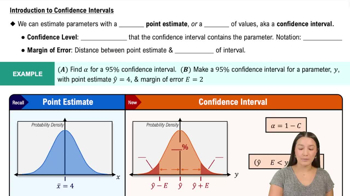
A confidence interval is a range of values, derived from sample statistics, that is likely to contain the population parameter with a specified level of confidence. For example, a 90% confidence interval suggests that if we were to take many samples and construct intervals in the same way, approximately 90% of those intervals would contain the true population parameter.
Recommended video:
06:33
Introduction to Confidence Intervals

Chi-Squared Distribution

The Chi-squared distribution is a statistical distribution that is used to estimate the variance of a population based on sample data. It is particularly relevant when constructing confidence intervals for population variance and standard deviation, as it accounts for the degrees of freedom, which is determined by the sample size minus one.
Recommended video:
Guided course
07:01
Intro to Least Squares Regression

Sample Variance and Standard Deviation

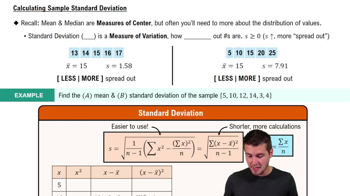
Sample variance (s²) measures the spread of sample data points around the sample mean, while the standard deviation (s) is the square root of the variance, providing a measure of dispersion in the same units as the data. These statistics are crucial for estimating the population variance and standard deviation, especially when the population is assumed to be normally distributed.
Recommended video:
Guided course
08:45
Calculating Standard Deviation