
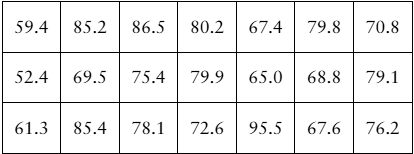

Constructing Confidence Intervals In Exercises 13–24, assume the sample is from a normally distributed population and construct the indicated confidence intervals for (b) the population standard deviation σ. Interpret the results. [APPLET] Earnings The annual earnings (in thousands of dollars) of 21 randomly selected level 1 computer hardware engineers are listed. Use a 99% level of confidence. (Adapted from Salary.com)
Verified step by step guidance
1
Step 1: Identify the sample size (n), which is given as 21, and note that the data is from a normally distributed population. Extract the earnings data from the table provided.
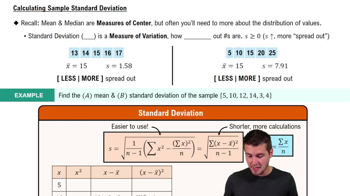
Step 2: Calculate the sample variance (s²) using the formula: s² = (Σ(xᵢ - x̄)²) / (n - 1), where x̄ is the sample mean, xᵢ are the individual data points, and n is the sample size. First, compute the sample mean (x̄) by summing all the data points and dividing by n.
Step 3: Use the Chi-Square distribution to construct the confidence interval for the population variance (σ²). The formula for the confidence interval is: [(n - 1)s² / χ²(α/2)], [(n - 1)s² / χ²(1 - α/2)], where χ²(α/2) and χ²(1 - α/2) are the critical values from the Chi-Square distribution table for the given confidence level (99%) and degrees of freedom (df = n - 1).
Step 4: To find the confidence interval for the population standard deviation (σ), take the square root of the lower and upper bounds of the variance confidence interval calculated in Step 3.
Step 5: Interpret the results: The confidence interval provides a range of values within which the true population standard deviation is likely to fall, with 99% confidence. This means that if we were to repeat the sampling process many times, 99% of the intervals constructed would contain the true population standard deviation.
Verified video answer for a similar problem:
This video solution was recommended by our tutors as helpful for the problem above
Video duration:
5m
Play a video:
0 Comments
Key Concepts
Here are the essential concepts you must grasp in order to answer the question correctly.
Confidence Interval
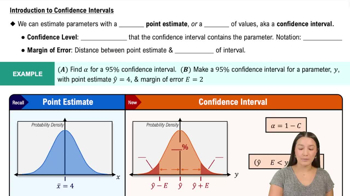
A confidence interval is a range of values, derived from sample statistics, that is likely to contain the true population parameter with a specified level of confidence. For example, a 99% confidence interval suggests that if we were to take many samples and construct intervals in the same way, approximately 99% of those intervals would contain the true population parameter.
The population standard deviation (σ) is a measure of the amount of variation or dispersion in a set of values in a population. It quantifies how much individual data points differ from the population mean. In constructing confidence intervals for σ, we often use sample data to estimate this parameter, which is crucial for understanding the variability of the population.
Normal distribution is a probability distribution that is symmetric about the mean, showing that data near the mean are more frequent in occurrence than data far from the mean. Many statistical methods, including confidence interval construction, assume that the underlying population is normally distributed, especially when sample sizes are small, as it affects the validity of the results.