
Ch. 7 - Estimating Parameters and Determining Sample Sizes
Triola - Elementary Statistics 14th Edition
Triola14th EditionElementary StatisticsISBN: 9780137366446Not the one you use?Change textbook
Chapter 7, Problem 7.1.9

Formats of Confidence Intervals. In Exercises 9–12, express the confidence interval using the indicated format. (The confidence intervals are based on the proportions of red, orange, yellow, and blue M&Ms in Data Set 38 “Candies” in Appendix B.)


Green M&Ms Express 0.116 < p < 0.192 in the form of p +-E.

Verified step by step guidance
1
Identify the given confidence interval: 0.116 < p < 0.192. Here, p represents the population proportion, and the interval provides the range of plausible values for p.
To express the confidence interval in the form p ± E, calculate the midpoint of the interval. The midpoint is the point estimate (p̂) and can be found using the formula: = Lower + Upper2, where 'Lower' is 0.116 and 'Upper' is 0.192.
Next, calculate the margin of error (E). The margin of error is the distance from the midpoint to either endpoint of the interval. Use the formula: E = Upper - or equivalently E = - Lower.
Substitute the calculated midpoint (p̂) and margin of error (E) into the format p ± E. This will give the confidence interval in the desired form.
Verify your result by checking that the reconstructed interval (p̂ - E to p̂ + E) matches the original interval (0.116 to 0.192). This ensures the conversion was done correctly.

Verified video answer for a similar problem:

This video solution was recommended by our tutors as helpful for the problem above.
Video duration:
1m
Was this helpful?

Key Concepts

Here are the essential concepts you must grasp in order to answer the question correctly.

Confidence Interval

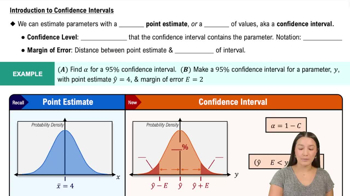
A confidence interval is a range of values, derived from sample statistics, that is likely to contain the true population parameter. It is expressed as an interval estimate, typically in the form of (lower limit, upper limit), and indicates the degree of uncertainty associated with a sample estimate. The width of the interval reflects the level of confidence, with wider intervals indicating more uncertainty.
Recommended video:
06:33
Introduction to Confidence Intervals

Margin of Error (E)

The margin of error (E) quantifies the amount of random sampling error in a survey's results. It represents the maximum expected difference between the true population parameter and a sample estimate. In the context of confidence intervals, it is calculated as half the width of the interval, allowing for the expression of the interval in the form of p ± E, where p is the sample proportion.
Recommended video:
06:33
Introduction to Confidence Intervals

Proportion

A proportion is a statistical measure that represents the fraction of a whole, often expressed as a decimal or percentage. In the context of the question, it refers to the proportion of a specific color of M&M's (e.g., green) in a sample. Understanding proportions is essential for calculating confidence intervals, as they serve as the basis for estimating population parameters.
Recommended video:
Guided course
09:27
Difference in Proportions: Hypothesis Tests
Related Practice
Textbook Question

Large Data Sets from Appendix B. In Exercises 21 and 22, use the data set in Appendix B. Assume that each sample is a simple random sample obtained from a population with a normal distribution.


Comparing Waiting Lines Refer to Data Set 30 “Queues” in Appendix B. Construct separate 95% confidence interval estimates of using the two-line wait times and the single-line wait times. Do the results support the expectation that the single line has less variation? Do the wait times from both line configurations satisfy the requirements for confidence interval estimates of sigma

121
views
Textbook Question

In Exercises 5–8, (a) identify the critical value ta/2 used for finding the margin of error, (b) find the margin of error, (c) find the confidence interval estimate of u, and (d) write a brief statement that interprets the confidence interval.


Pepsi Weights Here are summary statistics for the weights of Pepsi in randomly selected cans: n=36, x=0.82410 lb, s=0.00570 lb (based on Data Set 37 “Cola Weights and Volumes” in Appendix B). Use a confidence level of 99%.

217
views
Textbook Question

Constructing and Interpreting Confidence Intervals. In Exercises 13–16, use the given sample data and confidence level. In each case, (a) find the best point estimate of the population proportion p; (b) identify the value of the margin of error E; (c) construct the confidence interval; (d) write a statement that correctly interprets the confidence interval.


Medical Malpractice In a study of 1228 randomly selected medical malpractice lawsuits, it was found that 856 of them were dropped or dismissed (based on data from the Physicians Insurers Association of America). Construct a 95% confidence interval for the proportion of medical malpractice lawsuits that are dropped or dismissed.

181
views
Textbook Question

Body Temperature Data Set 5 “Body Temperatures” in Appendix B includes a sample of 106 body temperatures having a mean of and a standard deviation of 0.62F (for day 2 at 12 AM). Construct a 95% confidence interval estimate of the standard deviation of the body temperatures for the entire population.

133
views
Textbook Question

Mercury in Sushi An FDA guideline is that the mercury in fish should be below 1 part per million (ppm). Listed below are the amounts of mercury (ppm) found in tuna sushi sampled at different stores in New York City. The study was sponsored by the New York Times, and the stores (in order) are D’Agostino, Eli’s Manhattan, Fairway, Food Emporium, Gourmet Garage, Grace’s Marketplace, and Whole Foods. Construct a 98% confidence interval estimate of the mean amount of mercury in the population. Does it appear that there is too much mercury in tuna sushi?


0.56 0.75 0.10 0.95 1.25 0.54 0.88

120
views
Textbook Question

Atkins Weight Loss Program In a test of weight loss programs, 40 adults used the Atkins weight loss program. After 12 months, their mean weight loss was found to be 2.1 lb, with a standard deviation of 4.8 lb. Construct a 90% confidence interval estimate of the mean weight loss for all such subjects. Does the Atkins program appear to be effective? Does it appear to be practical?

161
views