Ch. 5 - Normal Probability Distributions
Larson - Elementary Statistics: Picturing the World 8th Edition
Larson8th EditionElementary Statistics: Picturing the WorldISBN: 9780137493470Not the one you use?Change textbook
Chapter 5, Problem 5.1.31

Finding Area
In Exercises 23–36, find the indicated area under the standard normal curve. If convenient, use technology to find the area.


Between z=0 and z=2.86

Verified step by step guidance
1
Step 1: Understand the problem. You are tasked with finding the area under the standard normal curve between z = 0 and z = 2.86. The standard normal curve is a bell-shaped curve with a mean of 0 and a standard deviation of 1.
Step 2: Recall that the area under the standard normal curve represents probabilities. To find the area between two z-scores, you can use the cumulative distribution function (CDF) of the standard normal distribution.
Step 3: Use the formula for the cumulative area under the curve: \( P(a \leq Z \leq b) = \Phi(b) - \Phi(a) \), where \( \Phi(z) \) is the cumulative probability up to z. In this case, \( a = 0 \) and \( b = 2.86 \).
Step 4: Look up the cumulative probabilities for \( \Phi(2.86) \) and \( \Phi(0) \) using a z-table or technology (e.g., a calculator or statistical software). Note that \( \Phi(0) \) is always 0.5 because the standard normal curve is symmetric around the mean.
Step 5: Subtract \( \Phi(0) \) from \( \Phi(2.86) \) to find the area between z = 0 and z = 2.86. The result represents the probability or area under the curve for the specified range.

Verified video answer for a similar problem:

This video solution was recommended by our tutors as helpful for the problem above.
Video duration:
2m
Was this helpful?

Key Concepts

Here are the essential concepts you must grasp in order to answer the question correctly.

Standard Normal Distribution

The standard normal distribution is a special normal distribution with a mean of 0 and a standard deviation of 1. It is represented by the z-score, which indicates how many standard deviations an element is from the mean. This distribution is crucial for calculating probabilities and areas under the curve, as it allows for the comparison of different data sets.
Recommended video:
Guided course
09:47
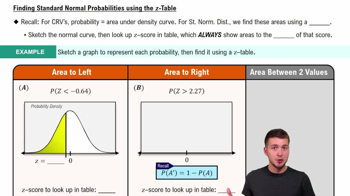
Finding Standard Normal Probabilities using z-Table

Z-scores

A z-score is a statistical measurement that describes a value's relationship to the mean of a group of values. It is calculated by subtracting the mean from the value and then dividing by the standard deviation. Z-scores are essential for finding areas under the standard normal curve, as they help determine the probability of a value falling within a certain range.
Recommended video:
Guided course
06:31
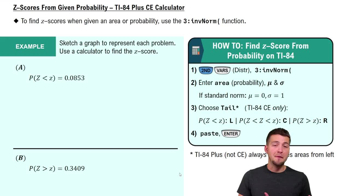
Z-Scores From Given Probability - TI-84 (CE) Calculator

Area Under the Curve

The area under the curve in a standard normal distribution represents the probability of a random variable falling within a specified range. To find the area between two z-scores, one can use statistical tables or technology, such as calculators or software, which provide the cumulative probabilities associated with those z-scores. This area is crucial for making inferences about data and understanding the likelihood of outcomes.
Recommended video:
Guided course
08:50
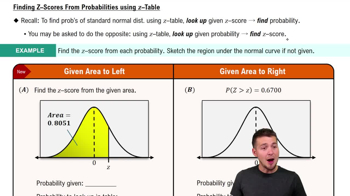
Z-Scores from Probabilities
Related Practice
Textbook Question

Graphical Analysis In Exercises 17–22, find the indicated z-score(s) shown in the graph.


" style="" width="260">

118
views

Textbook Question

Finding Probabilities In Exercises 15–18, the population mean and standard deviation are given. Find the indicated probability and determine whether the given sample mean would be considered unusual.


For a random sample of n=36, find the probability of a sample mean being less than 12,750 or greater than 12,753 when mu=12750 and 1.7.

105
views
Textbook Question

Graphical Analysis In Exercises 9 and 10, the graph of a population distribution is shown with its mean and standard deviation. Random samples of size 100 are drawn from the population. Determine which of the figures labeled (a)–(c) would most closely resemble the sampling distribution of sample means. Explain your reasoning.


The waiting time (in seconds) to turn left at an intersection

76
views
Textbook Question

Computing Probabilities for Normal Distributions In Exercises 1–6, the random variable x is normally distributed with mean mu=174 and standard deviation sigma=20. Find the indicated probability.


P(172 < x <192)

132
views
Textbook Question

Finding Probability In Exercises 47–56, find the indicated probability using the standard normal distribution. If convenient, use technology to find the probability.


P(- 1.54 < z < 1.54)

92
views
Textbook Question

Interpreting the Central Limit Theorem In Exercises 19–26, find the mean and standard deviation of the indicated sampling distribution of sample means. Then sketch a graph of the sampling distribution.


Renewable Energy During a recent period of two years, the day-ahead prices for renewable energy in Germany (in euros per mega-watt hour) have a mean of 31.58 and a standard deviation of 12.293. Random samples of size 75 are drawn from this population, and the mean of each sample is determined.

81
views