Ch. 3 - Probability
Larson - Elementary Statistics: Picturing the World 8th Edition
Larson8th EditionElementary Statistics: Picturing the WorldISBN: 9780137493470Not the one you use?Change textbook
Chapter 3, Problem 3.4.17

In Exercises 15-18, determine whether the situation involves permutations, combinations, or neither. Explain your reasoning.
17. The number of ways 2 captains can be chosen from 28 players on a lacrosse team

Verified step by step guidance
1
Determine whether the order of selection matters in the problem. Since the problem is about choosing 2 captains and the order in which they are chosen does not matter (e.g., Captain A and Captain B is the same as Captain B and Captain A), this situation involves combinations.
Recall the formula for combinations: C(n, r) = n! / [(r!)(n - r)!], where n is the total number of items to choose from, and r is the number of items to choose.
Identify the values of n and r in this problem. Here, n = 28 (the total number of players) and r = 2 (the number of captains to be chosen).
Substitute the values of n and r into the combination formula: C(28, 2) = 28! / [(2!)(28 - 2)!].
Simplify the expression by canceling out the common factorial terms in the numerator and denominator, leaving you with C(28, 2) = (28 × 27) / 2!.

Verified video answer for a similar problem:

This video solution was recommended by our tutors as helpful for the problem above.
Video duration:
1m
Was this helpful?

Key Concepts

Here are the essential concepts you must grasp in order to answer the question correctly.

Permutations

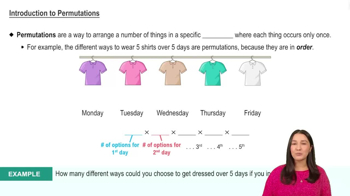
Permutations refer to the arrangement of items where the order matters. For example, if you are selecting a president and a vice president from a group, the order in which you select them is important, as different roles imply different arrangements.
Recommended video:
07:11
Introduction to Permutations

Combinations

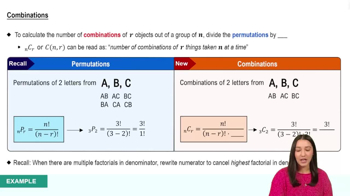
Combinations involve selecting items where the order does not matter. For instance, choosing 2 captains from a group of players means that selecting Player A and Player B is the same as selecting Player B and Player A; thus, the arrangement is irrelevant.
Recommended video:
05:22
Combinations

Choosing from a Group

When determining how to choose from a group, it's essential to identify whether the selection involves distinct roles or positions. In this case, since the captains are not assigned specific roles beyond being captains, the situation is a combination, as the order of selection does not affect the outcome.
Recommended video:
Guided course
08:50
Z-Scores from Probabilities
Related Practice
Textbook Question

56. Defective Disks A pack of 100 recordable DVDs contains 5 defective disks. You select four disks. What is the probability of selecting at least three non defective disks?

83
views

Textbook Question

Odds The chances of winning are often written in terms of odds rather than probabilities. The odds of winning is the ratio of the number of successful outcomes to the number of unsuccessful outcomes. The odds of losing is the ratio of the number of unsuccessful outcomes to the number of successful outcomes. For example, when the number of successful outcomes is 2 and the number of unsuccessful outcomes is 3, the odds of winning are 2 : 3 (read "2 to 3"). In Exercises 91-96, use this information about odds.

94. A card is picked at random from a standard deck of 52 playing cards. Find the odds that it is a spade.

242
views
Textbook Question

3. Explain why the statement is incorrect: The probability of rain is 150%.

156
views
Textbook Question

Identifying Simple Events In Exercises 33-36, determine the number of outcomes in the event. Then decide whether the event is a simple event or not. Explain your reasoning.

34. A spreadsheet is used to randomly generate a number from 1 to 4000. Event B is generating a number less than 500.

112
views
Textbook Question

"According to Bayes’ Theorem, the probability of event A , given that event B has occurred, is

P(A|B) = P(A) * P(B|A)P(A) * P(B|A) + P(A') * P(B|A').

In Exercises 33–38, use Bayes’ Theorem to find P(A|B).

36. P(A) = 0.62, P(A') = 0.38, P(B|A) = 0.41 , and P(B|A') = 0.17 "

104
views
Textbook Question

"Classifying Events as Independent or Dependent In Exercises 9-14, determine whether the events are independent or dependent. Explain your reasoning.

10. A father having hazel eyes and a daughter having hazel eyes"

69
views