Ch. 3 - Probability
Larson - Elementary Statistics: Picturing the World 8th Edition
Larson8th EditionElementary Statistics: Picturing the WorldISBN: 9780137493470Not the one you use?Change textbook
Chapter 3, Problem 3.1.84

Using a Pie Chart to Find Probabilities In Exercises 83-86, use the pie chart at the left, which shows the number of workers (in millions) by occupation for the United States. (Source: U.S. Bureau of Labor Statistics)
84. Find the probability that a worker chosen at random is not employed in a service occupation.
<IMAGE>

Verified step by step guidance
1
Step 1: Identify the total number of workers represented in the pie chart. To do this, sum up the values for all the occupational categories: 63.6 (Management, professional) + 29.7 (Sales, office) + 22.9 (Service) + 18.2 (Production, transportation, material moving) + 13.4 (Natural resources, construction, maintenance).
Step 2: Determine the number of workers employed in the 'Service' occupation. From the pie chart, this value is given as 22.9 million.
Step 3: Calculate the number of workers not employed in the 'Service' occupation. Subtract the number of workers in the 'Service' category from the total number of workers: Total workers - Workers in Service.
Step 4: Find the probability that a randomly chosen worker is not employed in the 'Service' occupation. This probability is calculated as the ratio of workers not in 'Service' to the total number of workers: (Workers not in Service) / (Total workers).
Step 5: Simplify the probability expression obtained in Step 4 to get the final probability value. Ensure the result is expressed as a decimal or fraction, depending on the context of the problem.

Verified video answer for a similar problem:

This video solution was recommended by our tutors as helpful for the problem above.
Video duration:
2m
Was this helpful?

Key Concepts

Here are the essential concepts you must grasp in order to answer the question correctly.

Probability

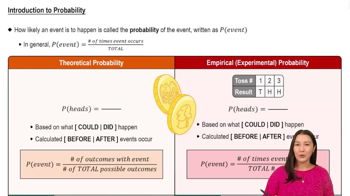
Probability is a measure of the likelihood that a particular event will occur, expressed as a number between 0 and 1. In this context, it refers to the chance of randomly selecting a worker not employed in a service occupation. To calculate this, one must consider the total number of workers and the number of workers in service occupations.
Recommended video:
5:37
Introduction to Probability

Pie Chart

A pie chart is a circular statistical graphic divided into slices to illustrate numerical proportions. Each slice represents a category's contribution to the whole. In this case, the pie chart displays the distribution of workers across various occupations, allowing for a visual understanding of the proportion of workers in service versus other occupations.
Recommended video:
06:10
Creating Pie Charts

Complementary Events

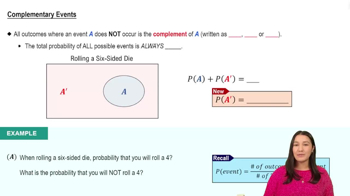
Complementary events are two outcomes of an event that are mutually exclusive and collectively exhaustive. In this scenario, the event of selecting a worker not in a service occupation is the complement of selecting a worker in a service occupation. Understanding this concept is crucial for calculating the probability of the desired outcome by subtracting the probability of the complementary event from 1.
Recommended video:
4:23
Complementary Events