
Ch. 3 - Probability
Larson - Elementary Statistics: Picturing the World 8th Edition
Larson8th EditionElementary Statistics: Picturing the WorldISBN: 9780137493470Not the one you use?Change textbook
Chapter 3, Problem 3.4.34

34. Lottery Number Selection A lottery has 52 numbers. In how many different ways can six of the numbers be selected? (Assume the order of selection is not important.)

Verified step by step guidance
1
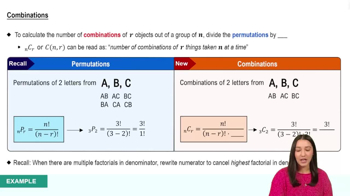
Step 1: Recognize that this is a combination problem because the order of selection does not matter. The formula for combinations is given by: C=n!r!(n-r)!, where n is the total number of items, r is the number of items to choose, and '!' denotes factorial.
Step 2: Identify the values of n and r from the problem. Here, n = 52 (total numbers in the lottery) and r = 6 (numbers to be selected).
Step 3: Substitute the values of n and r into the combination formula: C=52!6!(52-6)!.
Step 4: Simplify the factorials in the denominator. Compute (52 - 6) = 46, so the formula becomes: C=52!6!46!.
Step 5: Cancel out the common terms in the numerator and denominator. This simplifies to: C=52×51×50×49×48×476×5×4×3×2×1. Compute this to find the total number of ways.

Verified video answer for a similar problem:

This video solution was recommended by our tutors as helpful for the problem above.
Video duration:
1m
Was this helpful?

Key Concepts

Here are the essential concepts you must grasp in order to answer the question correctly.

Combinations

Combinations refer to the selection of items from a larger set where the order does not matter. In this context, we are interested in choosing 6 numbers from a total of 52, which is a classic example of a combination problem. The formula for combinations is given by C(n, k) = n! / (k!(n-k)!), where n is the total number of items, k is the number of items to choose, and '!' denotes factorial.
Recommended video:
05:22
Combinations

Factorial

A factorial, denoted as n!, is the product of all positive integers up to n. For example, 5! = 5 × 4 × 3 × 2 × 1 = 120. Factorials are essential in calculating combinations and permutations, as they help determine the total arrangements of a set of items. In the lottery question, factorials will be used to compute the number of ways to choose 6 numbers from 52.
Recommended video:
05:22
Combinations

Binomial Coefficient

The binomial coefficient, often represented as C(n, k) or 'n choose k', quantifies the number of ways to choose k elements from a set of n elements without regard to the order of selection. It is calculated using the formula C(n, k) = n! / (k!(n-k)!). This concept is crucial for solving the lottery number selection problem, as it directly provides the number of combinations of 6 numbers from 52.
Recommended video:
Guided course
06:14
Coefficient of Determination
Related Practice
Textbook Question

Using a Pie Chart to Find Probabilities In Exercises 83-86, use the pie chart at the left, which shows the number of workers (in millions) by occupation for the United States. (Source: U.S. Bureau of Labor Statistics)

84. Find the probability that a worker chosen at random is not employed in a service occupation.

" style="" width="260">

126
views
Textbook Question

"Classifying Events as Independent or Dependent In Exercises 9-14, determine whether the events are independent or dependent. Explain your reasoning.

13. Rolling a six-sided die and then rolling the die a second time so that the sum of the two rolls is five"

65
views
Textbook Question

Boy or Girl? In Exercises 71-74, a couple plans to have three children. Each child is equally likely to be a boy or a girl.

71. What is the probability that all three children are girls?

98
views
Textbook Question

"Classifying Events Based on Studies In Exercises 15-18, identify the two events described in the study. Do the results indicate that the events are independent or dependent? Explain your reasoning.

16. A study found no significant association between the use of talc powder and the incidence of ovarian cancer in women. (Source: JAMA)"

39
views
Textbook Question

25. Playlist A band is preparing a setlist of 21 songs for a concert. How many different ways can the band play the first six songs?

129
views
Textbook Question

Identifying the Sample Space of a Probability Experiment In Exercises 25-32, identify the sample space of the probability experiment and determine the number of outcomes in the sample space. Draw a tree diagram when appropriate.

25. Guessing the initial of a student's middle name

160
views