Ch. 5 - Normal Probability Distributions
Larson - Elementary Statistics: Picturing the World 8th Edition
Larson8th EditionElementary Statistics: Picturing the WorldISBN: 9780137493470Not the one you use?Change textbook
Chapter 5, Problem 5.T.3b

In Exercises 5 and 6, determine whether you can use a normal distribution to approximate the binomial distribution. If you can, use the normal distribution to approximate the indicated probabilities and sketch their graphs. If you cannot, explain why and use a binomial distribution to find the indicated probabilities.


A survey of U.S. undergraduates found that 37% of those attending in-state colleges would prefer to take a job in a different state after graduation. You randomly select 18 U.S. undergraduates attending in-state colleges. Find the probability that the number who would prefer to take a job in a different state after graduation is (b) less than 5. Identify any unusual events. Explain.

Verified step by step guidance
1
Step 1: Verify if the normal distribution can be used to approximate the binomial distribution. For this, check the conditions: (1) The sample size (n) must be large enough, and (2) both np and n(1-p) must be greater than or equal to 5. Here, n = 18 and p = 0.37. Calculate np = 18 * 0.37 and n(1-p) = 18 * (1 - 0.37).
Step 2: If the conditions are satisfied, proceed to approximate the binomial distribution using the normal distribution. The mean (μ) and standard deviation (σ) of the binomial distribution are given by μ = np and σ = √(np(1-p)). Calculate these values using the given n and p.
Step 3: To find the probability that the number of students who prefer to take a job in a different state is less than 5, convert the binomial random variable to a z-score using the formula z = (x - μ) / σ, where x is the value of interest. Since the problem asks for 'less than 5,' use x = 4.5 (apply the continuity correction).
Step 4: Use the z-score obtained in Step 3 to find the corresponding probability from the standard normal distribution table or a statistical software. This will give the approximate probability for the event.
Step 5: Identify any unusual events by comparing the calculated probability to a threshold (e.g., 0.05 for a 5% significance level). If the probability is less than the threshold, the event is considered unusual. Additionally, sketch the graph of the normal distribution curve with the area corresponding to the probability shaded.

Verified video answer for a similar problem:

This video solution was recommended by our tutors as helpful for the problem above.
Video duration:
10m
Was this helpful?

Key Concepts

Here are the essential concepts you must grasp in order to answer the question correctly.

Binomial Distribution

The binomial distribution models the number of successes in a fixed number of independent Bernoulli trials, each with the same probability of success. In this context, it applies to the scenario of selecting undergraduates who prefer to take a job in a different state, where each student represents a trial with a success probability of 0.37.
Recommended video:
Guided course
03:28
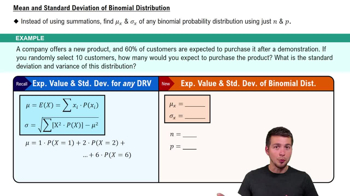
Mean & Standard Deviation of Binomial Distribution

Normal Approximation to the Binomial

The normal approximation to the binomial distribution is applicable when the number of trials is large, and both the expected number of successes and failures are greater than 5. This allows us to use the normal distribution to estimate probabilities for binomial scenarios, simplifying calculations and providing a continuous approximation.
Recommended video:
06:23
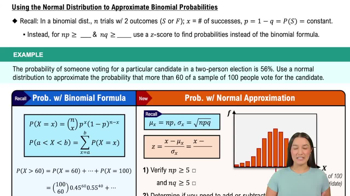
Using the Normal Distribution to Approximate Binomial Probabilities

Unusual Events

An unusual event in statistics is typically defined as one that has a low probability of occurring, often less than 5%. In this problem, identifying whether the event of having fewer than 5 students preferring a job out of state is unusual involves calculating its probability using either the binomial or normal distribution and comparing it to this threshold.
Recommended video:
05:54
Probability of Multiple Independent Events
Related Practice
Textbook Question

In Exercises 2–4, the random variable x is normally distributed with mean mu= 18 and standard deviation sigma 7.6


Find each probability.


b. P(0 < x < 5)

128
views

Textbook Question

Use technology to find the standard deviation of the set of 36 sample means. How does it compare with the standard deviation of the ages found in Exercise 5? Does this agree with the result predicted by the Central Limit Theorem?

78
views
Textbook Question

The per capita disposable income for residents of a U.S. city in a recent year is normally distributed, with a mean of about \$44,000 and a standard deviation of about \(2450. Use this information in Exercises 7–10.


Out of 800 residents, about how many would you expect to have a disposable income of between \)40,000 and \$42,000?

65
views
Textbook Question

In Exercises 5 and 6, determine whether you can use a normal distribution to approximate the binomial distribution. If you can, use the normal distribution to approximate the indicated probabilities and sketch their graphs. If you cannot, explain why and use a binomial distribution to find the indicated probabilities.


A survey of U.S. undergraduates found that 37% of those attending in-state colleges would prefer to take a job in a different state after graduation. You randomly select 18 U.S. undergraduates attending in-state colleges. Find the probability that the number who would prefer to take a job in a different state after graduation is (a) exactly 7. Identify any unusual events. Explain.

121
views
Textbook Question

In Exercises 2–4, the random variable x is normally distributed with mean mu= 18 and standard deviation sigma 7.6


Find the value of x that has 88.3% of the distribution’s area to its left.

50
views
Textbook Question

During a recent period of one year, the mean percent increase in value on Wednesdays of the cryptocurrency Dogecoin was 7.46%, with a standard deviation of 53.47%. Random samples of size 50 are drawn from this population and the mean of each sample is determined. (Source: Crypto Indicators)


c. What is the probability that the mean percent increase for a given sample is between −10% and 30%?

46
views