Ch. 9 - Inferences from Two Samples
Triola - Elementary Statistics 14th Edition
Triola14th EditionElementary StatisticsISBN: 9780137366446Not the one you use?Change textbook
Chapter 9, Problem 9.5.7

In Exercises 5–8, use (a) randomization and (b) bootstrapping for the indicated exercise from Section 9-1. Compare the results to those obtained in the original exercise.


Exercise 9 in Section 9-1 “Cell Phones and Handedness”

Verified step by step guidance
1
Step 1: Understand the problem. The exercise involves using randomization and bootstrapping methods to analyze data related to 'Cell Phones and Handedness' from Section 9-1. Randomization involves shuffling or resampling the data to test hypotheses, while bootstrapping involves generating multiple samples by resampling with replacement to estimate statistics.
Step 2: Randomization method. Begin by identifying the original dataset from Exercise 9 in Section 9-1. Shuffle the data randomly to break any existing associations between variables (e.g., handedness and cell phone usage). Perform the analysis on the randomized data to test the null hypothesis. Repeat this process multiple times to create a distribution of results.
Step 3: Bootstrapping method. Using the original dataset, generate multiple bootstrap samples by resampling with replacement. For each bootstrap sample, calculate the statistic of interest (e.g., mean, proportion, or difference in proportions). This will create a distribution of the statistic, which can be used to estimate confidence intervals or test hypotheses.
Step 4: Compare results. Compare the results obtained from the randomization and bootstrapping methods to those from the original exercise. Look for similarities or differences in the distributions, confidence intervals, or p-values. Discuss the implications of these findings in the context of the problem.
Step 5: Interpret and conclude. Summarize the findings from both methods and explain how they support or refute the conclusions drawn in the original exercise. Highlight the advantages and limitations of randomization and bootstrapping in this context.

Verified video answer for a similar problem:

This video solution was recommended by our tutors as helpful for the problem above.
Video duration:
7m
Was this helpful?

Key Concepts

Here are the essential concepts you must grasp in order to answer the question correctly.

Randomization

Randomization is a statistical technique used to eliminate bias by randomly assigning subjects to different groups or treatments. This process ensures that each participant has an equal chance of being placed in any group, which helps to create comparable groups and allows for valid inferences about the effects of treatments or interventions.
Recommended video:
Guided course
07:09
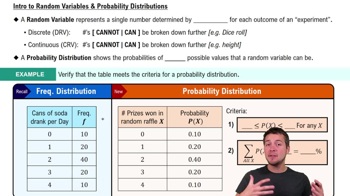
Intro to Random Variables & Probability Distributions

Bootstrapping

Bootstrapping is a resampling method that involves repeatedly drawing samples from a dataset with replacement to estimate the distribution of a statistic. This technique allows statisticians to assess the variability of a sample statistic, such as the mean or median, and is particularly useful when the underlying distribution is unknown or when sample sizes are small.

Comparative Analysis

Comparative analysis in statistics involves evaluating the results obtained from different methods or datasets to identify similarities and differences. In the context of the question, it refers to comparing the outcomes from randomization and bootstrapping with those from the original exercise, providing insights into the robustness and reliability of the statistical findings.
Recommended video:
Guided course
04:48
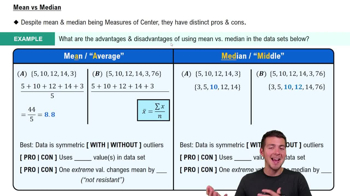
Comparing Mean vs. Median
Related Practice
Textbook Question

Body Temperatures Listed below are body temperatures from six different subjects measured at two different times in a day (from Data Set 5 “Body Temperatures” in Appendix B).


a. Are the two sets of data independent or dependent? Explain.


[Image]

376
views
Textbook Question

In Exercises 5–8, use (a) randomization and (b) bootstrapping for the indicated exercise from Section 9-1. Compare the results to those obtained in the original exercise.


Exercise 8 in Section 9-1 “Tennis Challenges”


89
views
Textbook Question

Testing Effects of Alcohol Researchers conducted an experiment to test the effects of alcohol. Errors were recorded in a test of visual and motor skills for a treatment group of 22 people who drank ethanol and another group of 22 people given a placebo. The errors for the treatment group have a standard deviation of 2.20, and the errors for the placebo group have a standard deviation of 0.72 (based on data from “Effects of Alcohol Intoxication on Risk Taking, Strategy, and Error Rate in Visuomotor Performance,” by Streufert et al., Journal of Applied Psychology, Vol. 77, No. 4). Use a 0.05 significance level to test the claim that both groups have the same amount of variation among the errors.

125
views
Textbook Question

Degrees of Freedom For Example 1, we used df=smaller of n1-1 and n2-1 we got df=11 and the corresponding critical value is t=-1.796 (found from Table A-4). If we calculate df using Formula 9-1, we get df=19.370 and the corresponding critical value is t=-1.727 How is using the critical value of t=-1.796 “more conservative” than using the critical value of t=-1.727

241
views
Textbook Question

Is Friday the 13th Unlucky? Listed below are numbers of hospital admissions in one region due to traffic accidents on different Fridays falling on the 6th day of a month and the following 13th day of the month (based on data from “Is Friday the 13th Bad for Your Health,” by Scanlon et al., British Medical Journal, Vol. 307). Assume that we want to use a 0.05 significance level to test the claim that the data support the claim that fewer hospital admissions due to traffic accidents occur on Friday the 6th than on the following Friday the 13th. Identify the null hypothesis and alternative hypothesis.


132
views
Textbook Question

In Exercises 17–24, use the indicated Data Sets from Appendix B. The complete data sets can be found at www.TriolaStats.com. Assume that the paired sample data are simple random samples and the differences have a distribution that is approximately normal.

Measured and Reported Weights Repeat Example 1 using all of the 2784 measured and reported weights of males listed in Data Set 4 “Measured and Reported” in Appendix B. Did the larger data set have much of an effect on the results?

106
views