
Ch. 9 - Correlation and Regression
Larson - Elementary Statistics: Picturing the World 8th Edition
Larson8th EditionElementary Statistics: Picturing the WorldISBN: 9780137493470Not the one you use?Change textbook
Chapter 9, Problem 9.R.22

"In Exercises 19-24, construct the indicated prediction interval and interpret the results.
22. Construct a 95% prediction interval for the fuel efficiency of an automobile in Exercise 12 that has an engine displacement of 265 cubic inches."

Verified step by step guidance
1
Identify the regression equation from Exercise 12, which relates fuel efficiency (dependent variable) to engine displacement (independent variable). This equation typically has the form: \(\hat{y}\) = b_0 + b_1 x, where \(\hat{y}\) is the predicted fuel efficiency and x is the engine displacement.
Calculate the predicted fuel efficiency for an engine displacement of 265 cubic inches by substituting x = 265 into the regression equation to find \(\hat{y}\).
Determine the standard error of the prediction, which accounts for both the variability of the regression line and the individual prediction. The formula for the standard error of prediction is: SE_{pred} = s \(\sqrt{1 + \frac{1}{n}\) + \(\frac{(x_0 - \bar{x}\))^2}{\(\sum\) (x_i - \(\bar{x}\))^2}}, where s is the standard error of the estimate, n is the sample size, x_0 is 265, and \(\bar{x}\) is the mean of the engine displacements.
Find the critical t-value for a 95% prediction interval with degrees of freedom equal to n - 2. This value comes from the t-distribution table and depends on the confidence level and sample size.
Construct the 95% prediction interval using the formula: \(\hat{y}\) \(\pm\) t_{\(\alpha\)/2, n-2} \(\times\) SE_{pred}. This interval estimates the range in which the fuel efficiency of a single automobile with 265 cubic inches engine displacement is expected to fall with 95% confidence.

Verified video answer for a similar problem:

This video solution was recommended by our tutors as helpful for the problem above.
Video duration:
5m
Was this helpful?

Key Concepts

Here are the essential concepts you must grasp in order to answer the question correctly.

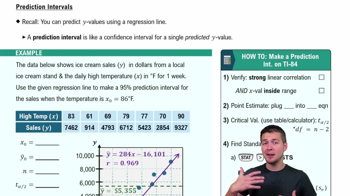
Prediction Interval

A prediction interval estimates the range within which a single new observation is expected to fall, with a certain level of confidence. Unlike confidence intervals for mean responses, prediction intervals account for both the variability in the estimated mean and the individual data point's variability.
Recommended video:
Guided course
09:00
Prediction Intervals

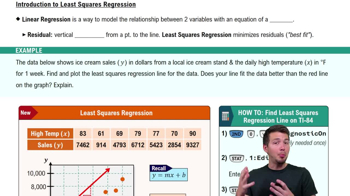
Regression Analysis

Regression analysis models the relationship between a dependent variable and one or more independent variables. In this context, it helps predict fuel efficiency based on engine displacement by fitting a line that best describes their relationship.
Recommended video:
Guided course
07:01
Intro to Least Squares Regression

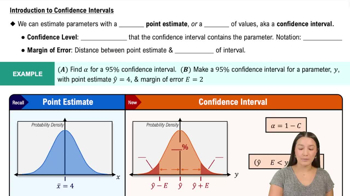
Confidence Level and Interpretation

The confidence level, such as 95%, indicates the probability that the interval contains the true value for a new observation. Interpreting the prediction interval means understanding that there is a 95% chance the actual fuel efficiency for an engine displacement of 265 cubic inches falls within the calculated range.
Recommended video:
06:33
Introduction to Confidence Intervals
Related Practice
Textbook Question

"In Exercises 27 and 28, use the multiple regression equation to predict the y-values for the values of the independent variables.

28. Use the regression equation found in Exercise 25.

a. x_1 = 9.0, x_2 = 0.70

b. x_1 = 3.0, x_2 = 0.25

c. x_1 = 8.0, x_2 = 0.60

d. x_1 = 5.2, x_2 = 0.46"

43
views
Textbook Question

"In Exercises 17 and 18, use the data to (a) find the coefficient of determination r^2 and interpret

the result, and (b) find the standard error of estimate s_e and interpret the result.

17. The table shows the times (in seconds) to accelerate from 0 to 60 miles per hour and the top speeds (in miles per hour) for eight electric cars. The regression equation is y =- 14.399x + 196.996. (Source: Car and Driver)

56
views
Textbook Question

"In Exercises 13-16, use the value of the correlation coefficient r to calculate the coefficient of determination r^2. What does this tell you about the explained variation of the data about the regression line? about the unexplained variation?

14.r =- 0.937"

69
views
Textbook Question

"In Exercises 27 and 28, use the multiple regression equation to predict the y-values for the values of the independent variables.

27. An equation that can be used to predict fuel economy (in miles per gallon) for automobiles is

y=41.3- 0.004x_1 - 0.0049x_2

where x_1 is the engine displacement (in cubic inches) and x_2 is the vehicle weight (in

pounds).

a. x_1 = 305, x_2 = 3750

b. x_1 = 225, x_2 = 3100

c. x_1 = 105, x_2 = 2200

d. x_1 = 185, x_2 = 3000"

32
views
Textbook Question

"In Exercises 19-24, construct the indicated prediction interval and interpret the results.

21. Construct a 95% prediction interval for the number of hours of sleep for an adult in Exercise 11 who is 45 years old."

54
views
Textbook Question

"In Exercises 19-24, construct the indicated prediction interval and interpret the results.

19. Construct a 90% prediction interval for the amount of milk produced in Exercise 9 when there are an average of 9275 thousand milk cows."

43
views