
Ch. 1 - Introduction to Statistics
Larson - Elementary Statistics: Picturing the World 8th Edition
Larson8th EditionElementary Statistics: Picturing the WorldISBN: 9780137493470Not the one you use?Change textbook
Chapter 1, Problem 1.1.40

Determine whether the number describes a population parameter or a sample statistic. Explain your reasoning.
Voter registration records show that 47% of all voters in a county are registered as Democrats.

Verified step by step guidance
1
Identify the key terms in the problem: 'population parameter' refers to a value that describes a characteristic of an entire population, while 'sample statistic' refers to a value that describes a characteristic of a subset (sample) of the population.
Examine the context of the problem. The problem states that 47% of *all voters* in the county are registered as Democrats. The phrase 'all voters' indicates that the data pertains to the entire population of voters in the county.
Determine whether the value (47%) is describing the entire population or just a sample. Since the data is based on all voters in the county, it is describing a population characteristic.
Conclude that the number 47% is a population parameter because it represents a proportion calculated from the entire population of voters in the county, not just a sample.
Explain the reasoning: A population parameter is used when the data represents the entire group being studied, as opposed to a sample statistic, which is derived from a subset of the population.

Verified video answer for a similar problem:

This video solution was recommended by our tutors as helpful for the problem above.
Video duration:
4m
Was this helpful?

Key Concepts

Here are the essential concepts you must grasp in order to answer the question correctly.

Population Parameter

A population parameter is a numerical value that summarizes a characteristic of an entire population. In statistics, it is often denoted by symbols such as 'μ' for the mean or 'p' for the proportion. Population parameters are typically unknown and are estimated through sample statistics. In the given question, the 47% figure represents a characteristic of all voters in the county, making it a population parameter.
Recommended video:
Guided course
05:53
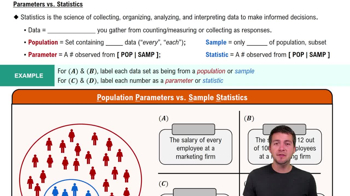
Parameters vs. Statistics

Sample Statistic

A sample statistic is a numerical value that summarizes a characteristic of a sample drawn from a population. It is used to estimate the corresponding population parameter. Sample statistics are denoted by symbols like 'x̄' for the sample mean or 'p̂' for the sample proportion. If the 47% figure were derived from a smaller group of voters rather than the entire population, it would be considered a sample statistic.
Recommended video:
05:11
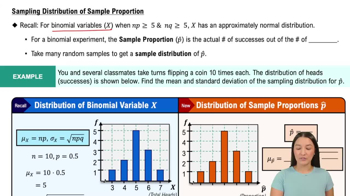
Sampling Distribution of Sample Proportion

Voter Registration Records

Voter registration records are official documents that track the registration status of voters within a specific jurisdiction. These records provide data on various demographic characteristics, including party affiliation. In this context, the records indicate that 47% of all registered voters in the county identify as Democrats, which is crucial for understanding the political landscape and making informed decisions based on the population parameter.
Recommended video:
Guided course
02:58
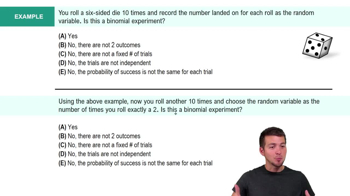
The Binomial Experiment Example 1
Related Practice
Textbook Question

Determine whether the data are qualitative or quantitative, and determine the level of measurement of the data set.

The top six final scores at the 2021 U.S. Women’s Figure Skating Championships are listed. (Source: NBC Sports)

232.61 215.33 214.98 213.39 199.95 178.89

212
views
Textbook Question

The items below appear on a physician’s intake form. Determine the level of measurement of the data for each category.


a. Temperature


b. Allergies


c. Weight


d. Pain level (scale of 0 to 10)

134
views
Textbook Question

A researcher wants to study the effects of sleep deprivation on motor skills. Eighteen people volunteer for the experiment: Jake, Arya, Xavier, Nyla, Shaniece, Chen, Juan, Hana, Nia, Ansel, Liam, Bruno, Mei, Zoey, Kayla, Liam, Sofia, and Kai. Use a random number generator to choose nine subjects for the treatment group. The other nine subjects will go into the control group. List the subjects in each group. Tell which method you used to generate the random numbers.

114
views
Textbook Question

Identify the sampling technique used, and discuss potential sources of bias (if any). Explain.

Soybeans are planted on a 48-acre field. The field is divided into one-acre subplots. A sample is taken from each subplot to estimate the harvest.

218
views
Textbook Question

Determine whether the statement is true or false. If it is false, rewrite it as a true statement.

Inferential statistics involves using a population to draw a conclusion about a corresponding sample.

199
views
Textbook Question

Determine whether the data are qualitative or quantitative. Explain your reasoning.

Ages of dogs at a rescue facility

207
views