Ch. 9 - Correlation and Regression
Larson - Elementary Statistics: Picturing the World 8th Edition
Larson8th EditionElementary Statistics: Picturing the WorldISBN: 9780137493470Not the one you use?Change textbook
Chapter 9, Problem 9.R.21

"In Exercises 19-24, construct the indicated prediction interval and interpret the results.
21. Construct a 95% prediction interval for the number of hours of sleep for an adult in Exercise 11 who is 45 years old."

Verified step by step guidance
1
Identify the regression equation from Exercise 11, which relates the number of hours of sleep (dependent variable) to age (independent variable). This equation typically has the form: ŷ = b0 + b1x, where ŷ is the predicted value, b_0 is the intercept, b_1 is the slope, and x is the age.
Calculate the predicted number of hours of sleep for a 45-year-old by substituting x = 45 into the regression equation to find ŷ.
Determine the standard error of the prediction, which accounts for both the variability of the estimate of the mean response and the individual variability around the regression line. The formula for the standard error of prediction is: SE_{pred} = s \(\sqrt{1 + \frac{1}{n}\) + \(\frac{(x - \bar{x}\))^2}{\(\sum\) (x_i - \(\bar{x}\))^2}}, where s is the standard error of the estimate, n is the sample size, \(\bar{x}\) is the mean of the predictor values, and x is the specific value (45 in this case).
Find the critical t-value for a 95% prediction interval with n - 2 degrees of freedom from the t-distribution table.
Construct the 95% prediction interval using the formula: ŷ \(\pm\) t_{\(\alpha\)/2, n-2} \(\times\) SE_{pred}. This interval estimates the range in which the number of hours of sleep for an individual 45-year-old adult is likely to fall with 95% confidence.

Verified video answer for a similar problem:

This video solution was recommended by our tutors as helpful for the problem above.
Video duration:
6m
Was this helpful?

Key Concepts

Here are the essential concepts you must grasp in order to answer the question correctly.

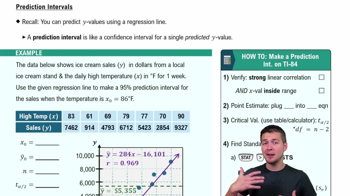
Prediction Interval

A prediction interval estimates the range within which a single new observation is expected to fall, with a specified level of confidence. Unlike confidence intervals for the mean, prediction intervals account for both the variability in the estimate and the individual data point's variability.
Recommended video:
Guided course
09:00
Prediction Intervals

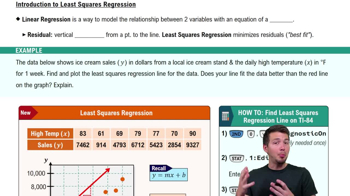
Regression Analysis

Regression analysis models the relationship between a dependent variable and one or more independent variables. In this context, it helps predict the number of hours of sleep based on age, providing the basis for constructing prediction intervals.
Recommended video:
Guided course
07:01
Intro to Least Squares Regression

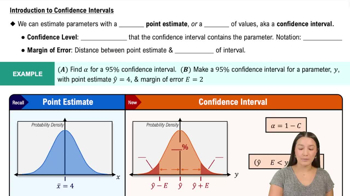
Confidence Level (95%)

The confidence level indicates the probability that the interval contains the true value. A 95% confidence level means that if we repeated the sampling many times, 95% of the constructed intervals would contain the actual value of the predicted observation.
Recommended video:
06:33
Introduction to Confidence Intervals
Related Practice
Textbook Question

"In Exercises 27 and 28, use the multiple regression equation to predict the y-values for the values of the independent variables.

28. Use the regression equation found in Exercise 25.

a. x_1 = 9.0, x_2 = 0.70

b. x_1 = 3.0, x_2 = 0.25

c. x_1 = 8.0, x_2 = 0.60

d. x_1 = 5.2, x_2 = 0.46"

43
views
Textbook Question

"In Exercises 13-16, use the value of the correlation coefficient r to calculate the coefficient of determination r^2. What does this tell you about the explained variation of the data about the regression line? about the unexplained variation?

13. r =- 0.450"

58
views
Textbook Question

"In Exercises 13-16, use the value of the correlation coefficient r to calculate the coefficient of determination r^2. What does this tell you about the explained variation of the data about the regression line? about the unexplained variation?

15. r = 0.642"

140
views
Textbook Question

"In Exercises 19-24, construct the indicated prediction interval and interpret the results.

22. Construct a 95% prediction interval for the fuel efficiency of an automobile in Exercise 12 that has an engine displacement of 265 cubic inches."

58
views
Textbook Question

"In Exercises 13-16, use the value of the correlation coefficient r to calculate the coefficient of determination r^2. What does this tell you about the explained variation of the data about the regression line? about the unexplained variation?

14.r =- 0.937"

69
views
Textbook Question

"The U.S. Food and Drug Administration (FDA) requires nutrition labeling for most foods. Un FDA regulations, manufacturers are required to list the amounts of certain nutrients in their foods, such as calories, sugar, fat, and carbohydrates. This nutritional information is displayed in the ""Nutrition Facts"" panel on the food's package.

The table shows the nutritional content below for one cup of each of 21 different breakfast

cereals.

C = calories

S = sugar in grams

F = fat in grams

R = carbohydrates in grams

7. Use the equations from Exercise 6 to predict the calories in 1 cup of cereal that has 7 grams of sugar, 0.5 gram of fat, and 31 grams of carbohydrates."

50
views