Ch. 1 - Introduction to Statistics
Larson - Elementary Statistics: Picturing the World 8th Edition
Larson8th EditionElementary Statistics: Picturing the WorldISBN: 9780137493470Not the one you use?Change textbook
Chapter 1, Problem 1.T.2

Determine whether each number describes a population parameter or a sample statistic. Explain.
In a recent year, the average evidence-based reading and writing score on the SAT was 528. (Source: College Board)

Verified step by step guidance
1
Understand the definitions: A population parameter is a numerical value that describes a characteristic of an entire population, while a sample statistic is a numerical value that describes a characteristic of a subset (sample) of the population.
Identify the context of the problem: The problem states that the average evidence-based reading and writing score on the SAT was 528 for a recent year. This value is based on all test-takers in that year, as it is provided by the College Board, which collects data for the entire population of SAT test-takers.
Determine whether the value represents a population parameter or a sample statistic: Since the value of 528 is based on the entire population of SAT test-takers for that year, it is a population parameter.
Explain the reasoning: A population parameter is used when the data represents the entire group being studied. In this case, the College Board has access to the scores of all SAT test-takers, so the average score of 528 is a parameter, not a statistic.
Conclude: The number 528 describes a population parameter because it summarizes a characteristic (average score) of the entire population of SAT test-takers for that year.

Verified video answer for a similar problem:

This video solution was recommended by our tutors as helpful for the problem above.
Video duration:
1m
Was this helpful?

Key Concepts

Here are the essential concepts you must grasp in order to answer the question correctly.

Population Parameter

A population parameter is a numerical value that summarizes a characteristic of an entire population. It is a fixed value, often unknown, and is typically estimated through statistical methods. In the context of the SAT score, if the average score of 528 represents all test-takers in a given year, it is a population parameter.
Recommended video:
Guided course
05:53
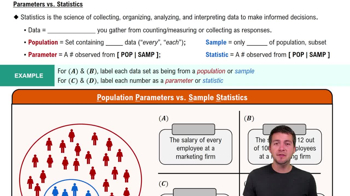
Parameters vs. Statistics

Sample Statistic

A sample statistic is a numerical value that summarizes a characteristic of a sample, which is a subset of the population. Sample statistics are used to estimate population parameters and can vary from sample to sample. If the average SAT score of 528 was calculated from a smaller group of test-takers rather than all, it would be considered a sample statistic.
Recommended video:
05:11
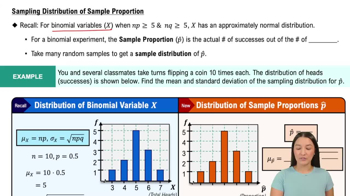
Sampling Distribution of Sample Proportion

Descriptive Statistics

Descriptive statistics are methods for summarizing and organizing data to describe the main features of a dataset. This includes measures such as mean, median, mode, and standard deviation. The average SAT score of 528 is an example of descriptive statistics, as it provides a summary measure of the reading and writing scores for the population or sample in question.
Recommended video:
Guided course
05:53
Parameters vs. Statistics