Ch. 1 - Introduction to Statistics
Larson - Elementary Statistics: Picturing the World 8th Edition
Larson8th EditionElementary Statistics: Picturing the WorldISBN: 9780137493470Not the one you use?Change textbook
Chapter 1, Problem 1.RE.6

Determine whether the number describes a population parameter or a sample statistic. Explain your reasoning.
In a survey of 1000 household food purchasers, 24.7% say that they avoid meat, dairy, and eggs produced by animals living in confined conditions. (Source: FoodPrint)

Verified step by step guidance
1
Identify the key terms in the problem: A population parameter refers to a numerical value that describes a characteristic of an entire population, while a sample statistic refers to a numerical value that describes a characteristic of a subset (sample) of the population.
Examine the context of the problem: The problem mentions a survey of 1000 household food purchasers. This indicates that the data was collected from a subset of the entire population of household food purchasers.
Determine whether the percentage provided (24.7%) is based on the entire population or just the sample: Since the survey was conducted on 1000 individuals, this percentage represents a characteristic of the sample, not the entire population.
Conclude that the number 24.7% is a sample statistic because it is derived from a subset of the population (the 1000 surveyed individuals) rather than the entire population of household food purchasers.
Explain the reasoning: A sample statistic is used to estimate or infer information about the population parameter. In this case, the 24.7% is an estimate of the proportion of all household food purchasers who avoid meat, dairy, and eggs produced by animals in confined conditions.

Verified video answer for a similar problem:

This video solution was recommended by our tutors as helpful for the problem above.
Video duration:
1m
Was this helpful?

Key Concepts

Here are the essential concepts you must grasp in order to answer the question correctly.

Population Parameter

A population parameter is a numerical value that summarizes a characteristic of an entire population. It is a fixed value that is often unknown and can only be estimated through sampling. In the context of the question, if the percentage of 24.7% were derived from the entire population of household food purchasers, it would be considered a population parameter.
Recommended video:
Guided course
05:53
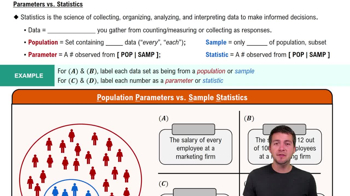
Parameters vs. Statistics

Sample Statistic

A sample statistic is a numerical value that summarizes a characteristic of a sample drawn from a population. It is used to estimate the corresponding population parameter. In this case, the 24.7% figure comes from a survey of 1000 households, making it a sample statistic that reflects the behavior of a subset of the larger population of all household food purchasers.
Recommended video:
05:11
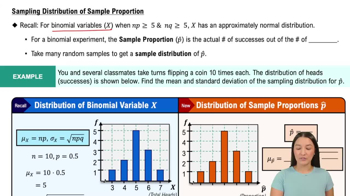
Sampling Distribution of Sample Proportion

Sampling Methodology

Sampling methodology refers to the techniques used to select individuals from a population to participate in a study. The validity of a sample statistic depends on how representative the sample is of the population. Understanding the sampling method used in the survey is crucial for assessing the reliability of the 24.7% statistic and determining whether it can be generalized to the entire population.
Recommended video:
05:11
Sampling Distribution of Sample Proportion