Ch. 1 - Introduction to Statistics
Larson - Elementary Statistics: Picturing the World 8th Edition
Larson8th EditionElementary Statistics: Picturing the WorldISBN: 9780137493470Not the one you use?Change textbook
Chapter 1, Problem 1.2.29

Determine whether the data are qualitative or quantitative, and determine the level of measurement of the data set.
Census Regions The four geographical regions of the United States recognized by the U.S. Census Bureau are listed.
Northeast, South, Midwest, West

Verified step by step guidance
1
Step 1: Understand the difference between qualitative and quantitative data. Qualitative data describes categories or qualities and is non-numerical, while quantitative data represents numerical values that can be measured or counted.
Step 2: Analyze the given data set. The data consists of geographical regions: Northeast, South, Midwest, and West. These are names of categories rather than numerical values, indicating that the data is qualitative.
Step 3: Determine the level of measurement for qualitative data. Qualitative data can be classified as either nominal or ordinal. Nominal data represents categories without any inherent order, while ordinal data has a meaningful order.
Step 4: Assess whether the geographical regions have a meaningful order. In this case, the regions (Northeast, South, Midwest, West) are simply names of categories without any inherent ranking or order, so the level of measurement is nominal.
Step 5: Conclude that the data is qualitative and its level of measurement is nominal, as the regions are non-numerical categories without a meaningful order.

Verified video answer for a similar problem:

This video solution was recommended by our tutors as helpful for the problem above.
Video duration:
3m
Was this helpful?

Key Concepts

Here are the essential concepts you must grasp in order to answer the question correctly.

Qualitative vs. Quantitative Data

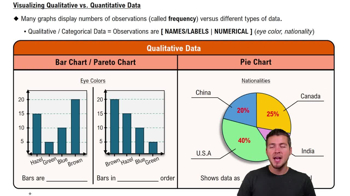
Qualitative data refers to non-numerical information that describes characteristics or qualities, such as names or categories. In contrast, quantitative data consists of numerical values that can be measured or counted, allowing for statistical analysis. Understanding the distinction is crucial for determining how to analyze and interpret the data.
Recommended video:
Guided course
04:39
Visualizing Qualitative vs. Quantitative Data

Levels of Measurement

The levels of measurement categorize data based on the nature of the information they represent. There are four levels: nominal, ordinal, interval, and ratio. Nominal data represents categories without a specific order, while ordinal data has a defined order. Recognizing the level of measurement helps in selecting appropriate statistical methods for analysis.
Recommended video:
Guided course
10:28
Difference in Proportions: Hypothesis Tests Example 1

Nominal Data

Nominal data is a type of qualitative data that consists of categories without any inherent order or ranking. Examples include names of regions, colors, or types of animals. In the context of the question, the U.S. Census Regions (Northeast, South, Midwest, West) are nominal data, as they simply categorize geographical areas without implying any hierarchy.
Recommended video:
Guided course
04:39
Visualizing Qualitative vs. Quantitative Data