
Ch. 1 - Introduction to Statistics
Larson - Elementary Statistics: Picturing the World 8th Edition
Larson8th EditionElementary Statistics: Picturing the WorldISBN: 9780137493470Not the one you use?Change textbook
Chapter 1, Problem 1.RE.12

Determine whether the data are qualitative or quantitative. Explain your reasoning.
The zip codes of a sample of 200 customers at a sporting goods store

Verified step by step guidance
1
Identify the type of data being analyzed. In this case, the data consists of zip codes, which are numerical identifiers assigned to geographic regions.
Understand the distinction between qualitative and quantitative data. Qualitative data describes categories or qualities (e.g., colors, names, or labels), while quantitative data represents numerical values that can be measured or counted (e.g., height, weight, or age).
Consider whether the zip codes represent measurable quantities or simply serve as labels. Zip codes are not used to measure or count anything; instead, they categorize geographic areas.
Conclude that zip codes are qualitative data because they are used as labels to identify regions rather than as numerical values with inherent mathematical meaning.
Explain that even though zip codes are represented as numbers, their purpose is categorical, not quantitative, which makes them qualitative data.

Verified video answer for a similar problem:

This video solution was recommended by our tutors as helpful for the problem above.
Video duration:
1m
Was this helpful?

Key Concepts

Here are the essential concepts you must grasp in order to answer the question correctly.

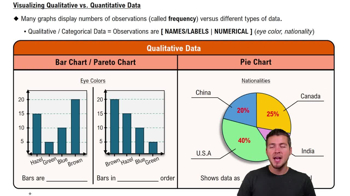
Qualitative Data

Qualitative data refers to non-numeric information that describes characteristics or qualities. It is often categorical, meaning it can be divided into groups or categories based on attributes. Examples include names, colors, or zip codes, which provide descriptive insights rather than measurable quantities.
Recommended video:
Guided course
04:39
Visualizing Qualitative vs. Quantitative Data

Quantitative Data

Quantitative data consists of numeric values that can be measured and analyzed statistically. This type of data can be further classified into discrete data, which can take specific values, and continuous data, which can take any value within a range. Examples include height, weight, or sales figures, which allow for mathematical operations.
Recommended video:
Guided course
04:39
Visualizing Qualitative vs. Quantitative Data

Zip Codes as Data

Zip codes are a specific type of qualitative data, as they categorize geographic areas without providing numerical measurements. While they consist of numbers, zip codes serve to identify locations rather than quantify them. Therefore, when analyzing zip codes, one should treat them as labels that represent different regions rather than as numerical data.
Recommended video:
Guided course
04:39
Visualizing Qualitative vs. Quantitative Data
Related Practice
Textbook Question

Determine whether the number describes a population parameter or a sample statistic. Explain your reasoning.

In a survey of 1000 household food purchasers, 24.7% say that they avoid meat, dairy, and eggs produced by animals living in confined conditions. (Source: FoodPrint)

240
views
Textbook Question

Determine whether the data are qualitative or quantitative. Explain your reasoning.

The marital statuses of the employees of a casino

237
views
Textbook Question

An experiment is performed to test the effects of a new drug on attention-deficit/hyperactivity disorder (ADHD). The experimenter identifies 320 people ages 7 to 44 with ADHD to participate in the experiment. The subjects are divided into equal groups according to age. Within each group, subjects are then randomly selected to be in either the treatment group or the control group. What type of experimental design is being used for this experiment?

193
views
Textbook Question

Which part of the survey described in Exercise 3 represents the descriptive branch of statistics? Make an inference based on the results of the survey.

158
views
Textbook Question

Identify the population and the sample. Describe the sample data set.

Eighty-three doctors working in the St. Louis area were surveyed concerning their opinions on health care reform.

269
views
Textbook Question

Determine the level of measurement of the data set. Explain.

The total compensations (in millions of dollars) of the ten highest-paid CEOs at U.S. public companies are listed. (Source: 24/7 Wall St.)

280.6 66.9 42.9 36.5 34.3 31.6 31.6 28.8 26.4 25.8

156
views