Ch. 2 - Descriptive Statistics
Larson - Elementary Statistics: Picturing the World 8th Edition
Larson8th EditionElementary Statistics: Picturing the WorldISBN: 9780137493470Not the one you use?Change textbook
Chapter 2, Problem 2.5.15b

Drawing a Box-and-Whisker Plot In Exercises 15–18,
(b) draw a box-and-whisker plot that represents the data set.


39 36 30 27 26 24 28 35 39 60 50 41 35 32 51

Verified step by step guidance
1
Step 1: Organize the data set in ascending order. The given data set is: 39, 36, 30, 27, 26, 24, 28, 35, 39, 60, 50, 41, 35, 32, 51. Arrange these values from smallest to largest.
Step 2: Identify the five-number summary of the data set. This includes the minimum value, first quartile (Q1), median (Q2), third quartile (Q3), and maximum value. Use the ordered data to calculate these values.
Step 3: Calculate the interquartile range (IQR) by subtracting Q1 from Q3. The formula is: IQR = Q3 - Q1. This will help determine the range of the box in the plot.
Step 4: Draw a number line that includes the range of the data. Mark the five-number summary (minimum, Q1, median, Q3, and maximum) on the number line. Draw a box from Q1 to Q3, with a vertical line at the median. Extend whiskers from the box to the minimum and maximum values.
Step 5: Check for outliers using the 1.5 * IQR rule. Any data point below Q1 - 1.5 imes IQR or above Q3 + 1.5 imes IQR is considered an outlier. Adjust the whiskers accordingly if outliers are present.

Verified video answer for a similar problem:

This video solution was recommended by our tutors as helpful for the problem above.
Video duration:
4m
Was this helpful?

Key Concepts

Here are the essential concepts you must grasp in order to answer the question correctly.

Box-and-Whisker Plot

A box-and-whisker plot is a graphical representation of a data set that displays its minimum, first quartile, median, third quartile, and maximum. The 'box' shows the interquartile range (IQR), which contains the middle 50% of the data, while the 'whiskers' extend to the smallest and largest values within 1.5 times the IQR from the quartiles. This plot helps visualize the distribution, central tendency, and variability of the data.
Recommended video:
Guided course
07:38
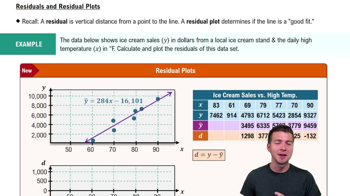
Residuals and Residual Plots

Quartiles

Quartiles are values that divide a data set into four equal parts, each containing 25% of the data. The first quartile (Q1) is the median of the lower half of the data, the second quartile (Q2) is the overall median, and the third quartile (Q3) is the median of the upper half. Understanding quartiles is essential for constructing a box-and-whisker plot, as they determine the boundaries of the box and the placement of the median.
Recommended video:
Guided course
04:51
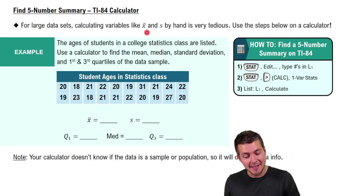
Find 5-Number Summary - TI-84 Calculator

Interquartile Range (IQR)

The interquartile range (IQR) is a measure of statistical dispersion that represents the range between the first quartile (Q1) and the third quartile (Q3). It is calculated as IQR = Q3 - Q1 and indicates the spread of the middle 50% of the data. The IQR is crucial for identifying outliers and is used to determine the length of the box in a box-and-whisker plot, providing insight into the variability of the data set.
Recommended video:
Guided course
05:45
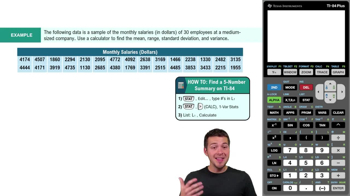
Find 5-Number Summary - TI-84 Calculator Example 1
Related Practice
Textbook Question

Drawing a Box-and-Whisker Plot In Exercises 15–18,

(b) draw a box-and-whisker plot that represents the data set.


171 176 182 150 178 180 173 170 174 178 181 180

124
views

Textbook Question

Drawing a Box-and-Whisker Plot In Exercises 15–18,

(b) draw a box-and-whisker plot that represents the data set.


4 7 7 5 2 9 7 6 8 5 8 4 1 5 2 8 7 6 6 9

173
views
Textbook Question

What Would You Do? You work at a bank and are asked to recommend the amount of cash to put in an ATM each day. You do not want to put in too much (which would cause security concerns) or too little (which may create customer irritation). The daily withdrawals (in hundreds of dollars) for 30 days are listed. 72 84 61 76 104 76 86 92 80 88 98 76 97 82 84 67 70 81 82 89 74 73 86 81 85 78 82 80 91 83

If you put \$9000 in the ATM each day, what percent of the days in a month should you expect to run out of cash? Explain.

119
views
Textbook Question

Use the relative frequency histogram to

approximate the greatest and least relative frequencies.

179
views
Textbook Question

Life Spans of Fruit Flies The life spans of a species of fruit fly have a bell-shaped distribution, with a mean of 33 days and a standard deviation of 4 days.


b. The life spans of three randomly selected fruit flies are 29 days, 41 days, and 25 days. Using the Empirical Rule, find the percentile that corresponds to each life span.

137
views
Textbook Question

Extending Concepts


Golf The distances (in yards) for nine holes of a golf course are listed.

336 393 408 522 147 504 177 375 360


b. Convert the distances to feet. Then rework part (a).

123
views