
Ch. 2 - Descriptive Statistics
Larson - Elementary Statistics: Picturing the World 8th Edition
Larson8th EditionElementary Statistics: Picturing the WorldISBN: 9780137493470Not the one you use?Change textbook
Chapter 2, Problem 2.5.20

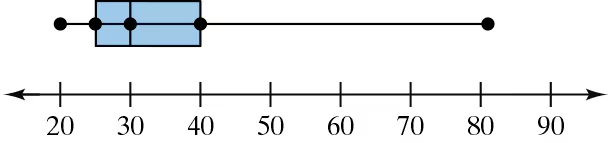
Graphical Analysis In Exercises 19–22, use the box-and-whisker plot to determine whether the shape of the distribution represented is symmetric, skewed left, skewed right, or none of these. Justify your answer.
Box-and-whisker plot showing data distribution with a range from 20 to 90, highlighting median and quartiles.

Verified step by step guidance
1
Examine the box-and-whisker plot. Identify the positions of the minimum, first quartile (Q1), median, third quartile (Q3), and maximum values on the number line.
Observe the length of the whiskers on both sides of the box. The left whisker (from the minimum to Q1) is shorter than the right whisker (from Q3 to the maximum). This indicates that the data is not symmetric.
Compare the position of the median within the box. The median is closer to Q1 than Q3, which further suggests that the distribution is not symmetric.
Determine the skewness of the distribution. Since the right whisker is longer and the median is closer to Q1, the distribution is skewed right.
Justify the conclusion: A right-skewed distribution typically has a longer tail on the right side, and the median is closer to the lower quartile. This matches the characteristics observed in the box-and-whisker plot.

Verified video answer for a similar problem:

This video solution was recommended by our tutors as helpful for the problem above.
Video duration:
3m
Was this helpful?

Key Concepts

Here are the essential concepts you must grasp in order to answer the question correctly.

Box-and-Whisker Plot

A box-and-whisker plot is a graphical representation of a dataset that displays its minimum, first quartile, median, third quartile, and maximum. The 'box' shows the interquartile range (IQR), which contains the middle 50% of the data, while the 'whiskers' extend to the smallest and largest values within 1.5 times the IQR from the quartiles. This plot helps visualize the distribution and identify potential outliers.
Recommended video:
03:54
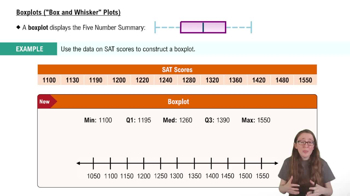
Boxplots ("Box and Whisker Plots")

Distribution Shape

The shape of a distribution refers to how data points are spread across the range of values. Common shapes include symmetric, where data is evenly distributed around the center; skewed left, where more data points are concentrated on the right; and skewed right, where more data points are on the left. Understanding the shape is crucial for interpreting data characteristics and making statistical inferences.
Recommended video:
05:11
Sampling Distribution of Sample Proportion

Median and Quartiles

The median is the middle value of a dataset when arranged in ascending order, dividing the data into two equal halves. Quartiles are values that divide the dataset into four equal parts: the first quartile (Q1) is the median of the lower half, the second quartile (Q2) is the overall median, and the third quartile (Q3) is the median of the upper half. These measures are essential for understanding the central tendency and spread of the data.
Recommended video:
07:11
Percentiles and Quartiles
Related Practice
Textbook Question

Finding the Mean of a Frequency Distribution In Exercises 49–52, approximate the mean of the frequency distribution.


Populations The populations (in thousands) of the counties in Montana in 2019 (Source: U.S. Census Bureau)

126
views
Textbook Question

Constructing a Frequency Distribution and a Frequency Polygon In Exercises 35 and 36, construct a frequency distribution and a frequency polygon for the data set using the indicated number of classes. Describe any patterns.

Declaration of Independence

Number of classes: 5

Data set: Number of children of those who signed the Declaration of Independence (Source: The U.S. National Archives & Records Administration) 5 2 12 18 7 4 10 8 16 3 3 7 3 1 2 7 13 0 8 3 7 5 2 6 0 6 7 9 0 11 9 10 7 8 13 5 8 3 5 0 3 13 3 15 5 6 3 2 5 2 0 3 7 12 4 1

95
views
Textbook Question

Using and Interpreting Concepts


Finding and Discussing the Mean, Median, and Mode In Exercises 17–34, find the mean, the median, and the mode of the data, if possible. If any measure cannot be found or does not represent the center of the data, explain why.


Video Durations The lengths (in minutes) of seven educational videos from the Public Broadcasting Service (PBS) (Source: PBS)

83 67 90 55 56 119 52

102
views
Textbook Question

In Exercises 37– 40, without performing any calculations, determine which measure of central tendency best represents the graphed data. Explain your reasoning.


" style="" width="300">

88
views
Textbook Question

Graphing Data Sets In Exercises 17–32, organize the data using the indicated type of graph. Describe any patterns.


Smartphone Sales The five best-selling smartphone manufacturers of 2020 were Apple (206.1 million units), Huawei (189.0 million units), Samsung (266.7 million units), vivo (111.7 million units), and Xiaomi (147.8 million units). Use a Pareto chart to display the data. (Source: International Data Corporation)

145
views
Textbook Question

Comparing Variation in Different Data Sets In Exercises 45–50, find the coefficient of variation for each of the two data sets. Then compare the results.

Annual Salaries Sample annual salaries (in thousands of dollars) for entry level architects in Denver, CO, and Los Angeles, CA, are listed.

156
views