
Ch. 2 - Descriptive Statistics
Larson - Elementary Statistics: Picturing the World 8th Edition
Larson8th EditionElementary Statistics: Picturing the WorldISBN: 9780137493470Not the one you use?Change textbook
Chapter 2, Problem 2.5.11b

Using and Interpreting Concepts


Using and Interpreting Concepts Finding Quartiles, Interquartile Range, and Outliers In Exercises 11 and 12,
(b) find the interquartile range


56 63 51 60 57 60 60 54 63 59 80 63 60 62 65

Verified step by step guidance
1
Step 1: Arrange the data set in ascending order. The given data set is: 56, 63, 51, 60, 57, 60, 60, 54, 63, 59, 80, 63, 60, 62, 65. Sorting it will help identify quartiles more easily.
Step 2: Divide the sorted data set into two halves to find the median (Q2). The median is the middle value of the data set when arranged in order. If the number of data points is odd, the median is the middle value. If even, it is the average of the two middle values.
Step 3: Identify the first quartile (Q1) and third quartile (Q3). Q1 is the median of the lower half of the data (excluding the overall median), and Q3 is the median of the upper half of the data (excluding the overall median).
Step 4: Calculate the interquartile range (IQR) using the formula: IQR=Q3-Q1. The IQR measures the spread of the middle 50% of the data.
Step 5: Determine outliers using the IQR. Outliers are values that fall below Q1-1.5×IQR or above Q3+1.5×IQR. Identify any values in the data set that meet these criteria.

Verified video answer for a similar problem:

This video solution was recommended by our tutors as helpful for the problem above.
Video duration:
3m
Was this helpful?

Key Concepts

Here are the essential concepts you must grasp in order to answer the question correctly.

Quartiles

Quartiles are values that divide a data set into four equal parts, each containing 25% of the data. The first quartile (Q1) is the median of the lower half of the data, the second quartile (Q2) is the overall median, and the third quartile (Q3) is the median of the upper half. Understanding quartiles is essential for analyzing the spread and central tendency of a data set.
Recommended video:
Guided course
04:51
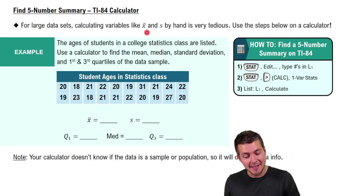
Find 5-Number Summary - TI-84 Calculator

Interquartile Range (IQR)

The interquartile range (IQR) is a measure of statistical dispersion, calculated as the difference between the third quartile (Q3) and the first quartile (Q1). It represents the range within which the central 50% of the data lies, making it a robust measure of variability that is less affected by outliers compared to the overall range.
Recommended video:
Guided course
05:45
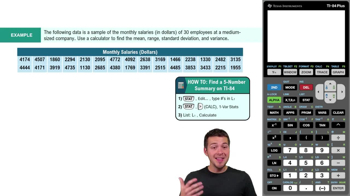
Find 5-Number Summary - TI-84 Calculator Example 1

Outliers

Outliers are data points that significantly differ from the other observations in a data set. They can skew the results and affect statistical analyses. Identifying outliers often involves using the IQR; a common rule is that any data point below Q1 - 1.5 * IQR or above Q3 + 1.5 * IQR is considered an outlier, which helps in understanding the data's distribution.
Recommended video:
Guided course
04:48
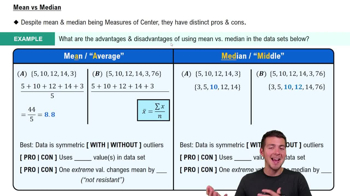
Comparing Mean vs. Median
Related Practice
Textbook Question

Shifting Data Sample annual salaries (in thousands of dollars) for employees at a company are listed.

40   35   49   53   38   39   40

37   49   34   38   43   47   35


c. Each employee in the sample takes a pay cut of \$2000 from their original salary. Find the sample mean and the sample standard deviation for the revised data set.

77
views
Textbook Question

Hourly Earnings Refer to the data set in Exercise 26 and the box-and-whisker plot you drew that represents the data set.


b. What percent of the employees made more than \$23.39 per hour?

86
views
Textbook Question

Mean Absolute Deviation Another useful measure of variation for a data set is the mean absolute deviation (MAD). It is calculated by the formula

MAD = Σ |x − x̄| / n.

b. Find the mean absolute deviation of the data set in Exercise 16. Compare your result with the sample standard deviation obtained in Exercise 16.

198
views
Textbook Question

Life Spans of Tires A brand of automobile tire has a mean life span of 35,000 miles, with a standard deviation of 2250 miles. Assume the life spans of the tires have a bell-shaped distribution.


b. The life spans of three randomly selected tires are 30,500 miles, 37,250 miles, and 35,000 miles. Using the Empirical Rule, find the percentile that corresponds to each life span.

159
views
Textbook Question

Extending Concepts


Trimmed Mean To find the 10% trimmed mean of a data set, order the data, delete the lowest 10% of the entries and the highest 10% of the entries, and find the mean of the remaining entries.


b. Compare the four measures of central tendency, including the midrange.

92
views
Textbook Question

Use the ogive to approximate

the height for which the cumulative frequency is 15.

263
views