
Ch. 3 - Probability
Larson - Elementary Statistics: Picturing the World 8th Edition
Larson8th EditionElementary Statistics: Picturing the WorldISBN: 9780137493470Not the one you use?Change textbook
Chapter 3, Problem 3.1.43

Finding Classical Probabilities In Exercises 41-46, a probability experiment consists of rolling a 12-sided die numbered 1 to 12. Find the probability of the event.
43. Event C: rolling a number greater than 4

Verified step by step guidance
1
Step 1: Understand the problem. The experiment involves rolling a 12-sided die, and we are tasked with finding the probability of rolling a number greater than 4. Classical probability is calculated as the ratio of favorable outcomes to the total number of possible outcomes.
Step 2: Identify the total number of possible outcomes. Since the die is 12-sided, the total number of outcomes is 12. This represents all the numbers from 1 to 12.
Step 3: Determine the favorable outcomes. The event 'rolling a number greater than 4' includes all numbers greater than 4, which are {5, 6, 7, 8, 9, 10, 11, 12}. Count these numbers to find the number of favorable outcomes.
Step 4: Write the formula for classical probability. The probability of an event is given by: Number of favorable outcomesTotal number of possible outcomes
Step 5: Substitute the values into the formula. The number of favorable outcomes is the count of numbers greater than 4, and the total number of possible outcomes is 12. Simplify the fraction to express the probability.

Verified video answer for a similar problem:

This video solution was recommended by our tutors as helpful for the problem above.
Video duration:
1m
Was this helpful?

Key Concepts

Here are the essential concepts you must grasp in order to answer the question correctly.

Classical Probability

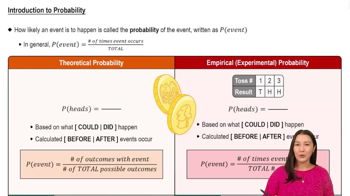
Classical probability is defined as the ratio of the number of favorable outcomes to the total number of possible outcomes in a probability experiment. It assumes that all outcomes are equally likely. For example, when rolling a 12-sided die, the total outcomes are 12, and the probability of rolling a specific number is 1/12.
Recommended video:
5:37
Introduction to Probability

Favorable Outcomes

Favorable outcomes refer to the specific results of an experiment that satisfy the conditions of the event being analyzed. In the context of rolling a die, if the event is rolling a number greater than 4, the favorable outcomes would be the numbers 5, 6, 7, 8, 9, 10, 11, and 12, totaling 8 favorable outcomes.
Recommended video:
Guided course
06:00
The Binomial Experiment

Calculating Probability

To calculate the probability of an event, you divide the number of favorable outcomes by the total number of possible outcomes. For the event of rolling a number greater than 4 on a 12-sided die, the probability would be calculated as 8 (favorable outcomes) divided by 12 (total outcomes), resulting in a probability of 2/3.
Recommended video:
Guided course
07:09
Probability From Given Z-Scores - TI-84 (CE) Calculator
Related Practice
Textbook Question

According to Bayes’ Theorem, the probability of event A , given that event B has occurred, is

P(A|B) = P(A) * P(B|A)P(A) * P(B|A) + P(A') * P(B|A').

In Exercises 33–38, use Bayes’ Theorem to find P(A|B).

33. P(A) = 2/3, P(A') = 1/3, P(B|A) = 1/5 , and P(B|A') = 1/2

237
views
Textbook Question

Using a Tree Diagram In Exercises 67-70, a probability experiment consists of rolling a six-sided die and spinning the spinner shown at the left. The spinner is equally likely to land on each color. Use a tree diagram to find the probability of the event. Then explain whether the event can be considered unusual.

68. Event B: rolling an odd number and the spinner landing on green

86
views
Textbook Question

"True or False? In Exercises 5 and 6, determine whether the statement is true or false. If it is false, rewrite it as a true statement.

5. If two events are independent, then P(A|B) = P(B)."

37
views
Textbook Question

Matching Probabilities In Exercises 11-16, match the event with its probability.

a. 0.95

b. 0.005

c. 0.25

d. 0

e. 0.375

f. 0.5

11. A random number generator is used to select a number from 1 to 100. What is the probability of selecting the number 153?

111
views
Textbook Question

Cards In Exercises 59-62, you are dealt a hand of five cards from a standard deck of 52 playing cards.

59. Find the probability of being dealt two clubs and one of each of the other three suits.

116
views
Textbook Question

Finding the Probability of an Event In Exercises 21-24, the probability that an event will not happen is given. Find the probability that the event will happen. 

23. P(E')=3/4

256
views