
Ch. 3 - Probability
Larson - Elementary Statistics: Picturing the World 8th Edition
Larson8th EditionElementary Statistics: Picturing the WorldISBN: 9780137493470Not the one you use?Change textbook
Chapter 3, Problem 3.4.9

In Exercises 7-14, perform the indicated calculation.
9.8C3

Verified step by step guidance
1
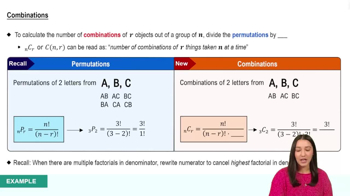
Step 1: Understand the problem. The notation 9.8C3 represents a combination calculation, where we are selecting 3 items from a total of 9.8 items. The formula for combinations is given by: n!r!(n-r)!, where n is the total number of items, r is the number of items to choose, and '!' denotes factorial.
Step 2: Substitute the values into the formula. Here, n = 9.8 and r = 3. The formula becomes: (9.8)!(3)!(9.8-3)!.
Step 3: Simplify the denominator. Calculate (n - r), which is 9.8 - 3 = 6.8. The denominator now becomes: (3)!(6.8)!.
Step 4: Factorials for non-integer values like 9.8! and 6.8! are calculated using the Gamma function, which extends the factorial function to real numbers. You would use a calculator or software capable of handling Gamma functions to compute these values.
Step 5: Divide the result of 9.8! by the product of 3! and 6.8! to find the combination value. Ensure all calculations are performed accurately using appropriate tools.

Verified video answer for a similar problem:

This video solution was recommended by our tutors as helpful for the problem above.
Video duration:
2m
Was this helpful?

Key Concepts

Here are the essential concepts you must grasp in order to answer the question correctly.

Combinations

Combinations refer to the selection of items from a larger set where the order of selection does not matter. The notation 'nCr' or 'C(n, r)' represents the number of ways to choose 'r' items from 'n' items. This concept is crucial in probability and statistics, especially when determining possible outcomes in scenarios where arrangement is irrelevant.
Recommended video:
05:22
Combinations

Factorial

A factorial, denoted as 'n!', is the product of all positive integers up to 'n'. It is used in combinations and permutations to calculate the total arrangements of a set. For example, 5! equals 5 × 4 × 3 × 2 × 1 = 120. Understanding factorials is essential for performing calculations involving combinations and permutations.
Recommended video:
05:22
Combinations

Binomial Coefficient

The binomial coefficient, often represented as 'C(n, r)' or 'nCr', quantifies the number of ways to choose 'r' elements from a set of 'n' elements without regard to the order of selection. It is calculated using the formula C(n, r) = n! / (r!(n-r)!), which incorporates factorials. This concept is fundamental in combinatorial mathematics and probability theory.
Recommended video:
Guided course
06:14
Coefficient of Determination
Related Practice
Textbook Question

Identifying the Sample Space of a Probability Experiment In Exercises 25-32, identify the sample space of the probability experiment and determine the number of outcomes in the sample space. Draw a tree diagram when appropriate.

32. Rolling a six-sided die, tossing two coins, and spinning the fair spinner shown

157
views
Textbook Question

Using the Fundamental Counting Principle In Exercises 37-40, use the Fundamental Counting Principle.

37. Menu A restaurant offers a \$15 dinner special that lets you choose from 6 appetizers, 12 entrées, and 8 desserts. How many different meals are available when you select an appetizer, an entrée, and a dessert?

224
views
Textbook Question

Identifying the Sample Space of a Probability Experiment In Exercises 25-32, identify the sample space of the probability experiment and determine the number of outcomes in the sample space. Draw a tree diagram when appropriate.

31. Rolling a pair of six-sided dice

107
views
Textbook Question

Identifying the Sample Space of a Probability Experiment In Exercises 25-32, identify the sample space of the probability experiment and determine the number of outcomes in the sample space. Draw a tree diagram when appropriate.

28. Identifying a person's eye color (brown, blue, green, hazel, gray, other) and hair color (black, brown, blonde, red, other).

113
views
Textbook Question

31. Experiment A researcher is randomly selecting a treatment group of 10 human subjects from a group of 20 people taking part in an experiment. In how many different ways can the treatment group be selected?

182
views
Textbook Question

Using a Frequency Distribution to Find Probabilities In Exercises 49-52, use the frequency distribution at the left, which shows the population of the United States by age group, to find the probability that a U.S. resident chosen at random is in the age range. (Source: U.S. Census Bureau)

49. 18 to 24 years old

134
views