Ch. 3 - Probability
Larson - Elementary Statistics: Picturing the World 8th Edition
Larson8th EditionElementary Statistics: Picturing the WorldISBN: 9780137493470Not the one you use?Change textbook
Chapter 3, Problem 3.1.9

True or False? In Exercises 7-10, determine whether the statement is true or false. If it is false, rewrite it as a true statement.
9. A probability of 1/10 indicates an unusual event.

Verified step by step guidance
1
Step 1: Understand the concept of an 'unusual event' in probability. In statistics, an event is typically considered unusual if its probability is less than or equal to 0.05 (5%). This threshold is commonly used but can vary depending on context.
Step 2: Convert the given probability of 1/10 into decimal form for easier comparison. The probability 1/10 is equivalent to 0.1 (10%).
Step 3: Compare the probability of 0.1 to the threshold of 0.05. Since 0.1 is greater than 0.05, the event is not considered unusual based on the standard threshold.
Step 4: Rewrite the statement if it is false. The correct statement would be: 'A probability of 1/10 does not indicate an unusual event.'
Step 5: Conclude the reasoning by emphasizing that the classification of an event as unusual depends on the probability threshold, which is typically 0.05 in most statistical contexts.

Verified video answer for a similar problem:

This video solution was recommended by our tutors as helpful for the problem above.
Video duration:
1m
Was this helpful?

Key Concepts

Here are the essential concepts you must grasp in order to answer the question correctly.

Probability

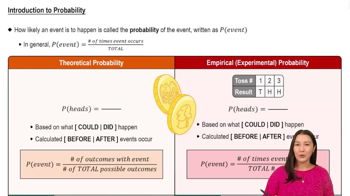
Probability is a measure of the likelihood that a particular event will occur, expressed as a number between 0 and 1. A probability of 0 indicates that an event will not happen, while a probability of 1 indicates certainty. Probabilities can also be expressed as fractions, percentages, or decimals, and they help in assessing the risk and making informed decisions.
Recommended video:
5:37
Introduction to Probability

Unusual Events

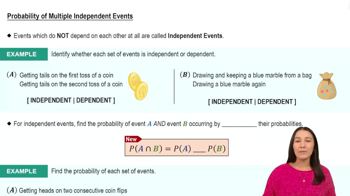
An unusual event is typically defined as one that has a low probability of occurring. In many contexts, events with probabilities less than 0.05 (or 5%) are considered unusual. However, the threshold for what constitutes 'unusual' can vary depending on the specific context and the norms of the field of study.
Recommended video:
05:54
Probability of Multiple Independent Events

Interpreting Probability Values

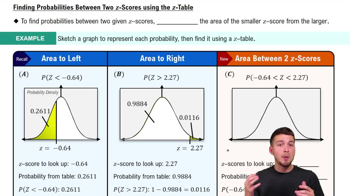
Interpreting probability values involves understanding what different probabilities signify about the likelihood of events. A probability of 1/10 (or 0.1) suggests that the event is not very likely to occur, but it is not necessarily unusual. This interpretation is crucial for accurately assessing statements about events and their probabilities.
Recommended video:
Guided course
03:50
Probabilities Between Two Values
Related Practice
Textbook Question

Classifying Events as Independent or Dependent In Exercises 9-14, determine whether the events are independent or dependent. Explain your reasoning.

11. Returning a rented movie after the due date and receiving a late fee

109
views

Textbook Question

"Using the Multiplication Rule In Exercises 19-32, use the Multiplication Rule.

22.Pickup Trucks In a survey, 510 U.S. adults were asked whether they drive a pickup truck and whether they drive a Ford. The results showed that three in twenty adults surveyed drive a Ford. Of the adults surveyed that drive Fords, nine in twenty drive a pickup truck. Find the probability that a randomly selected adult drives a Ford and drives a pickup truck.

82
views
Textbook Question

"Identifying the Sample Space of a Probability Experiment In Exercises 25-32, identify the sample space of the probability experiment and determine the number of outcomes in the sample space. Draw a tree diagram when appropriate.

26. Guessing a student's letter grade (A, B, C, D, F) in a class

"

119
views
Textbook Question

"According to Bayes’ Theorem, the probability of event A , given that event B has occurred, is

P(A|B) = P(A) * P(B|A)P(A) * P(B|A) + P(A') * P(B|A').

In Exercises 33–38, use Bayes’ Theorem to find P(A|B).

38. P(A) = 12%, P(A') = 88%, P(B|A) = 66% , and P(B|A') = 19% "

80
views
Textbook Question

Classifying Types of Probability In Exercises 53-58, classify the statement as an example of classical probability, empirical probability, or subjective probability. Explain your reasoning.

58. You estimate that the probability of getting all the classes you want on your next schedule

is about 25%.

150
views
Textbook Question

28. Necklaces You are putting nine blue glass beads, three red glass beads, and seven green glass beads on a necklace. In how many distinguishable ways can the colored beads be put on the necklace?

186
views