Ch. 4 - Discrete Probability Distributions
Larson - Elementary Statistics: Picturing the World 8th Edition
Larson8th EditionElementary Statistics: Picturing the WorldISBN: 9780137493470Not the one you use?Change textbook
Chapter 4, Problem 4.2.5

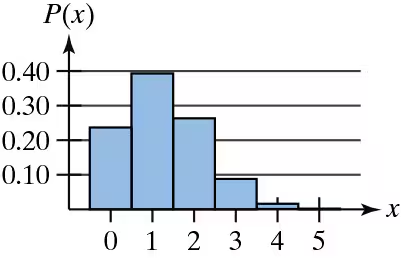
Graphical Analysis In Exercises 3–5, the histogram represents a binomial distribution with five trials. Match the histogram with the appropriate probability of success p. Explain your reasoning.
a. p = 0.25
b. p = 0.50
c. p = 0.75
Histogram displaying a binomial distribution with five trials, showing probabilities for outcomes 0 to 5.

Verified step by step guidance
1
Step 1: Understand the problem. The histogram represents a binomial distribution with five trials, and we need to match it with the correct probability of success (p). The options are p = 0.25, p = 0.50, and p = 0.75.
Step 2: Recall the properties of a binomial distribution. The binomial distribution is defined by two parameters: the number of trials (n) and the probability of success (p). The shape of the distribution depends on the value of p. For smaller values of p, the distribution is skewed to the left, while for larger values of p, it is skewed to the right. When p = 0.50, the distribution is symmetric.
Step 3: Analyze the histogram. The histogram shows that the probabilities are highest for x = 0 and x = 1, and they decrease as x increases. This indicates a left-skewed distribution, which is characteristic of a smaller probability of success (p).
Step 4: Match the histogram with the correct value of p. Since the distribution is left-skewed, the probability of success is likely to be p = 0.25. For p = 0.50, the distribution would be symmetric, and for p = 0.75, the distribution would be skewed to the right.
Step 5: Conclude the reasoning. Based on the shape of the histogram and the properties of binomial distributions, the correct probability of success is p = 0.25.

Verified video answer for a similar problem:

This video solution was recommended by our tutors as helpful for the problem above.
Video duration:
1m
Was this helpful?

Key Concepts

Here are the essential concepts you must grasp in order to answer the question correctly.

Binomial Distribution

A binomial distribution models the number of successes in a fixed number of independent Bernoulli trials, each with the same probability of success. It is characterized by two parameters: the number of trials (n) and the probability of success (p). The distribution is discrete, meaning it only takes on integer values from 0 to n, and is often represented graphically by histograms.
Recommended video:
Guided course
03:28
Mean & Standard Deviation of Binomial Distribution

Probability of Success (p)

The probability of success (p) in a binomial distribution indicates the likelihood of achieving a success in a single trial. It ranges from 0 to 1, where 0 means no chance of success and 1 means certainty of success. Different values of p affect the shape of the distribution; for example, p = 0.5 typically results in a symmetric distribution, while values closer to 0 or 1 create skewed distributions.
Recommended video:
5:37
Introduction to Probability

Histogram Interpretation

A histogram visually represents the frequency distribution of a dataset, in this case, the outcomes of a binomial distribution. Each bar corresponds to the probability of achieving a specific number of successes (x) in the trials. By analyzing the height and shape of the bars, one can infer the underlying probability of success (p) and the distribution's characteristics, such as skewness and modality.
Recommended video:
Guided course
05:54
Intro to Histograms