
Ch. 5 - Normal Probability Distributions
Larson - Elementary Statistics: Picturing the World 8th Edition
Larson8th EditionElementary Statistics: Picturing the WorldISBN: 9780137493470Not the one you use?Change textbook
Chapter 5, Problem 5.5.23c

Approximating Binomial Probabilities In Exercises 19–26, determine whether you can use a normal distribution to approximate the binomial distribution. If you can, use the normal distribution to approximate the indicated probabilities and sketch their graphs. If you cannot, explain why and use a binomial distribution to find the indicated probabilities. Identify any unusual events. Explain.


Athletes on Social Issues In a survey of college athletes, 84% said they are willing to speak up and be more active in social issues. You randomly select 25 college athletes. Find the probability that the number who are willing to speak up and be more active in social issues is (c) between 18 and 22, inclusive.

Verified step by step guidance
1
Step 1: Verify if the normal approximation to the binomial distribution can be used. The conditions are: (1) The sample size (n) is large enough, and (2) both np and n(1-p) are greater than or equal to 5. Here, n = 25 and p = 0.84. Calculate np = 25 * 0.84 and n(1-p) = 25 * (1 - 0.84). Check if both values meet the condition.
Step 2: If the conditions are satisfied, approximate the binomial distribution using a normal distribution. The mean (μ) and standard deviation (σ) of the binomial distribution are given by μ = np and σ = sqrt(np(1-p)). Calculate these values.
Step 3: Apply the continuity correction for the normal approximation. Since we are finding the probability that the number of athletes is between 18 and 22 (inclusive), adjust the range to 17.5 to 22.5 for the normal distribution.
Step 4: Standardize the values using the z-score formula: z = (x - μ) / σ. Compute the z-scores for x = 17.5 and x = 22.5 using the mean and standard deviation calculated earlier.
Step 5: Use the standard normal distribution table (or a calculator) to find the probabilities corresponding to the z-scores. Subtract the cumulative probability at z = 17.5 from the cumulative probability at z = 22.5 to find the probability that the number of athletes is between 18 and 22, inclusive.

Verified video answer for a similar problem:

This video solution was recommended by our tutors as helpful for the problem above.
Video duration:
9m
Was this helpful?

Key Concepts

Here are the essential concepts you must grasp in order to answer the question correctly.

Binomial Distribution

The binomial distribution models the number of successes in a fixed number of independent Bernoulli trials, each with the same probability of success. It is characterized by two parameters: the number of trials (n) and the probability of success (p). In this context, the success is defined as a college athlete willing to speak up on social issues.
Recommended video:
Guided course
03:28
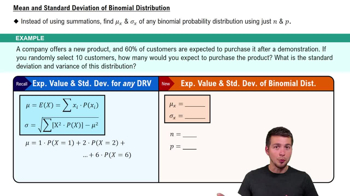
Mean & Standard Deviation of Binomial Distribution

Normal Approximation to the Binomial

The normal approximation to the binomial distribution is applicable when the number of trials is large, and both np and n(1-p) are greater than 5. This allows us to use the normal distribution to estimate probabilities for binomial outcomes, simplifying calculations. In this case, we can check if the conditions are met to use the normal distribution for approximating the probability of athletes willing to speak up.
Recommended video:
06:23
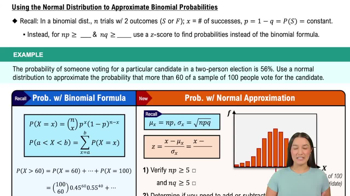
Using the Normal Distribution to Approximate Binomial Probabilities

Probability Calculation

Probability calculation involves determining the likelihood of a specific outcome occurring within a defined set of possibilities. For the given problem, we need to calculate the probability that between 18 and 22 athletes are willing to speak up, which can be done using either the binomial formula or the normal approximation, depending on the conditions met.
Recommended video:
Guided course
07:09
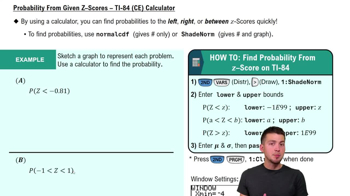
Probability From Given Z-Scores - TI-84 (CE) Calculator
Related Practice
Textbook Question

Approximating Binomial Probabilities In Exercises 19–26, determine whether you can use a normal distribution to approximate the binomial distribution. If you can, use the normal distribution to approximate the indicated probabilities and sketch their graphs. If you cannot, explain why and use a binomial distribution to find the indicated probabilities. Identify any unusual events. Explain.


Social Media A survey of Americans found that 55% would be disappointed if Facebook disappeared. You randomly select 500 Americans and ask them whether they would be disappointed if Facebook disappeared. Find the probability that the number who say yes is (c) between 240 and 280, inclusive.

87
views
Textbook Question

Daily Commute About 83% of U.S. employees drive their own vehicle to work. You randomly select a sample of U.S. employees. Find the probability that more than 100 of the employees drive their own vehicle to work. (Source: U.S. Bureau of Labor Statistics)


c. You select 150 U.S. employees.

74
views
Textbook Question

Employee Wellness A survey of employed U.S. adults found that only 35% believe their employer cares about their well-being. You randomly select a sample of U.S. employees. Find the probability that fewer than 100 believe their employer cares about their well-being. (Source: Gallup)


c. You select 400 U.S. employees.

106
views
Textbook Question

Approximating Binomial Probabilities In Exercises 19–26, determine whether you can use a normal distribution to approximate the binomial distribution. If you can, use the normal distribution to approximate the indicated probabilities and sketch their graphs. If you cannot, explain why and use a binomial distribution to find the indicated probabilities. Identify any unusual events. Explain.


Advancing Research In a survey of U.S. adults, 77% said are willing to share their personal health information to advance medical research. You randomly select 500 U.S. adults. Find the probability that the number who are willing to share their personal health information to advance medical research is (c) between 380 and 390 inclusive.

68
views
Textbook Question

Finding Specified Data Values In Exercises 31–38, answer the questions about the specified normal distribution.


Weights of Teenagers In a survey of 18-year old males, the mean weight was 166.7 pounds with a standard deviation of 49.3 pounds. (Adapted from National Center for Health Statistics)


c. What weight represents the first quartile?

84
views
Textbook Question

Finding Specified Data Values In Exercises 31–38, answer the questions about the specified normal distribution.


COVID-19 Response Surveyors asked respondents to rate ten key aspects of their government’s response to the COVID-19 pandemic, including preparedness, communication, and material aid. A pandemic response score that ranged from 0 to 100 was calculated. The mean score for U.S. respondents was 50.6 with a standard deviation of 29.0. (Source: PLOS One)


b. What score represents the 61st percentile?

69
views