
Ch. 5 - Normal Probability Distributions
Larson - Elementary Statistics: Picturing the World 8th Edition
Larson8th EditionElementary Statistics: Picturing the WorldISBN: 9780137493470Not the one you use?Change textbook
Chapter 5, Problem 5.1.5

Draw two normal curves that have the same mean but different standard deviations. Describe the similarities and differences.

Verified step by step guidance
1
Step 1: Understand the concept of a normal curve. A normal curve, also known as a bell curve, is a graphical representation of a normal distribution. It is symmetric about the mean, and its shape is determined by the mean (μ) and standard deviation (σ). The mean determines the center of the curve, while the standard deviation determines the spread or width of the curve.
Step 2: Recognize the impact of the mean on the curve. Since both curves have the same mean, their centers will align at the same point on the horizontal axis. This means the peak of both curves will occur at the same location.
Step 3: Understand the role of standard deviation. The standard deviation affects the spread of the curve. A smaller standard deviation results in a narrower and taller curve, while a larger standard deviation results in a wider and shorter curve. This is because the standard deviation measures the variability of the data around the mean.
Step 4: Draw the two curves. Start by sketching the horizontal axis and marking the mean (μ) at the center. Then, draw one curve with a smaller standard deviation (narrow and tall) and another curve with a larger standard deviation (wide and short). Ensure both curves are symmetric about the mean.
Step 5: Describe the similarities and differences. The similarity is that both curves are centered at the same mean, indicating they share the same average value. The difference lies in their spread: the curve with the smaller standard deviation is more concentrated around the mean, while the curve with the larger standard deviation is more spread out, indicating greater variability in the data.

Verified video answer for a similar problem:

This video solution was recommended by our tutors as helpful for the problem above.
Video duration:
3m
Was this helpful?

Key Concepts

Here are the essential concepts you must grasp in order to answer the question correctly.

Normal Distribution

A normal distribution is a probability distribution that is symmetric about the mean, showing that data near the mean are more frequent in occurrence than data far from the mean. It is characterized by its bell-shaped curve, defined by two parameters: the mean (average) and the standard deviation (spread). This distribution is fundamental in statistics as it describes how values are distributed in many natural phenomena.
Recommended video:
06:23
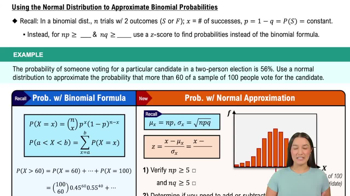
Using the Normal Distribution to Approximate Binomial Probabilities

Mean

The mean, often referred to as the average, is a measure of central tendency that summarizes a set of values by dividing the sum of those values by the number of values. In the context of normal distributions, the mean indicates the center of the distribution, where the highest point of the curve occurs. When comparing two normal curves, having the same mean means they are centered at the same point on the horizontal axis.
Recommended video:
Guided course
04:52
Calculating the Mean

Standard Deviation

Standard deviation is a statistic that measures the dispersion or spread of a set of values around the mean. A smaller standard deviation indicates that the values tend to be closer to the mean, resulting in a steeper curve, while a larger standard deviation indicates that the values are spread out over a wider range, leading to a flatter curve. This concept is crucial for understanding how variability affects the shape of normal distributions.
Recommended video:
Guided course
08:45
Calculating Standard Deviation
Related Practice
Textbook Question

In Exercises 39 and 40, determine whether the finite correction factor should be used. If so, use it in your calculations when you find the probability.


Parking Infractions In a sample of 1000 fines issued by the City of Toronto for parking infractions in September of 2020, the mean fine was \$49.83 and the standard deviation was \$52.15. A random sample of size 60 is selected from this population. What is the probability that the mean fine is less than \$40?

158
views
Textbook Question

Graphical Analysis In Exercises 11–16, determine whether the graph could represent a variable with a normal distribution. Explain your reasoning. If the graph appears to represent a normal distribution, estimate the mean and standard deviation.

75
views
Textbook Question

Testing a Drug A drug manufacturer claims that a drug cures a rare skin disease 75% of the time. The claim is checked by testing the drug on 100 patients. If at least 70 patients are cured, then this claim will be accepted. Use this information in Exercises 31 and 32.


Find the probability that the claim will be accepted, assuming that the actual probability that the drug cures the skin disease is 65%.

118
views
Textbook Question

In Exercises 21–24, a control chart is shown. Each chart has horizontal lines drawn at the mean mu, at mu ±2sigma, and at mu±3sigma. Determine whether the process shown is in control or out of control. Explain.


A gear has been designed to have a diameter of 3 inches. The standard deviation of the process is 0.2 inch.


100
views
Textbook Question

True or False? In Exercises 5–8, determine whether the statement is true or false. If it is false, rewrite it as a true statement.


A sampling distribution is normal only when the population is normal.

86
views
Textbook Question

Finding a z-Score In Exercises 1–16, use the Standard Normal Table or technology to find the z-score that corresponds to the cumulative area or percentile.


0.94

202
views