Ch. 5 - Normal Probability Distributions
Larson - Elementary Statistics: Picturing the World 8th Edition
Larson8th EditionElementary Statistics: Picturing the WorldISBN: 9780137493470Not the one you use?Change textbook
Chapter 5, Problem 5.5.6

In Exercises 5–8, match the binomial probability statement with its corresponding normal distribution probability statement (a)–(d) after a continuity correction.
P(x≥109)


a. P(x>109.5)
b. P(x<108.5)
c. P(x<109.5)
d. P(x>108.5)

Verified step by step guidance
1
Step 1: Understand the problem. The task is to match a binomial probability statement with its corresponding normal distribution probability statement after applying a continuity correction. The binomial statement given is P(x ≥ 109).
Step 2: Recall the concept of continuity correction. In a binomial distribution, x is discrete, but when approximating it with a normal distribution, which is continuous, we adjust the boundaries by ±0.5 to account for the discrete-to-continuous transition.
Step 3: Apply the continuity correction to the given binomial statement P(x ≥ 109). To include the value 109 in the normal distribution, we adjust the boundary to P(x > 108.5). This ensures that the probability includes all values starting from 109 and above.
Step 4: Match the corrected statement P(x > 108.5) with the options provided. From the list of options, the correct match is (d) P(x > 108.5).
Step 5: Conclude that the binomial probability statement P(x ≥ 109) corresponds to the normal distribution probability statement P(x > 108.5) after applying the continuity correction.

Verified video answer for a similar problem:

This video solution was recommended by our tutors as helpful for the problem above.
Video duration:
1m
Was this helpful?

Key Concepts

Here are the essential concepts you must grasp in order to answer the question correctly.

Binomial Distribution

The binomial distribution models the number of successes in a fixed number of independent Bernoulli trials, each with the same probability of success. It is characterized by two parameters: the number of trials (n) and the probability of success (p). Understanding this distribution is crucial for analyzing scenarios where outcomes are binary, such as success/failure or yes/no.
Recommended video:
Guided course
03:28
Mean & Standard Deviation of Binomial Distribution

Normal Approximation to the Binomial

The normal approximation to the binomial distribution is used when the number of trials is large, allowing the binomial probabilities to be approximated by a normal distribution. This is particularly useful because normal distributions are easier to work with mathematically. The approximation is valid when both np and n(1-p) are greater than 5, ensuring that the distribution is not too skewed.
Recommended video:
06:23
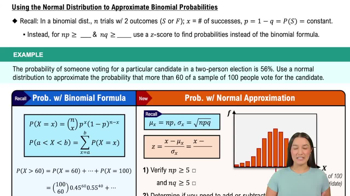
Using the Normal Distribution to Approximate Binomial Probabilities

Continuity Correction

Continuity correction is applied when using a normal distribution to approximate a discrete distribution, such as the binomial. It involves adjusting the discrete values by 0.5 to account for the fact that the normal distribution is continuous. For example, to find P(X ≥ k) in a binomial distribution, one would use P(X > k - 0.5) in the normal approximation.
Recommended video:
06:23
Using the Normal Distribution to Approximate Binomial Probabilities
Related Practice