Ch. 6 - Confidence Intervals
Larson - Elementary Statistics: Picturing the World 8th Edition
Larson8th EditionElementary Statistics: Picturing the WorldISBN: 9780137493470Not the one you use?Change textbook
Chapter 6, Problem 6.7

In Exercises 7–10, the statement represents a claim. Write its complement and state which is Ho and which is Ha.


μ<33

Verified step by step guidance
1
Identify the given claim: The claim is μ < 33, which is a statement about the population mean being less than 33.
Understand the complement of the claim: The complement of μ < 33 is μ ≥ 33. This is because the complement includes all values not covered by the original claim.
Determine the null hypothesis (Ho): The null hypothesis is the complement of the claim, which is μ ≥ 33. The null hypothesis typically represents the status quo or no effect.
Determine the alternative hypothesis (Ha): The alternative hypothesis is the claim itself, which is μ < 33. The alternative hypothesis represents the researcher's assertion or the statement being tested.
Summarize the hypotheses: Ho: μ ≥ 33 and Ha: μ < 33. These hypotheses are mutually exclusive and collectively exhaustive, ensuring all possibilities are covered.

Verified video answer for a similar problem:

This video solution was recommended by our tutors as helpful for the problem above.
Video duration:
2m
Was this helpful?

Key Concepts

Here are the essential concepts you must grasp in order to answer the question correctly.

Null Hypothesis (H0)

The null hypothesis (H0) is a statement that indicates no effect or no difference, serving as a default position in statistical testing. In this context, it typically represents the status quo or a claim that a population parameter, such as the mean (μ), is equal to a specific value. For the given claim μ < 33, the null hypothesis would be H0: μ ≥ 33.
Recommended video:
Guided course
06:21
Step 1: Write Hypotheses

Alternative Hypothesis (Ha)

The alternative hypothesis (Ha) is a statement that contradicts the null hypothesis, suggesting that there is an effect or a difference. It represents what the researcher aims to support through evidence. In this case, since the claim is μ < 33, the alternative hypothesis would be Ha: μ < 33, indicating that the population mean is indeed less than 33.
Recommended video:
Guided course
06:21
Step 1: Write Hypotheses

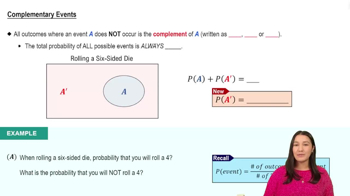
Complement of a Hypothesis

The complement of a hypothesis refers to the opposite scenario of the original claim. In hypothesis testing, if the null hypothesis states that a parameter is greater than or equal to a certain value, its complement would assert that the parameter is less than that value. For the claim μ < 33, the complement would be μ ≥ 33, which aligns with the null hypothesis.
Recommended video:
4:23
Complementary Events