
Ch. 7 - Hypothesis Testing with One Sample
Larson - Elementary Statistics: Picturing the World 8th Edition
Larson8th EditionElementary Statistics: Picturing the WorldISBN: 9780137493470Not the one you use?Change textbook
Chapter 7, Problem 7.5.13a

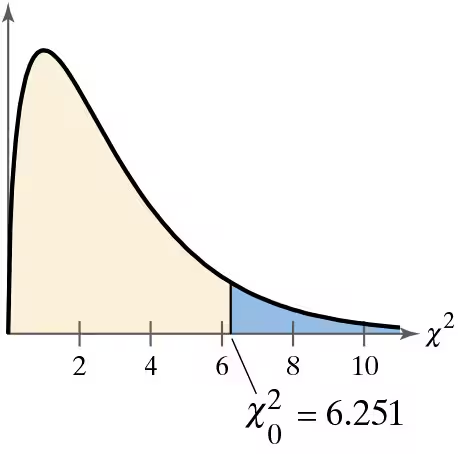
Graphical Analysis In Exercises 13 and 14, state whether each standardized test statistic X^2 allows you to reject the null hypothesis. Explain.


a. X^2=2.091
Graph showing a chi-squared distribution with shaded area indicating rejection region at X^2=6.251.

Verified step by step guidance
1
Step 1: Understand the problem. The question asks whether the standardized test statistic X^2 = 2.091 allows you to reject the null hypothesis. To answer this, compare the test statistic to the critical value (X^2_0 = 6.251) provided in the graph.
Step 2: Recall the decision rule for hypothesis testing using the chi-square test. If the test statistic X^2 is greater than the critical value X^2_0, you reject the null hypothesis. Otherwise, you fail to reject the null hypothesis.
Step 3: Analyze the graph. The critical value X^2_0 = 6.251 is marked on the chi-square distribution curve, dividing the rejection region (blue area) from the non-rejection region (yellow area). Values of X^2 less than 6.251 fall in the non-rejection region.
Step 4: Compare the test statistic X^2 = 2.091 to the critical value X^2_0 = 6.251. Since 2.091 is less than 6.251, it falls in the non-rejection region of the graph.
Step 5: Conclude based on the comparison. Since the test statistic does not exceed the critical value, you fail to reject the null hypothesis. This means there is insufficient evidence to support the alternative hypothesis.

Verified video answer for a similar problem:

This video solution was recommended by our tutors as helpful for the problem above.
Video duration:
2m
Was this helpful?

Key Concepts

Here are the essential concepts you must grasp in order to answer the question correctly.

Chi-Squared Distribution

The Chi-Squared distribution is a continuous probability distribution commonly used in hypothesis testing, particularly in tests of independence and goodness-of-fit. It is characterized by its right-skewed shape and is defined by degrees of freedom, which depend on the number of categories or variables involved. The distribution helps determine critical values for test statistics, which are used to assess the significance of observed data.
Recommended video:
Guided course
07:01
Intro to Least Squares Regression

Null Hypothesis

The null hypothesis is a statement that there is no effect or no difference, serving as a default position in statistical testing. It is typically denoted as H0 and is tested against an alternative hypothesis (H1) that suggests a significant effect or difference exists. In hypothesis testing, the goal is to determine whether the evidence from the data is strong enough to reject the null hypothesis in favor of the alternative.
Recommended video:
Guided course
06:21
Step 1: Write Hypotheses

Rejection Region

The rejection region is the area in the tail(s) of the distribution where, if the test statistic falls, the null hypothesis can be rejected. This region is determined by the significance level (alpha), which is the probability of making a Type I error. In the context of the Chi-Squared test, if the calculated Chi-Squared statistic exceeds the critical value (like 6.251 in the provided graph), it falls into the rejection region, indicating that the null hypothesis can be rejected.
Recommended video:
Guided course
09:56
Step 4: State Conclusion
Related Practice
Textbook Question

Writing Hypotheses: Backpack Manufacturer A backpack manufacturer claims that the mean life of its competitor’s backpacks is less than 5 years. You are asked to perform a hypothesis test to test this claim. How would you write the null and alternative hypotheses when


a. you represent the manufacturer and want to support the claim?

70
views
Textbook Question

Writing Hypotheses: Internet Provider An Internet provider is trying to gain advertising deals and claims that the mean time a customer spends online per day is greater than 28 minutes. You are asked to test this claim. How would you write the null and alternative hypotheses when


a. you represent the Internet provider and want to support the claim?

43
views
Textbook Question

Interpreting a Decision In Exercises 43–48, determine whether the claim represents the null hypothesis or the alternative hypothesis. If a hypothesis test is performed, how should you interpret a decision that


a. rejects the null hypothesis?


Gas Mileage An automotive manufacturer claims that the standard deviation for the gas mileage of one of the vehicles it manufactures is 3.9 miles per gallon.

54
views
Textbook Question

Graphical Analysis In Exercises 9–12, state whether each standardized test statistic t allows you to reject the null hypothesis. Explain.


a. t = 1.4


70
views
Textbook Question

Graphical Analysis In Exercises 9–12, state whether each standardized test statistic t allows you to reject the null hypothesis. Explain.


a. t = -1.755


32
views
Textbook Question

Interpreting a Decision In Exercises 43–48, determine whether the claim represents the null hypothesis or the alternative hypothesis. If a hypothesis test is performed, how should you interpret a decision that


a. rejects the null hypothesis?


Marketing A fitness equipment company claims that its competitor’s home gym does not have a customer satisfaction rate of 99%.

56
views