Ch. 7 - Hypothesis Testing with One Sample
Larson - Elementary Statistics: Picturing the World 8th Edition
Larson8th EditionElementary Statistics: Picturing the WorldISBN: 9780137493470Not the one you use?Change textbook
Chapter 7, Problem 7.4.6

In Exercises 3–6, determine whether a normal sampling distribution can be used. If it can be used, test the claim.
Claim: p > 0.70, α=0.04. Sample statistics: p_hat = 0.64, n=225

Verified step by step guidance
1
Step 1: Verify the conditions for using a normal sampling distribution. The two conditions are: (1) The sample size n must be large enough such that both n * p and n * (1 - p) are greater than or equal to 5, where p is the hypothesized population proportion. (2) The sampling must be random and independent.
Step 2: Calculate the standard error (SE) of the sampling distribution of the sample proportion using the formula: SE = sqrt((p * (1 - p)) / n), where p is the hypothesized population proportion and n is the sample size.
Step 3: Compute the z-test statistic using the formula: z = (p_hat - p) / SE, where p_hat is the sample proportion, p is the hypothesized population proportion, and SE is the standard error calculated in Step 2.
Step 4: Determine the critical value for the given significance level α = 0.04. Since the claim is one-tailed (p > 0.70), find the z-critical value corresponding to the upper tail of the standard normal distribution.
Step 5: Compare the z-test statistic to the z-critical value. If the z-test statistic is greater than the z-critical value, reject the null hypothesis. Otherwise, fail to reject the null hypothesis. Interpret the result in the context of the claim.

Verified video answer for a similar problem:

This video solution was recommended by our tutors as helpful for the problem above.
Video duration:
4m
Was this helpful?

Key Concepts

Here are the essential concepts you must grasp in order to answer the question correctly.

Normal Sampling Distribution

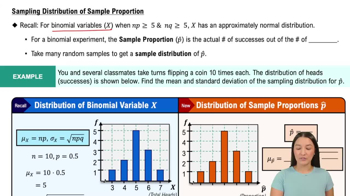
A normal sampling distribution is a probability distribution of sample means or proportions that approaches a normal distribution as the sample size increases, according to the Central Limit Theorem. For proportions, this is applicable when both np and n(1-p) are greater than 5, ensuring that the sample size is sufficiently large to approximate normality.
Recommended video:
05:11
Sampling Distribution of Sample Proportion

Hypothesis Testing

Hypothesis testing is a statistical method used to make decisions about a population based on sample data. It involves formulating a null hypothesis (H0) and an alternative hypothesis (H1), then using sample statistics to determine whether to reject H0 in favor of H1, based on a predetermined significance level (α).
Recommended video:
Guided course
06:21
Step 1: Write Hypotheses

Significance Level (α)

The significance level (α) is the threshold for determining whether a result is statistically significant. It represents the probability of rejecting the null hypothesis when it is actually true (Type I error). In this case, α=0.04 indicates a 4% risk of making such an error, guiding the decision-making process in hypothesis testing.
Recommended video:
Guided course
04:46
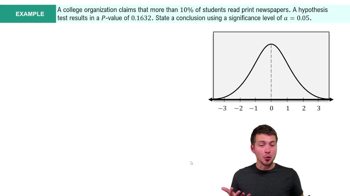
Step 4: State Conclusion Example 4
Related Practice
Textbook Question

Writing A null hypothesis is rejected with a level of significance of 0.10. Is it also rejected at a level of significance of 0.05? Explain.

197
views

Textbook Question

Hypothesis Testing Using Rejection Regions In Exercises 23–30, (a) identify the claim and state H0 and Ha, (b) find the critical value(s) and identify the rejection region(s), (c) find the standardized test statistic X^2, (d) decide whether to reject or fail to reject the null hypothesis, and (e) interpret the decision in the context of the original claim. Assume the population is normally distributed.


Salaries The annual salaries (in dollars) of 15 randomly chosen senior level graphic design specialists are shown in the table at the left. At α=0.05, is there enough evidence to support the claim that the standard deviation of the annual salaries is different from \$13,056?


109
views
Textbook Question

In Exercises 29–32, test the claim about the population mean at the level of significance α. Assume the population is normally distributed.


Claim: ; μ ≤ 22,500; α = 0.01; α = 1200

Sample statistics: x_bar = 23,500, n = 45

103
views
Textbook Question

In Exercises 29–32, test the claim about the population mean at the level of significance α. Assume the population is normally distributed.


Claim: ; μ ≠ 5880; α = 0.03; α = 413

Sample statistics: x_bar = 5771, n = 67

87
views
Textbook Question

Graphical Analysis In Exercises 9–12, match the P-value or z-statistic with the graph that represents the corresponding area. Explain your reasoning.


z = -0.51

70
views