Ch. 9 - Correlation and Regression
Larson - Elementary Statistics: Picturing the World 8th Edition
Larson8th EditionElementary Statistics: Picturing the WorldISBN: 9780137493470Not the one you use?Change textbook
Chapter 9, Problem 9.3.26

"Constructing and Interpreting a Prediction Interval In Exercises 21-30, construct the indicated prediction interval and interpret the results.
26. Voter Turnout Construct a 99% prediction interval for number of ballots cast in Exercise 16 when the voting age population is 210 million."

Verified step by step guidance
1
Identify the regression model from Exercise 16, which relates the voting age population (independent variable) to the number of ballots cast (dependent variable). This model typically has the form: \(\hat{y}\) = b_0 + b_1 x, where \(\hat{y}\) is the predicted number of ballots cast and x is the voting age population.
Calculate the predicted number of ballots cast for a voting age population of 210 million by substituting x = 210 into the regression equation to find \(\hat{y}\).
Determine the standard error of the prediction, which accounts for both the variability of the estimate of the mean response and the variability of individual observations. The formula for the standard error of prediction is: SE_{pred} = s \(\sqrt{1 + \frac{1}{n}\) + \(\frac{(x - \bar{x}\))^2}{\(\sum\) (x_i - \(\bar{x}\))^2}}, where s is the standard error of the estimate, n is the sample size, \(\bar{x}\) is the mean of the independent variable, and x is the value 210 million.
Find the critical t-value for a 99% prediction interval with degrees of freedom equal to n - 2. This value corresponds to the desired confidence level and is used to scale the standard error.
Construct the 99% prediction interval using the formula: \(\hat{y}\) \(\pm\) t_{\(\alpha\)/2, n-2} \(\times\) SE_{pred}. This interval estimates the range in which a single future observation (number of ballots cast) is expected to fall with 99% confidence when the voting age population is 210 million.

Verified video answer for a similar problem:

This video solution was recommended by our tutors as helpful for the problem above.
Video duration:
5m
Was this helpful?

Key Concepts

Here are the essential concepts you must grasp in order to answer the question correctly.

Prediction Interval

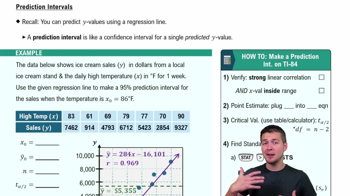
A prediction interval estimates the range within which a single future observation is expected to fall, with a specified level of confidence. Unlike confidence intervals for means, prediction intervals account for both the variability in the estimate and the inherent variability of individual data points.
Recommended video:
Guided course
09:00
Prediction Intervals

Confidence Level

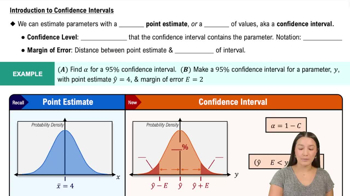
The confidence level, such as 99%, represents the probability that the interval constructed from sample data contains the true value of the future observation. Higher confidence levels produce wider intervals, reflecting greater uncertainty but more assurance that the interval captures the true value.
Recommended video:
06:33
Introduction to Confidence Intervals

Application of Regression Model to Prediction

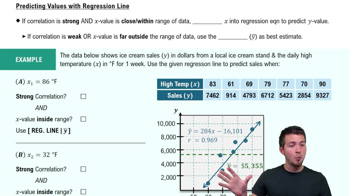
Using a regression model, prediction intervals are constructed by plugging in a specific predictor value (e.g., voting age population) to estimate the response variable (e.g., ballots cast). This involves calculating the predicted value and adding a margin of error that accounts for both estimation uncertainty and natural variability.
Recommended video:
Guided course
04:57
Using Regression Lines to Predict Values
Related Practice
Textbook Question

In Exercise 26, add data for an international soccer player who can perform the half squat with a maximum of 210 kilograms and can sprint 10 meters in 2.00 seconds. Describe how this affects the correlation coefficient r.

48
views

Textbook Question

"In Exercises 19-22, two variables are given that have been shown to have correlation but no cause-and-effect relationship. Describe at least one possible reason for the correlation.

20. Alcohol use and tobacco use"

52
views
Textbook Question

"In Exercises 7-10, use the value of the correlation coefficient r to calculate the coefficient of determination r^2. What does this tell you about the explained variation of the data about the regression line? about the unexplained variation?

10. r =0.881"

117
views
Textbook Question

"Confidence Intervals for y-Intercept and Slope

You can construct confidence intervals for the y-intercept B and slope M of the regression line y = Mx + B for the population by using the inequalities below.

y-intercept B :

b - E < B < b + E

where

E = t_c s_e \(\sqrt{\frac{1}{n}\) + \(\frac{\overline{x}\)^2}{\(\sum\) x^2 - \(\frac{(\Sigma x)^2}{n}\)}}

slope M :

m - E < M < m + E

where

E = \(\frac{t_c s_e}{\sqrt{\sum x^2 - \frac{(\Sigma x)^2}{n}\)}}

The values of m and b are obtained from the sample data, and the critical value t_c is found using Table 5 in Appendix B with n - 2 degrees of freedom.

In Exercises 37 and 38, construct the indicated confidence intervals for B and M using the gross domestic products and carbon dioxide emissions data found in Example 2.

38. 99% confidence interval"

119
views
Textbook Question

"[APPLET] For Exercises 1–8, use the data in the table, which shows the average annual salaries (both in thousands of dollars) for secondary and elementary school teachers, excluding special and vocational education teachers, in the United States for 11 years. (Source: U.S. Bureau of Labor Statistics)

8. Construct a 95% prediction interval for the average annual salary of elementary school teachers when the average annual salary of secondary school teachers is \$63,500. Interpret the results."

86
views
Textbook Question

"Predicting y-Values In Exercises 3-6, use the multiple regression equation to predict the y-values for the values of the independent variables.

5. Black Cherry Tree Volume The volume (in cubic feet) of a black cherry tree can be modeled by the equation

y =- 52.2+0.3x_1 +4.5x_2

where x_1 is the tree's height (in feet) and x_2 is the tree's diameter (in inches). (Source: Journal of the Royal Statistical Society)

a. x_1 = 70, x_2 = 8.6

b. x_1 = 65, x_2 = 11.0

c. x_1 = 83, x_2 = 17.6

d. x_1 = 87, x_2 = 19.6"

40
views