
Ch. 9 - Correlation and Regression
Larson - Elementary Statistics: Picturing the World 8th Edition
Larson8th EditionElementary Statistics: Picturing the WorldISBN: 9780137493470Not the one you use?Change textbook
Chapter 9, Problem 9.3.27

"Constructing and Interpreting a Prediction Interval In Exercises 21-30, construct the indicated prediction interval and interpret the results.
27. Natural Gas Construct a 95% prediction interval for the export of natural gas from the United States in Exercise 17 when the marketed production of natural gas in the United States is 31 trillion cubic feet."

Verified step by step guidance
1
Identify the regression equation from Exercise 17, which relates the marketed production of natural gas (independent variable, x) to the export of natural gas (dependent variable, y). This equation typically has the form: \(\hat{y}\) = b_0 + b_1 x, where b_0 is the intercept and b_1 is the slope.
Calculate the predicted export value \(\hat{y}\) by substituting x = 31 trillion cubic feet into the regression equation.
Determine the standard error of the prediction, which accounts for both the variability of the estimate of the mean response and the variability of individual observations. The formula for the standard error of prediction at a specific x_0 is: SE_{pred} = s \(\sqrt{1 + \frac{1}{n}\) + \(\frac{(x_0 - \bar{x}\))^2}{\(\sum\) (x_i - \(\bar{x}\))^2}}, where s is the standard error of the estimate, n is the sample size, \(\bar{x}\) is the mean of the x-values, and x_0 = 31.
Find the critical t-value for a 95% prediction interval with degrees of freedom equal to n - 2. This value comes from the t-distribution table and depends on the confidence level and sample size.
Construct the 95% prediction interval using the formula: \(\hat{y}\) \(\pm\) t_{\(\alpha\)/2, n-2} \(\times\) SE_{pred}. Finally, interpret this interval as the range in which we expect the export of natural gas to fall for a marketed production of 31 trillion cubic feet, with 95% confidence.

Verified video answer for a similar problem:

This video solution was recommended by our tutors as helpful for the problem above.
Video duration:
5m
Was this helpful?

Key Concepts

Here are the essential concepts you must grasp in order to answer the question correctly.

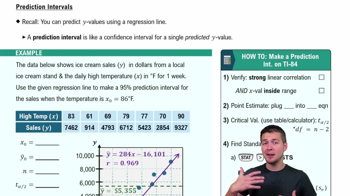
Prediction Interval

A prediction interval estimates the range within which a single future observation is expected to fall, with a specified level of confidence. Unlike confidence intervals for the mean, prediction intervals account for both the uncertainty in estimating the mean and the variability of individual data points.
Recommended video:
Guided course
09:00
Prediction Intervals

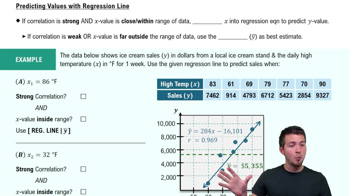
Linear Regression and Model Use

Prediction intervals often rely on a regression model that relates an independent variable (e.g., marketed production) to a dependent variable (e.g., natural gas export). Understanding how to use the regression equation and its residual variance is essential to calculate the interval for a new input value.
Recommended video:
Guided course
04:57
Using Regression Lines to Predict Values

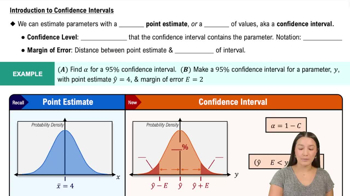
Confidence Level and Interpretation

The confidence level (e.g., 95%) indicates the probability that the prediction interval contains the true future observation. Interpreting this correctly means recognizing that if many such intervals were constructed, about 95% would capture the actual export value for the given production level.
Recommended video:
06:33
Introduction to Confidence Intervals