Ch. 9 - Correlation and Regression
Larson - Elementary Statistics: Picturing the World 8th Edition
Larson8th EditionElementary Statistics: Picturing the WorldISBN: 9780137493470Not the one you use?Change textbook
Chapter 9, Problem 9.3.22

"Constructing and Interpreting a Prediction Interval In Exercises 21-30, construct the indicated prediction interval and interpret the results.
22. Mean Hourly Wage Construct a 95% prediction interval for the mean hourly wage in Exercise 12 when the median hourly wage is \$21.50."

Verified step by step guidance
1
Identify the key components needed to construct a prediction interval: the sample mean (\( \bar{x} \)), the sample standard deviation (\( s \)), the sample size (\( n \)), and the desired confidence level (95% in this case).
Recall that a prediction interval estimates the range in which a single new observation is likely to fall, not the mean of the population. The formula for a prediction interval is: \( \bar{x} \pm t_{\alpha/2, n-1} \times s \times \sqrt{1 + \frac{1}{n}} \), where \( t_{\alpha/2, n-1} \) is the critical value from the t-distribution with \( n-1 \) degrees of freedom.
Find the critical t-value (\( t_{\alpha/2, n-1} \)) corresponding to a 95% confidence level and \( n-1 \) degrees of freedom using a t-table or statistical software.
Plug in the values for \( \bar{x} \), \( s \), \( n \), and the critical t-value into the prediction interval formula to calculate the lower and upper bounds of the interval.
Interpret the prediction interval by explaining that we are 95% confident that the hourly wage of a single new worker will fall within this interval, considering the variability in the data.

Verified video answer for a similar problem:

This video solution was recommended by our tutors as helpful for the problem above.
Video duration:
5m
Was this helpful?

Key Concepts

Here are the essential concepts you must grasp in order to answer the question correctly.

Prediction Interval

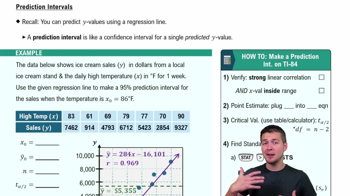
A prediction interval estimates the range within which a single new observation is expected to fall, with a certain level of confidence. Unlike confidence intervals for means, prediction intervals account for both the variability in the sample mean and the individual data points, making them wider and more appropriate for predicting individual outcomes.
Recommended video:
Guided course
09:00
Prediction Intervals

Confidence Level (e.g., 95%)

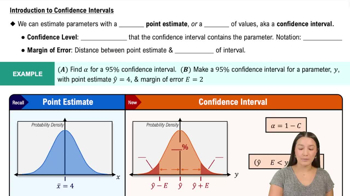
The confidence level represents the probability that the interval constructed from sample data contains the true parameter or future observation. A 95% confidence level means that if we repeated the sampling many times, about 95% of the prediction intervals would include the actual value.
Recommended video:
06:33
Introduction to Confidence Intervals

Relationship Between Median and Mean in Wage Data

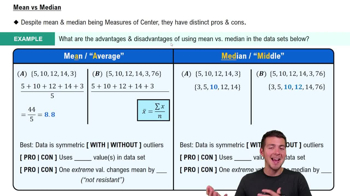
Understanding the difference between median and mean wages is important because the mean can be influenced by extreme values, while the median represents the middle value. When constructing prediction intervals for the mean hourly wage, knowing the median helps contextualize the distribution but does not replace the mean used in calculations.
Recommended video:
Guided course
04:48
Comparing Mean vs. Median
Related Practice
Textbook Question

In Exercise 24, remove the data for the student who is 57 inches tall and scored 128 on the IQ test. Describe how this affects the correlation coefficient r.

42
views

Textbook Question

"Constructing and Interpreting a Prediction Interval In Exercises 21-30, construct the indicated prediction interval and interpret the results.

30. New Vehicle Sales Construct a 99% prediction interval for new vehicle sales for Honda in Exercise 20 when the number of new vehicles sold by Toyota is 2159 thousand."

48
views
Textbook Question

"In Exercises 9 and 10, identify the explanatory variable and the response variable.

10. An actuary at an insurance company wants to determine whether the number of hours of safety driving classes can be used to predict the number of driving accidents for each

driver."

102
views
Textbook Question

Graphical Analysis In Exercises 11–14, determine whether there is a perfect positive linear correlation, a strong positive linear correlation, a perfect negative linear correlation, a strong negative linear correlation, or no linear correlation between the variables.

46
views
Textbook Question

"Graphical Analysis In Exercises 1–3, use the figure.

1. Describe the total variation about a regression line in words and in symbols."

74
views
Textbook Question

"In Exercises 7-10, use the value of the correlation coefficient r to calculate the coefficient of determination r^2. What does this tell you about the explained variation of the data about the regression line? about the unexplained variation?

8.r =- 0.328"

71
views