Ch. 10 - Correlation and Regression
Triola - Elementary Statistics 14th Edition
Triola14th EditionElementary StatisticsISBN: 9780137366446Not the one you use?Change textbook
Chapter 10, Problem 10.1.11a

Explore!
Exercises 11 and 12 provide two data sets from “Graphs in Statistical Analysis,” by F. J. Anscombe, the American Statistician, Vol. 27. For each exercise,


Table displaying two data sets with x values in the top row and corresponding y values in the bottom row.


a. Construct a scatterplot.

Verified step by step guidance
1
Step 1: Begin by identifying the data points from the table. Each pair of (x, y) values represents a coordinate in the scatterplot. For example, the first pair is (10, 9.14), the second pair is (8, 8.14), and so on.
Step 2: Set up a graph with an x-axis and y-axis. Label the x-axis with the values of 'x' and the y-axis with the values of 'y'. Ensure the axes cover the range of the data provided (x values range from 4 to 14, and y values range from 3.10 to 9.26).
Step 3: Plot each data point on the graph. For example, plot (10, 9.14) by locating 10 on the x-axis and 9.14 on the y-axis, then marking the point where these values intersect. Repeat this for all pairs in the table.
Step 4: After plotting all points, visually inspect the scatterplot to observe any patterns, trends, or clusters. This will help in understanding the relationship between x and y.
Step 5: Optionally, add a title to the scatterplot and label the axes to make the graph more informative. For example, the title could be 'Scatterplot of x vs. y', and the axes could be labeled 'x values' and 'y values'.

Verified video answer for a similar problem:

This video solution was recommended by our tutors as helpful for the problem above.
Video duration:
1m
Was this helpful?

Key Concepts

Here are the essential concepts you must grasp in order to answer the question correctly.

Scatterplot

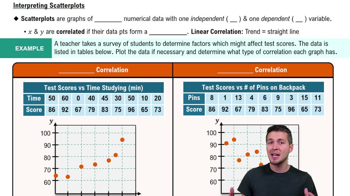
A scatterplot is a graphical representation of two variables, where each point represents an observation in the dataset. The x-axis typically represents the independent variable, while the y-axis represents the dependent variable. This visualization helps identify relationships, trends, or patterns between the variables, such as correlation or clustering.
Recommended video:
Guided course
06:36
Scatterplots & Intro to Correlation

Correlation

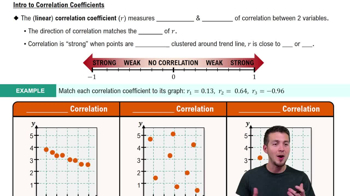
Correlation measures the strength and direction of a linear relationship between two variables. It is quantified using the correlation coefficient, which ranges from -1 to 1. A value close to 1 indicates a strong positive correlation, while a value close to -1 indicates a strong negative correlation. Understanding correlation is essential for interpreting scatterplots and assessing the relationship between the x and y values.
Recommended video:
Guided course
05:43
Correlation Coefficient

Data Sets

A data set is a collection of related data points, typically organized in a table format with rows and columns. In this context, the data set consists of paired x and y values, which can be analyzed to explore relationships. Understanding how to interpret and manipulate data sets is fundamental for statistical analysis, including creating visualizations like scatterplots.
Recommended video:
4:01
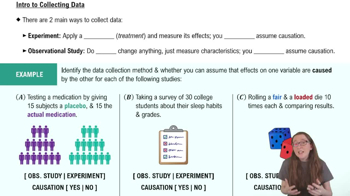
Introduction to Collecting Data
Related Practice
Textbook Question

Effects of an Outlier Refer to the Minitab-generated scatterplot given in Exercise 9 of Section 10-1


a. Using the pairs of values for all 10 points, find the equation of the regression line.

192
views
Textbook Question

Effects of Clusters Refer to the Minitab-generated scatterplot given in Exercise 10 of Section 10-1.


a. Using the pairs of values for all 8 points, find the equation of the regression line.

173
views
Textbook Question

Notation Using the weights (lb) and highway fuel consumption amounts (mi/gal) of the 48 cars listed in Data Set 35 “Car Data” of Appendix B, we get this regression equation:

y^ = 58.9 - 0.00749x, where x represents weight.

a. What does the symbol y^ represent?

149
views
Textbook Question

Clusters Refer to the Minitab-generated scatterplot. The four points in the lower left corner are measurements from women, and the four points in the upper right corner are from men.

a. Examine the pattern of the four points in the lower left corner (from women) only, and subjectively determine whether there appears to be a correlation between x and y for women.

146
views
Textbook Question

Variation and Prediction Intervals

In Exercises 17–20, find the (a) explained variation, (b) unexplained variation, and (c) indicated prediction interval. In each case, there is sufficient evidence to support a claim of a linear correlation, so it is reasonable to use the regression equation when making predictions.

Altitude and Temperature Listed below are altitudes (thousands of feet) and outside air temperatures (°F) recorded by the author during Delta Flight 1053 from New Orleans to Atlanta. For the prediction interval, use a 95% confidence level with the altitude of 6327 ft (or 6.327 thousand feet).

85
views
Textbook Question

Notation The author conducted an experiment in which the height of each student was measured in centimeters and those heights were matched with the same students’ scores on the first statistics test.

a. For this sample of paired data, what does r represent, and what does represent?

283
views