Ch. 2 - Exploring Data with Tables and Graphs
Triola - Elementary Statistics 14th Edition
Triola14th EditionElementary StatisticsISBN: 9780137366446Not the one you use?Change textbook
Chapter 2, Problem 2.2.14

In Exercises 9–18, construct the histograms and answer the given questions.


Burger King Dinner Service Times Use the frequency distribution from Exercise 18 in Section 2-1 to construct a histogram. Using a strict interpretation of the criteria for being a normal distribution, does the histogram appear to depict data from a population with a normal distribution?

Verified step by step guidance
1
Step 1: Understand the problem. A histogram is a graphical representation of data using bars of different heights. To construct the histogram, we need the frequency distribution from Exercise 18 in Section 2-1. Ensure you have the class intervals (bins) and their corresponding frequencies ready.
Step 2: Label the axes of the histogram. The x-axis will represent the class intervals (e.g., ranges of dinner service times), and the y-axis will represent the frequencies (e.g., the number of occurrences in each interval).
Step 3: Draw the bars for the histogram. For each class interval, draw a bar whose height corresponds to the frequency of that interval. Ensure the bars are adjacent to each other with no gaps, as histograms represent continuous data.
Step 4: Analyze the shape of the histogram. To determine if the data follows a normal distribution, check if the histogram has a bell-shaped curve. A normal distribution typically has a single peak in the center, symmetry about the center, and tails that taper off on both sides.
Step 5: Apply a strict interpretation of normality. Evaluate whether the histogram meets the criteria for a normal distribution. If the histogram deviates significantly from the bell-shaped curve (e.g., it is skewed, has multiple peaks, or lacks symmetry), then the data may not come from a population with a normal distribution.

Verified video answer for a similar problem:

This video solution was recommended by our tutors as helpful for the problem above.
Video duration:
4m
Was this helpful?

Key Concepts

Here are the essential concepts you must grasp in order to answer the question correctly.

Histogram

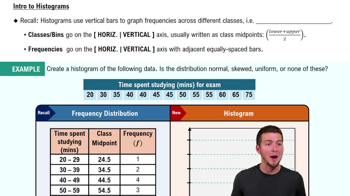
A histogram is a graphical representation of the distribution of numerical data, where the data is divided into intervals (bins) and the frequency of data points within each interval is represented by the height of bars. It helps visualize the shape, spread, and central tendency of the data, making it easier to identify patterns such as skewness or modality.
Recommended video:
Guided course
05:54
Intro to Histograms

Normal Distribution

A normal distribution is a continuous probability distribution characterized by its bell-shaped curve, where most of the observations cluster around the central peak and probabilities for values further away from the mean taper off symmetrically. Key properties include the mean, median, and mode being equal, and about 68% of the data falling within one standard deviation of the mean.
Recommended video:
Guided course
09:47
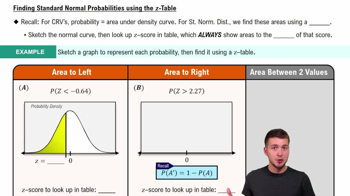
Finding Standard Normal Probabilities using z-Table

Criteria for Normality

The criteria for determining if a dataset follows a normal distribution include visual assessments (like histograms), statistical tests (such as the Shapiro-Wilk test), and checking for symmetry and the absence of skewness. A strict interpretation requires that the data closely aligns with the properties of a normal distribution, which can be evaluated through these methods.
Recommended video:
Guided course
09:47
Finding Standard Normal Probabilities using z-Table
Related Practice
Textbook Question

In Exercises 11 and 12 construct the Pareto chart.


Box Office Boffo Recent annual gross revenue (millions of dollars) for the leading movie studios are as follows: 20th Century Fox (1082), Buena Vista (3092), Paramount (757), Sony/Columbia (1304), Universal (1772), Warner Brothers (1941). Are these data likely to be reasonably accurate?

155
views
Textbook Question

Presidents Listed below are the ages (years) of presidents of the United States at the times of their first inaugurations (from Data Set 22 “Presidents” in Appendix B). Presidents who took office as a result of an assassination or resignation are not included. The data are current as of this writing. Use these ages to construct a frequency distribution. Use a class width of 5 years and begin with a lower class limit of 40 years. Do the ages appear to have a normal distribution?

244
views
Textbook Question

Hershey Kisses Refer to Data Set 38 “Candies” and use the weights (grams) of Hershey’s Kisses. Begin with a lower class limit of 4.300 g and use a class width of 0.100 g. Does this distribution appear to be a normal distribution?

144
views
Textbook Question

In Exercises 5–8, answer the questions by referring to the following Minitab-generated histogram, which depicts the weights (grams) of all quarters listed in Data Set 40 “Coin Weights” in Appendix B. (Grams are actually units of mass and the values shown on the horizontal scale are rounded.)

Class Width and Class Limits Give the approximate values of the class width, and the lower and upper class limits of the class depicted in the bar farthest to the left.

229
views
Textbook Question

In Exercises 25 and 26, construct the cumulative frequency distribution that corresponds to the frequency distribution in the exercise indicated.


Exercise 5 (Age of Best Actress When Oscar Was Won)

202
views
Textbook Question

In Exercises 5–8, answer the questions by referring to the following Minitab-generated histogram, which depicts the weights (grams) of all quarters listed in Data Set 40 “Coin Weights” in Appendix B. (Grams are actually units of mass and the values shown on the horizontal scale are rounded.)


Relative Frequency Histogram How would the shape of the histogram change if the vertical scale uses relative frequencies expressed in percentages instead of the actual frequency counts as shown here?

182
views