Ch. 3 - Describing, Exploring, and Comparing Data
Triola - Elementary Statistics 14th Edition
Triola14th EditionElementary StatisticsISBN: 9780137366446Not the one you use?Change textbook
Chapter 3, Problem 3.2.46

Mean Absolute Deviation Use the same population of {9 cigarettes, 10 cigarettes, 20 cigarettes} from Exercise 45. Show that when samples of size 2 are randomly selected with replacement, the samples have mean absolute deviations that do not center about the value of the mean absolute deviation of the population. What does this indicate about a sample mean absolute deviation being used as an estimator of the mean absolute deviation of a population?

Verified step by step guidance
1
Step 1: Calculate the mean absolute deviation (MAD) of the population. First, find the mean of the population by summing all the values and dividing by the number of values. Then, calculate the absolute deviation of each value from the mean, and finally, find the average of these absolute deviations.
Step 2: List all possible samples of size 2 that can be selected with replacement from the population {9, 10, 20}. For example, the samples include (9, 9), (9, 10), (9, 20), (10, 9), (10, 10), (10, 20), (20, 9), (20, 10), and (20, 20).
Step 3: For each sample, calculate the sample mean. Then, compute the absolute deviation of each value in the sample from the sample mean. Finally, calculate the mean absolute deviation (MAD) for each sample by averaging these absolute deviations.
Step 4: Compare the mean absolute deviations of the samples to the population MAD. Observe whether the sample MADs center around the population MAD. This involves analyzing the distribution of the sample MADs and comparing it to the population MAD.
Step 5: Conclude that the sample MADs do not center around the population MAD. This indicates that the sample MAD is a biased estimator of the population MAD, meaning it does not reliably estimate the population MAD when used in this context.

Verified video answer for a similar problem:

This video solution was recommended by our tutors as helpful for the problem above.
Video duration:
2m
Was this helpful?

Key Concepts

Here are the essential concepts you must grasp in order to answer the question correctly.

Mean Absolute Deviation (MAD)

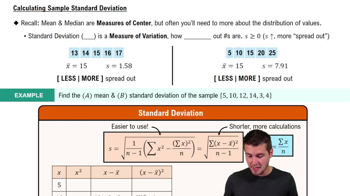
Mean Absolute Deviation is a measure of dispersion that quantifies the average distance between each data point in a dataset and the mean of that dataset. It is calculated by taking the absolute differences between each data point and the mean, summing these differences, and then dividing by the number of data points. MAD provides insight into the variability of the data, making it useful for understanding how spread out the values are around the mean.
Recommended video:
Guided course
08:45
Calculating Standard Deviation

Sampling Distribution

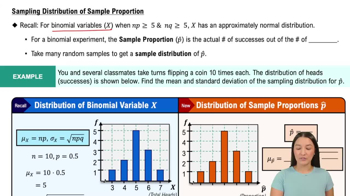
The sampling distribution refers to the probability distribution of a statistic (like the sample mean or sample MAD) obtained from a large number of samples drawn from a specific population. When samples are taken with replacement, the sampling distribution can differ from the population distribution, leading to variations in the calculated statistics. Understanding this concept is crucial for interpreting how sample statistics can estimate population parameters.
Recommended video:
05:11
Sampling Distribution of Sample Proportion

Estimator Bias

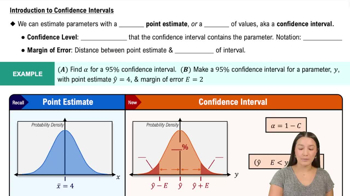
Estimator bias occurs when a statistical estimator consistently overestimates or underestimates a population parameter. In the context of mean absolute deviation, if the sample MAD does not center around the population MAD, it indicates that the sample may not be a reliable estimator of the population's true variability. Recognizing bias is essential for evaluating the accuracy and reliability of statistical estimates in inferential statistics.
Recommended video:
06:33
Introduction to Confidence Intervals
Related Practice
Textbook Question

In Exercises 5–20, find the range, variance, and standard deviation for the given sample data. Include appropriate units (such as “minutes”) in your results. (The same data were used in Section 3-1, where we found measures of center. Here we find measures of variation.) Then answer the given questions.


Jaws 3 Listed below are the number of unprovoked shark attacks worldwide for the last several years. What extremely important characteristic of the data is not considered when finding the measures of variation?


70 54 68 82 79 83 76 73 98 81

217
views
Textbook Question

Quadratic Mean The quadratic mean (or root mean square, or R.M.S.) is used in physical applications, such as power distribution systems. The quadratic mean of a set of values is obtained by squaring each value, adding those squares, dividing the sum by the number of values n, and then taking the square root of that result, as indicated below:


Quadratic mean = sqrt(∑x^2/n)


Find the R.M.S. of these voltages measured from household current: 0, 60, 110, 0. How does the result compare to the mean?

530
views
Textbook Question

In Exercises 21–28, use the same list of cell phone radiation levels given for Exercises 17–20. Find the indicated percentile or quartile.


Q1


135
views
Textbook Question

Finding Standard Deviation from a Frequency Distribution. In Exercises 37–40, refer to the frequency distribution in the given exercise and compute the standard deviation by using the formula below, where x represents the class midpoint, f represents the class frequency, and n represents the total number of sample values. Also, compare the computed standard deviations to these standard deviations obtained by using Formula 3-4 with the original list of data values: (Exercise 37) 18.5 minutes; (Exercise 38) 36.7 minutes; (Exercise 39) 6.9 years; (Exercise 40) 20.4 seconds.


Standard deviation for frequency distribution


292
views
Textbook Question

Why Divide by ? Let a population consist of the values 9 cigarettes, 10 cigarettes, and 20 cigarettes smoked in a day (based on data from the California Health Interview Survey). Assume that samples of two values are randomly selected with replacement from this population. (That is, a selected value is replaced before the second selection is made.)


a. Find the variance of the population {9 cigarettes, 10 cigarettes, 20 cigarettes}.

143
views
Textbook Question

In Exercises 5–20, find the range, variance, and standard deviation for the given sample data. Include appropriate units (such as “minutes”) in your results. (The same data were used in Section 3-1, where we found measures of center. Here we find measures of variation.) Then answer the given questions.


Super Bowl Ages Listed below are the ages of the same 11 players used in the preceding exercise. How are the resulting statistics fundamentally different from those found in the preceding exercise?


41 24 30 31 32 29 25 26 26 25 30

298
views