
Ch. 3 - Describing, Exploring, and Comparing Data
Triola - Elementary Statistics 14th Edition
Triola14th EditionElementary StatisticsISBN: 9780137366446Not the one you use?Change textbook
Chapter 3, Problem 3.2.6

In Exercises 5–20, find the range, variance, and standard deviation for the given sample data. Include appropriate units (such as “minutes”) in your results. (The same data were used in Section 3-1, where we found measures of center. Here we find measures of variation.) Then answer the given questions.


Super Bowl Ages Listed below are the ages of the same 11 players used in the preceding exercise. How are the resulting statistics fundamentally different from those found in the preceding exercise?


41 24 30 31 32 29 25 26 26 25 30

Verified step by step guidance
1
Step 1: Identify the data set provided. The ages of the 11 players are: 41, 24, 30, 31, 32, 29, 25, 26, 26, 25, 30. These values will be used to calculate the range, variance, and standard deviation.
Step 2: Calculate the range. The range is the difference between the maximum and minimum values in the data set. Identify the maximum value (41) and the minimum value (24), then compute the range as: Range = Max - Min.
Step 3: Calculate the variance. First, find the mean (average) of the data set by summing all the values and dividing by the number of data points (n = 11). Then, for each data point, compute the squared difference from the mean. Sum these squared differences and divide by (n - 1) to get the sample variance. Use the formula: Variance = (Σ(xᵢ - mean)²) / (n - 1).
Step 4: Calculate the standard deviation. The standard deviation is the square root of the variance. Use the formula: Standard Deviation = √(Variance).
Step 5: Compare the measures of variation (range, variance, and standard deviation) to the measures of center (mean, median, mode) from the preceding exercise. Discuss how measures of variation provide information about the spread of the data, while measures of center describe the central tendency.

Verified video answer for a similar problem:

This video solution was recommended by our tutors as helpful for the problem above.
Video duration:
12m
Was this helpful?

Key Concepts

Here are the essential concepts you must grasp in order to answer the question correctly.

Range

The range is a measure of variation that represents the difference between the maximum and minimum values in a data set. It provides a simple way to understand the spread of the data, indicating how far apart the highest and lowest values are. For example, in the ages of the Super Bowl players, the range would be calculated by subtracting the youngest age from the oldest age.
Recommended video:
Guided course
05:45
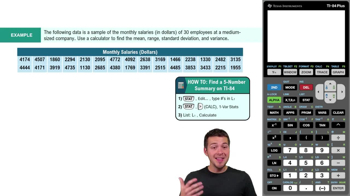
Find 5-Number Summary - TI-84 Calculator Example 1

Variance

Variance quantifies the degree to which data points in a set differ from the mean of the set. It is calculated by averaging the squared differences between each data point and the mean. A higher variance indicates that the data points are more spread out from the mean, while a lower variance suggests they are closer together. This concept is crucial for understanding the distribution of the players' ages.
Recommended video:
Guided course
04:48
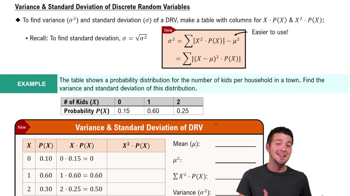
Variance & Standard Deviation of Discrete Random Variables

Standard Deviation

Standard deviation is the square root of the variance and provides a measure of the average distance of each data point from the mean. It is expressed in the same units as the data, making it more interpretable than variance. A smaller standard deviation indicates that the ages of the players are clustered closely around the mean, while a larger standard deviation suggests a wider spread of ages among the players.
Recommended video:
Guided course
08:45
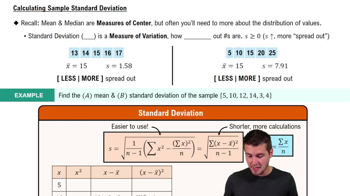
Calculating Standard Deviation
Related Practice
Textbook Question

Quadratic Mean The quadratic mean (or root mean square, or R.M.S.) is used in physical applications, such as power distribution systems. The quadratic mean of a set of values is obtained by squaring each value, adding those squares, dividing the sum by the number of values n, and then taking the square root of that result, as indicated below:


Quadratic mean = sqrt(∑x^2/n)


Find the R.M.S. of these voltages measured from household current: 0, 60, 110, 0. How does the result compare to the mean?

530
views
Textbook Question

In Exercises 21–28, use the same list of cell phone radiation levels given for Exercises 17–20. Find the indicated percentile or quartile.


Q1


135
views
Textbook Question

Mean Absolute Deviation Use the same population of {9 cigarettes, 10 cigarettes, 20 cigarettes} from Exercise 45. Show that when samples of size 2 are randomly selected with replacement, the samples have mean absolute deviations that do not center about the value of the mean absolute deviation of the population. What does this indicate about a sample mean absolute deviation being used as an estimator of the mean absolute deviation of a population?

188
views
Textbook Question

Finding Standard Deviation from a Frequency Distribution. In Exercises 37–40, refer to the frequency distribution in the given exercise and compute the standard deviation by using the formula below, where x represents the class midpoint, f represents the class frequency, and n represents the total number of sample values. Also, compare the computed standard deviations to these standard deviations obtained by using Formula 3-4 with the original list of data values: (Exercise 37) 18.5 minutes; (Exercise 38) 36.7 minutes; (Exercise 39) 6.9 years; (Exercise 40) 20.4 seconds.


Standard deviation for frequency distribution


292
views
Textbook Question

Boxplots. In Exercises 29–32, use the given data to construct a boxplot and identify the 5-number summary.


Blood Pressure Measurements Fourteen different second-year medical students at Bellevue Hospital measured the blood pressure of the same person. The systolic readings (mm Hg) are listed below.


138 130 135 140 120 125 120 130 130 144 143 140 130 150

197
views
Textbook Question

Why Divide by ? Let a population consist of the values 9 cigarettes, 10 cigarettes, and 20 cigarettes smoked in a day (based on data from the California Health Interview Survey). Assume that samples of two values are randomly selected with replacement from this population. (That is, a selected value is replaced before the second selection is made.)


a. Find the variance of the population {9 cigarettes, 10 cigarettes, 20 cigarettes}.

143
views