Ch. 4 - Probability
Triola - Elementary Statistics 14th Edition
Triola14th EditionElementary StatisticsISBN: 9780137366446Not the one you use?Change textbook
Chapter 4, Problem 4.1.31

In Exercises 29–32, use the given sample space or construct the required sample space to find the indicated probability.


Four Children Exercise 29 lists the sample space for a couple having three children. After identifying the sample space for a couple having four children, find the probability of getting three girls and one boy (in any order).

Verified step by step guidance
1
Step 1: Understand the problem. The couple has four children, and we need to identify the sample space for all possible gender combinations of these children. Each child can either be a boy (B) or a girl (G), so the sample space consists of all possible arrangements of B and G for four children.
Step 2: Construct the sample space. Since there are four children, and each child has two possible outcomes (B or G), the total number of combinations is 2^4 = 16. The sample space includes all permutations of B and G, such as {BBBB, BBGG, BGGB, etc.}. Write out all 16 combinations explicitly.
Step 3: Identify the favorable outcomes. To find the probability of getting three girls and one boy, look for all arrangements in the sample space where there are exactly three G's and one B. For example, {GGGB, GGBG, GBGG, BGGG}. Count the number of such favorable outcomes.
Step 4: Calculate the probability. The probability of an event is given by the formula P(Event) = (Number of favorable outcomes) / (Total number of outcomes in the sample space). Use the count of favorable outcomes from Step 3 and the total number of outcomes (16) to set up the probability calculation.
Step 5: Simplify the probability expression. If needed, simplify the fraction obtained in Step 4 to its lowest terms to express the probability in its simplest form.

Verified video answer for a similar problem:

This video solution was recommended by our tutors as helpful for the problem above.
Video duration:
4m
Was this helpful?

Key Concepts

Here are the essential concepts you must grasp in order to answer the question correctly.

Sample Space

The sample space is the set of all possible outcomes of a random experiment. In the context of having four children, the sample space includes all combinations of boys and girls, represented as sequences like 'GGGB', 'GBGG', etc. Understanding the sample space is crucial for calculating probabilities, as it provides the foundation for determining how many favorable outcomes exist.
Recommended video:
05:11
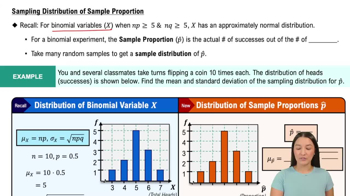
Sampling Distribution of Sample Proportion

Probability

Probability is a measure of the likelihood that a particular event will occur, expressed as a number between 0 and 1. To find the probability of getting three girls and one boy in any order from the sample space of four children, you would count the number of favorable outcomes (combinations of three girls and one boy) and divide it by the total number of outcomes in the sample space.
Recommended video:
5:37
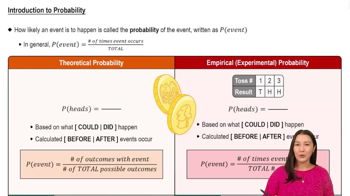
Introduction to Probability

Combinatorics

Combinatorics is a branch of mathematics dealing with combinations and permutations of objects. In this scenario, it helps determine how many different ways three girls and one boy can be arranged among four children. The formula for combinations can be used to calculate the number of ways to choose positions for the girls, which is essential for finding the probability of the desired outcome.
Related Practice
Textbook Question

In Exercises 13–20, express the indicated degree of likelihood as a probability value between 0 and 1.


Movies Based on a study of the movies made in a recent year, 33 out of every 100 movies have a female lead or co-lead.

119
views

Textbook Question

In Exercises 29–32, use the given sample space or construct the required sample space to find the indicated probability.


Three Children Use this sample space listing the eight simple events that are possible when a couple has three children (as in Example 2): {bbb, bbg, bgb, bgg, gbb, gbg, ggb, ggg}. Assume that boys and girls are equally likely, so that the eight simple events are equally likely. Find the probability that when a couple has three children, there is exactly one girl.

155
views
Textbook Question

Simulating Dice When two dice are rolled, the total is between 2 and 12 inclusive. A student simulates the rolling of two dice by randomly generating numbers between 2 and 12. Does this simulation behave in a way that is similar to actual dice? Why or why not?

246
views
Textbook Question

In Exercises 9–12, assume that 100 births are randomly selected. Use subjective judgment to describe the given number of girls as (a) significantly low, (b) significantly high, or (c) neither significantly low nor significantly high.


53 girls.

126
views
Textbook Question

Teed Off When four golfers are about to begin a game, they often toss a tee to randomly select the order in which they tee off. What is the probability that they tee off in alphabetical order by last name?

122
views
Textbook Question

Quinela In a horse race, a quinela bet is won if you selected the two horses that finish first and second, and they can be selected in any order. The 144th running of the Kentucky Derby had a field of 20 horses. What is the probability of winning a quinela bet if you randomly select the horses?

193
views